Saturday, April 28, 2012

The Road to Emmitsburg


The road to Emmitsburg is the iconic pastoral scene.  The road begins at Gettysburg center and continues into Maryland.  The white painted fences separate the wheat fields, orchards and farmlands that make up the panorama before you.  The low hills that rise and fall paint a scene straight out of an artist’s sketchbook.  The white framed farmhouses with their bright red barns stand as reminders to the area’s agrarian past.  This is also the road where much of the fighting and dying occurred on three days of July, 1863.  It was the job of the 16th Mass Infantry to defend the Emmetsburg Road. 

James and Jane Roche and their 6 children probably left Ireland about the time of the famine and found employment and housing in Lowell.  When their son, David, was old enough he got a job as an operative in the mills.  The family lived on Suffolk Street and seems probable that their life resembled that of the many thousands of other Irish living in the Acre.  When the call came up for volunteers after the Riots in Baltimore, David Roche, like many Irish, signed up, and was given the commission of Lieutenant.  Before the 16th Mass left Lowell, they attended Mass at St Patrick’s Church and marched to the trains that would carry them to war. 

The 16th Mass had a full record of encounters in the early years of the war.  As 1863 dawned, now Cpt. David Roche, was given a furlough and traveled to Lowell to marry his sweetheart, Margaret Harrington, before returning to the war.  The 16th had just finished the battle at Chancellorsville when they were ordered to Gettysburg.  By day 2 of the battle it was apparent Lee was going to try to take the road.   It is said that the artillery the two forces engaged could be heard all the way to Washington.  It wouldn’t be until 8 days later that Roche’s family would be notified that their son was shot in the head during the fighting.  Cpt. Matthew Donovan, anther Lowell Irish who enlisted into the 16th, made sure that his comrade’s body was quickly buried under a tree and a marker placed for future identification.  Back in Lowell, James Roche, David’s father, hired Alonzo Quimby, a local painter, to retrieve his son’s body.  Bringing the wounded and dead back to their homes became a new business as was advertised in many newspapers.  Ads also began appearing in the Lowell Courier for women’s black woolen shawls.  The ads noted how the capes were in great demand and supplies were being replenished as quickly as possible.  The young widow may have taken advantage of the sale.
16th Mass Monument on Emmitsburg Road
Mr. Quimby’s mission was successfully accomplished, and a full military funeral was carried out at St Patrick’s Church.  “The services were very appropriate and interesting.”  The procession was lengthy with several military companies represented as well as City officials.  It would be remiss not to state that the Courier was filled with such sad stories on a daily basis recounting the deeds “of the brave soldiers who sleep their last sleep.”  Such accounts went on for the entirety of the war.

Standing by the monument, taking a photo for this entry, I noted a small grove of trees and wondered if this was where Cpt. Roche was hastily interred.  The only sound that could be heard was the wind through the tall grasses.  The tranquility of the Emmitsburg’s Road today masks the horrors of 150 years ago.
Crowley & Roche Monuments at St Patrick Cemetery

Sunday, April 22, 2012

On Location - Gettysburg

One Who Did Not Come Home

2nd Mass Monument at Gettysburg
He was his mother’s only son.  Maybe Patrick was the reason why the family came to America.  They likely emigrated from Ireland about the time of the famine.  Thomas Hoey, his wife Ann, and their three children came to Lowell.  By 1855 Thomas lists himself as a laborer with the future looking hopeful.  Ann dies about 1859.  Then the war began.  The mills closed, and jobs were lost, including Patrick Hoey’s job as carder in the mill.  Maybe this is what drove Patrick to enlist in the 2nd Mass.  Or maybe it was what all the other young men were doing in Lowell after hearing of the Riot in Baltimore and what happened to the 6th Mass and the boys from Lowell.  He participated in the Battle of Antietam and was promoted to Corporal.
Patrick Hoey's Grave at Gettysburg
In July of 1863 the 2nd Mass found themselves in Pennsylvania in the little town of Gettysburg.  On the second day of fighting the 2nd Mass found themselves at Spangler’s Spring.  Some say the opposing forces spent the evening sitting by the spring exchanging stories while filling their canteens.  But the next morning the slaughter began.  On the rocky ledges of the spring the 2nd Mass was engaged and overpowered.  Twenty year old Patrick Hoey fell.  Only 13 of the 35 soldiers under Cpt. Francis’ command escaped unhurt.  Many of the Lowell boys were among the casualties.  Patrick would not be returning home.  His remains were put in a hasty grave and days later exhumed to be interred in the new National Cemetery to be dedicated by President Lincoln.  Today he is in Section 19, Row B, Number 14.
Spangler's Spring at Gettysburg
I’ve been to Gettysburg a dozen times before, but never with the connection that I have now.  It is one thing to read about the Civil War and collect a bunch of facts.  It’s quite another to put names and families with the thousand of stones that surround you.  To visit the spot where he fell, and to see where he now rests is just a little honor to the sacrifice he and so many others made. 

As usual many thanks to Walter for doing the research while I get to walk the battlefield.  Slowly, but surely, the story of Lowell’s Irish is being recorded for those who will follow us.

Thursday, April 12, 2012

The Working Girls Home

St Patrick Calendar Magazine, 1899
Who knows how many tens of thousands left the homes of their mothers and fathers and made their way to the mill cities of New England?   During Lowell’s Golden Age, company housing was provided for the single women.  Their boarding house had strict regulations and was overseen by a matron who was there to ensure that the corporation’s reputation remained intact.  Lowell was not about to become another Manchester, England.

As the decades passed and more mill towns began sprouting up, the utopian ideal of the perfect mill town began to fade away.  That did not stop the number of females who made their way from foreign lands and small farms seeking mill jobs in the big cities.  But what would happen to them without the boarding house and matrons?  The newspapers were filled with horror stories of young girls coming to the city and being lost in the potential dangers with which they were confronted.

The solution was the Working Girls Home.  In the latter half of the 19th century, religious institutions, social organizations, and some individual philanthropists began finding homes where girls new to the city could find housing and where a clean bed, good meals, and a safe environment would help with the transition.  Lowell was no exception.  As the corporation boarding houses closed one after another, the need for such a home became evident.

In 1896 the priests of the St. Patrick parish took it upon themselves to purchase the property next to the church on Cross Street.  It was the old Moran’s Yard and everyone in the neighborhood knew what went on there at all hours of the night.   The architect was none other than the famed, Patrick Keely, the same architect as the church.  The four story brick structure would have granite window sills and doorways.  The 50 rooms would allow light to fill the building and make it an inviting home to those in need.  

The financial undertaking was massive.  The ladies of the parish sponsored a bazaar to help defray the cost.  The event went on nightly for two weeks and was held at the American House.  The grand prize was a diamond stick pin.  Other awards included a barrel of flour, a lemonade set, a print of St. Cecelia, “and a handsome writing desk.”  There was no grand opening to note, but the house filled up quickly.  Fifteen young ladies were the first guests.  It was decided it would be open to women of all faiths and would include those too old to care for themselves.  Even three years later, the Parish was still paying off the debt.  That is when Fr. Michael O’Brien gave a personal purse of $40,000 towards the mortgage.  This was money given to him in honor of his ordination anniversary.  It’s interesting to note that for many years the Fathers O’Brien would routinely make trips back to Ireland and bring back friends and family to find jobs in Lowell, some of whom would make the Working Girls Home their first home.

The Franciscan Sisters of Allegany were put in charge of the home.  They oversaw the physical and spiritual needs of the girls and took gentle care of the aged and infirm.  The girls paid a small stipend of what their take home pay would be.  Those who could not afford it paid nothing.  As the years passed, fewer and fewer young women saw the need for such a facility.  Eventually the home became “the old ladies home.”  By 1967 the building was showing its age.  Newer facilities were opening.  The government was providing better resources and there were fewer vocations to those who would give their lives serving the aged.  The building closed and remained empty until it was torn down around 1970.
A Franciscan Sister of Allegany
A personal note.  The Working Girls Home was where we’d run between the alley ways after school.  As we walked by we’d sneak a look into the wooden paneled and ceramic tiled foyer.  The Parish helped support the home for many years, but the Sisters who ran the home would annually go door to door seeking donations to support their mission of serving the poor and infirm.  I know this because each year for many years they would knock on our door on Broadway Street before beginning their rounds.  How it started I don’t know, but our home was their first stop.  It seemed they always chose the hottest day of the year to do their begging.  There would be a knock on the door, and they’d walk into our kitchen.  They would be carrying heavy, leather briefcases filled with their little religious magazine.  Our house was their rendezvous point.  There were always two of them, the Superior and a younger nun.  Throughout the day they would come back to the house to replenish their magazine supply.  The annual subscription was $3.  They would return to our tenement about 3 pm and wait for my father to return home so he could drive them back to the Home on Cross Street.  They would sit in the kitchen in the full Franciscan habit in the summer heat.  A white hanky would appear from a hidden pocket and wipe her face.  My mother would offer ice tea, but the Sisters only would drink water.  The older nun had a very heavy Irish accent.  I always wanted to ask where she was from, or why she was here, but my parents knew enough not to ask a nun about her life before receiving the habit.  The older Sister had a young face, but her hands were reddened and knuckles swollen.  She would sit there in the kitchen under the multiple layers of her habit with those heavy black shoes that had walked how many miles that day.  The younger Sister never said much, just sat their quietly waiting to go home.  The Sister would then collect the $3 from my mother, and in typical nun style, would ask if she wanted to make an extra donation. 
Right at four my father would come home for the half hour he had to eat supper before leaving for job number 2.  He’d see the nuns and immediately put out his cigarette.  The Superior would declare that they were ready to be driven home.  My father would cast a sideways glance to my mother, and my mother would return with a silent nod.  There was no escape.  The Superior would then announce, “The boy will come with us.”  Later I would learn the Sisters could not be alone in a car with a man.  The nuns would gather their goods, the older Sister holding tightly to her little purse filled with one dollar bills. The Sisters would say their goodbyes to my mother and assure her of their prayers.   In the car, the radio would be turned off for the drive.  Once again they’d tell my father that a place in heaven was made for him.  Then they would enter the aging brick building probably to work the night shift.  I often wondered why they did what they did.  Each month the little magazine appeared at our door; then they stopped.  There was no more Working Girls Home, and the Sisters went on to their next mission. 

Thursday, April 5, 2012

Easter - 1896


Today's season of Lent varies greatly from a century ago.  At that time the mandatory dietary restrictions were far more severe.  There was abstinence from meat on Wednesdays as well as Fridays. and even included eggs and butter.  Marriages could not be performed.  Many parishes had extended parish missions which required the faithful to often walk through ice and snow to keep their Lenten promises.  On Holy Thursday was the visitation of the 7 churches.  Secretly each competed with its neighbor to who could have the most candles and flowers.  On Good Friday were the 3 hours of silence from noon until 3.  At the Exaltation of the Cross service the clergy would walk in barefoot and lie prostrate on the altar area.  Early on Holy Saturday was the blessing of the Easter water.  Crowds would line up to bring the water home to bless their houses.  The churches would close after the Saturday morning service, and at St Patrick's the Sisters of Notre Dame were in charge of decorating the church.  This practice stopped when the Sisters became semi-cloistered.  The job was taken over by the young ladies of the parish.  But Easter is the major Christian feast, and on Easter the Church calls us to share in the Resurrection story through song, liturgy, and the beauty of Creation. 

Taken from the Lowell Sun, 1896

The principal Easter service at St. Patrick's church yesterday was indeed grand and impressive. At every mass the church was crowded but at the celebration of the solemn high mass the attendance taxed the seating capacity of the magnificent edifice. At 10.30 sixty sanctuary boys gowned in cassocks of black and white surplices emerged from the vestry to the main altar preceding the priests dressed in their vestments of gold and yellow.
From the white marble altars sparkled hundreds of lighted candles while the sweet fragrance of flowers which decked the altars, permeated the church. The celebrant of the mass was Rev. Fr. Leonard with Rev. Fr. Burke deacon, Rev. Fr. Gleason, sub-deacon and John J. Sullivan master of ceremonies. The venerable pastor, Rev. Michael O'Brien, occupied a seat in the sanctuary.
The sermon was preached by Rev. Fr. Burke. The musical portion of the service was under the direction of E. P. Faulkner, and nothing equal to it has ever been heard at St. Patrick's. A choir of 60 voices, accompanied by Hibbard's orchestra and Mr. M. J. Johnson, organist, rendered the mass with the utmost precision. Every solo was sustained in excellent style, and the difficult portion of the mass was handled in a masterly manner by the grand concert.
At the evening service the altar was one perfect blaze of lights. The incandescent effects were grand. Over the main altar extended strings of numerous incandescents in semi-circular shape, formed a brilliant arch over the altar.

Thursday, March 29, 2012

Patrick Dempsey and the Rum Riots

City Directory, 1876
America has long had a love-hate relationship with alcohol.  Our history shows these periods of temperance and intemperance.  The 19thth century is ideal to reflect on the people involved in the never ending debate, and Lowell was no exception.  Let’s take the case of Patrick Dempsey.

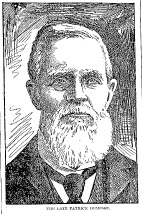
His obituary reads like the cause for canonization of a saint.  He was a man of few words, but when he spoke they had worth.  His name appears as a regular contributor to a number of causes, especially to St. John’s Hospital where he contributed preserves, sugar, and a child’s bathtub.  He was one of the founding members who donated heavily to the hospital’s opening.  His name appears frequently for sending floral tributes to funerals of friends, neighbors, and employees.  He was so well known to his fellow Irish that he was asked to be a pall bearer at Father John O’Brien’s funeral.  It was said that he was the first of Lowell’s Irish immigrants to have earned considerable wealth. 

His financial status enabled him to buy considerable real estate, centering in the Acre.  He bought an estate on Salem Street where he made his home for his 2 wives and a dozen children.  Though he could have moved into any of the newer neighborhoods, he chose to remain in the Acre.  The property attached to his home was called Dempsey’s Place and was a heavily crowded series of tenements typically rented to other Irish.  He also bought property in Salem, Mass where he had a summer home, and his family often made trips across the country.  His son, however, would move into a great home on Andover Street following his father’s death. 

At one point he was sued by a neighbor for erecting a high stockade fence which she argued caused  an unhealthy lack of light resulting in sickness and even a death in her home.  And then there was the case where Mr. Dempsey sued the Congregational Church on Merrimack Street for water damage from the church’s gutters that flooded Dempsey’s liquor business on Lowell (Market) Street.  He made it a point to stay out of politics, but could be quite outspoken if there was a possibility of his property being rezoned or of taxes status being altered.
Lowell Cultural Resource Inventory
So where did his wealth come from?  Alcohol.  Born in County Wicklow, Patrick Dempsey came to America and began work in a print and dye factory.  He moved from place to place until landing in Lowell.  He rented a basement on Lowell Street where he brewed root beer.  He was so successful that he branched into beer and other spirits.  Within a few years he became the leading saloon owner not only in Lowell, but in the entire state.  He turned brewing into big business opening shops and bars across the city and dealing sprits across the state.  And that brings us to “the rum riot.”

The 19th century was a period of great change.  The temperance movement had begun in the early part of the century and made advancements throughout the decades.  Across the country laws were being passed on restrictions of who, where, and how much alcohol could be brewed.  Massachusetts was no exception.  The state sent sheriffs out to seize barrels of the stuff during a particularly strict period of prohibition in 1870s.  When they came to Lowell, Dempsey, since he was the largest, was also the first establishment to be visited.  As soon as word got out that they were at Dempsey’s a crowd gathered from amongst “the lower strata of the population.”  “The roughs collected, ready for a row or fight.”  The crowds began stoning the officers.  One of the roughians used a hoe to strike an officer.  The officer’s gun fired during the melee hitting one of the crowd.    The man who struck the officer, Pender, was arrested and held for bail, but his case was quickly moved since his family was known to have small pox.  The next day the crowd returned, but was informed of undercover constables in the crowd who were ready to stop any trouble before it erupted.  The establishments that were visited read like a list of Lowell’s Irish who’s who.  There was Lynch, Cummiskey, and Collins.  It goes on.  The constables came back yet a third day when the crowds started up again.  This time the constables came back in full force.  They were supported by women and girls waving handkerchiefs and shouting, “Huzza,” cheering on the police.   Over the 3 days, hundreds of barrels of alcohol were confiscated and placed under guard until they could be shipped to Boston.  There were fears that the crowds might attempt to remove the spirits.
Lowell Sun, 1902
Things must have changed quickly, for very shortly Mr. Dempsey was back in business and his advertisements were back in the papers.  His son took over the business and even moved it to Boston where the Dempsey name was exported across the country.  His son was rumored to have tried influencing Lowell’s politicians by swaying elections.  Dempsey died in 1902.  The church where he worshipped for over 50 years was filled to near capacity.   He was laid to rest in the Catholic Burial Ground, and the era of the old Irish immigrant making good came to an end. 

Thursday, March 22, 2012

The Man Who Built Dreams - Patrick Keely


When Father John O’Brien was assigned the pastorate of Saint Patrick Parish he knew the assignment would not be an easy one.  The previous pastor had lasted about a year and asked to be removed.  It was 1848 and the famine Irish were filling the tenements and hovels of Lowell’s Acre neighborhood.  Just a few doors down from St. Pat’s could be found St. Mary’s church.  Was there really a need for two churches within yards from each other, or were other things going on within the tight knit, but often divided, community?  What he found when he arrived in Lowell was not good.  Those who remained at St Pat’s were very much the poorest of the poor.  The neighborhood was riddled with tenements and shanties.  The odors of open garbage and sewers pervaded the mishmash of what was supposed to be streets and alleys.  Most dwellings were overcrowded with more new people arriving daily.  On top of all this the church was in poor condition.  Though less than 20 years old there were problems with the building and with a growing population, Father John, as he was lovingly known to his congregation, knew he needed to do something grand to unite his people and give them a vision of what could be done.

He came up with a plan, actually several plans.  He would eventually build a school for the neighborhood children.  Education would lead the Irish into the mainstream.  He also would want something done about health care; a place where the sick could go to be cared for.  But his piece de resistance would be a new church.  Not another small wooden one, but one that would announce to Lowell and the growing anti-Irish bigots that they were here to stay.  He would build the grandest building Lowell could claim.  There was only one man whom he could entrust to do the job- the Irish born architect, Patrick Charles Keely.
Courtesy: The Keely Society

Coincidentally, or was it, both men were born in County Tipperary, but it was Keely’s growing reputation as an ecclesiastical architect and builder that fostered his reputation.  By the end of his life he would design over 600 churches and hundreds more rectories, schools, and municipal building up and down the east coast and west to Indiana.  He was especially well known in the Archdiocese of Boston as the designer of the Cathedral of the Holy Cross.  At the time he visited Lowell, he was also working on the Church of the Immaculate Conception in Albany, New York.  The two churches look amazingly similar with mild differences.  This was a method employed by Keely as his popularity grew.  Each church had its own unique style while maintaining a basic set of plans.  This saved the parish money by using and reusing design plans with minimal changes.  Keely would have left the plans with the church.  In St Pat’s case these went missing decades ago.  We are told that Keely made at least one visit to the Acre site, and the Sisters of Notre Dame employed him to draw up plans for their own school which needed expansion.  In the spring of 1870, he designed a new boarding school for the Sisters at the cost of $5000.

St. Patrick’s was not the only Keely building in Lowell.  He also designed St Michael’s, St. Peter’s and the Immaculate Conception.  Keely also offered a package deal bringing other artisans with him.  For example, the murals in St Pat’s were done by Gustav Kinkelin.  The altars were designed by the Joseph Sibbel Studio.  When St. Pat’s suffered fire damage in 1904, Keely’s firm was once again called in to repair and improve the church structure.  His son in law, James Houghton, had taken over the business and completed the renovations, employing local workers and quarry men when needed.
The Messenger, 1907

Keely’s Irish birth; his strong Catholic faith; his practice of hiring locals; and his reputation for honesty made him the first choice for many parishes and bishops.   He is buried in Holy Cross Cemetery in Brooklyn, NY with a rather plain marker with just his last name to mark his resting place.  He worked right up to the end, still refining plans and details until his death in 1879.

Friday, March 16, 2012

The Day We Celebrate

St Patrick Church, 1880s

So begins the opening line of the first recorded celebration of St Patrick’s Day in Lowell.  The Lowell Mercury of 1833 gives us a picture into the past.  They were all there at the Mansion House.  Mr. Blanchard, the owner of the establishment, served a fine supper.  He was known for his oysters and setting a fine table.  They were a close-knit group, a tight band of “native sons” who were making new lives for themselves.  Of course there was Hugh and Eugene Cummiskey.  Hugh’s close friend and business partner, Samuel Murray, was also there.  At the head table would be Charles Short.  He seemed to be involved in everything in the Paddy Camps, land dealings, business arrangements, and even causing the Bishop some grief with choosing a new Pastor.  But that won’t be for a few months.  The Campbells came in, one a tailor and the other a laborer for the Corporation.  They were among the growing number of businesses in the Acre.  Most of the crowd, being solely men, made their way over from Lowell (Market) Street and Fenwick Street.  Most were part of Lowell’s growing Irish middle class.  There were teamsters, carpenters, real estate agents, stable owners.  They were here to show their fellow Irish countrymen that America had much to offer.
Lowell Directory, 1833

After the table cloth was removed the musicians, and they were a fine group by all accounts, started up their tunes.  Of course the first was St. Patrick’s Day.  They slapped their hands on the tables and prepared the first round of toasts.  “The day we celebrate- may its memory be celebrated in the breast of every Irishman.”  The glasses were lifted, another jig was played and the sentiments continued.  They remembered their homeland and those left behind.  They remembered their heroes and cursed their oppressors.  They lifted their glasses to O’Connell and the Irish harp.  Over and over again they remembered their new home: President Jackson, Democracy, the Constitution, the Merrimac River and to the owners of the loom.  They sang Adeste Fideles when they recalled Bishop Fenwick and sang Yankee Doodle.  Music and poetry filled the room.  As the night drew late someone reminded the crowd that it was a Saturday and the next day was Mass.  And so some made their way to their hacks and others bundled up and walked out into the March night to return to their homes. 
In the words of James Campbell, “May the Sons of Old Hibernia celebrate the festival of their Patron Saint, with mirth, cheerfulness and convivia

Saturday, March 10, 2012

Thank you, Mr. Kenney


Lowell Sun, 1960
In my cellar I have boxes and folders of materials dealing with the Acre’s Irish past.  Some I’ve gathered on my own research.  Others have been handed down by those who share my vocation.  And then there’s the GOK pile.  (GOK means God Only Knows.)  Either I have to take a sabbatical or wait until retirement to sort all this “stuff” out.  Ask me where something is and given enough time I can locate it for you.  There is one piece that is special.  Where it comes from I have no idea, but it’s one that with which I have a personal connection.  It’s an old article from the Lowell Sun, 1958.  It was written by John F. Kenney.
Sports fans may remember Mr Kenney’s name from the Golden Gloves days.  He was born in 1905.  Throughout his life he referred to himself as a “Son of the Acre.”  He was proud to say he attended St. Patrick Church and St Patrick School.  He was a walking library of Lowell’s Irish past and often wrote columns for the Lowell Sun around St Patrick’s Day.  His columns are little vignettes of life in the Acre.   The names and places he mentioned have all but faded into the past.  But the spirit of the man lives on.  In one column he wrote of a slight despair of how the Saint’s day was being celebrated and asked if somehow the sense of a true celebration could be renewed.  That was over 50 years ago!  I wonder what Mr. Kenney would say of us today?  Though ill for many years, he continued his work at the Sun and actually wrote his last St Patrick’s Day column just days before his death at the age of 55 in 1960.  As he wished, he was buried in St Patrick Cemetery with all those Irish who came before him.
I have held onto that yellowed Lowell Sun article from 1958 for maybe 40 years.  I’ve read it so many times I have sections memorized.  So I want to say thank you, Mr. Kenney.  Your words have lasted these many years and perhaps will inspire others today.  Suaimhneas síoraí dá anam. May he rest in peace.

St. Patrick's Day
(The following editorial was written by John F. Kenney, former Sun staffer, who has been confined to the Rutland State Sanatorium for the past few years. Traditionally Mr. Kenncy has contributed a colorful and interesting St. Patrick's Day item for the past 30 years.)

Today, in year 1960, the gay-hearted folk of Irish stock assemble again in the manner of their tradition and nature to celebrate the Feast of St. Patrick as their patron saint. They'll join in song, and ask you to join them—and with wetting the shamrock, and feasting, and dancing and all, they'll be merry indeed 'til the crow of the cock in the mornin'.

Yet, the celebration today is but "a reasonable facsimile" of the mardi gras atmosphere that once upon a time gripped Lowell. The newer generations cannot conceive of the excitement in the streets a half-century ago—the "St. Patrick's Day Parades" with up to 15,000 marchers accompanied by as many as 16 kilted and military bands; when the boys of several Catholic parishes marched in cadet uniforms. And the horse-drawn floats! They depicted scenes ranging from the lightning struck on the Rock of Tara by the rod of St. Patrick, to the oration of Daniel O'Connell as he offered his life for Ireland's Freedom before the beruffled and wigged Parliament.

Times have a way of changing, however, and it was Marcus Aurelius—no Irishman —who maintained that "all change is inevitably for the best." There are those who would have my head, I suppose, for saying as much, so I hasten to point out that it would not mean at all that the proud Irish spirit has been diluted. The sons of Erin's sons continue to love the mother country with its tradition of hard toil with integrity, and above all the Faith which is their heritage.

The Irish are a people who loved the contest—and a race which loves to compete, must of necessity be a race to love a challenge. The ancestors of Lowell Irish-Americans therefore left monuments to this capacity of theirs to meet ‘the tests of positive action, and these are clearly visible in the structures of the city itself in which these descendants are now prospering.
Lowell Sun, 1954

The grandsires of today's generation, who never made more than $10 or $12 for a six-day workweek in mills and machine shops, built cathedral-like churches of granite; they erected multifloored schools of brick, libraries and public buildings that would be regarded as extravagances were they undertaken now. These pioneers and immigrants, mind you—and there were many minorities other than Irish, of course—built them to "last forever."

Time has brought changes in life, and the living of it, to be sure. But always there will be the challenge to improve on the old order. The "O's" and the "Mc's" are still on occasion, prodded by the proud old men who "came over", with that biting and provocative charge,  "You'll never be the man your father was!" That salient "message" of reminder is familiar to every boy born in an Irish home. It is never spoken without point; it is uttered by one of the father's clan . . . his father's friend who knew his father as a man to stand up to a task; a man for a man's challenge.

"You'll never be the man your father was . . ."

Or, will you be?

This is the time.

Sixty years of this century have passed with a history already rich in content of blood, daring, courage and resolute growth by the people who celebrate St. Patrick's Day today.

Today's Irish-Americans can and will be the men their fathers were.

It's Greater-Lowell now, and it's growing greater still, by that old-fashioned way the old-timers had in resolutely coming to grips with challenges- and making them into changes.

Wednesday, March 7, 2012

Francis Xavier in the Acre


For generations in the Acre, one of the signs of the approaching spring was the Annual Novena of Grace.   The tradition went back generations  to the 1890s when the Xaverian Brothers opened the school for boys.  The Sisters of Notre Dame taught only girls, leaving the boys to attend the public schools.  Long story short the Brothers were brought to Lowell to teach the boys.  The Congregation was named after St, Francis Xavier, a 16th century missionary to India.  In memory of the zeal with which Francis Xavier preached, a novena (9 days of prayer) was held annually from March 4 to 12.

St. Patrick’s used this as a Parish mission.  A Xaverian preacher would hold services in the morning for the school children and again in the evening for adults.  It began with a hymn that began “O Father St Francis, we kneel at thy feet….”  This was followed by a series of prayers, and then the preaching began.  From what I remember, the priest often had an Irish accent and often talked about vocations.  Of course I was 6 and had little idea of what was going on.  Since the novena occurred so close to March 17th every year, in my naiveté I confused St Francis with St Patrick and wondered why the giant statue of St Francis wasn’t wearing green.   We’d even have to attend church on Saturday to make sure we got all 9 days in.  Heaven forbid if one day of the novena was skipped.   All kinds of natural calamities might follow.   Following the preaching there were intercessions and the novena prayer.  In the prayer booklet we were given, there was place where the congregation would silently state their intentions.  Each day I would pray for something important to me like ice cream, a puppy, or more plastic army men.  I’d run home and look under my bed, only to be disappointed.  (I still have my novena prayer booklet.  I stole it.  That’s how archivists begin.  We steal things with the justification of saving it for the future.  Even at the tender age of 6, I had visions of starting a collection.)

The most striking part I have of the novena experience was the closing day.  The priest would lift up a reliquary holding a piece of bone from the Saint.  The tradition is that the faithful kiss the relic as a sign of respect as it is presented to them.  Being a first grader, I had no idea of any of this.  Each of us was assigned to an 8th grader to sit with, like a big buddy.  I just went along with whatever was going on.  I followed my mentor to the communion rail and knelt down like everyone else did.  I saw the priest go from person to person, saw them lean over towards the relic, and then the priest moved on.  The priest put the relic in front of my face.  I did what I thought everyone else was doing.  I leaned forward and sniffed the relic.  I looked up.  The priest had an odd look on his face. He presented the relic again; I leaned forward and sniffed as loud as I kid.  The priest and the 8th grader looked at me and  shook their heads, and then the priest moved on.  It wouldn’t be until years later that I learned the appropriate procedure when I was confronted with a relic of St. Theresa.  But that’s another story.
COMING EVENTS:
- Tuesday, March 13, Lowell National Park Visitor Cntr, 7 pm- Digging Up Lowell’s Irish Past- Find out about the most recent finds in Lowell’s Irish past and most recent archaeological dig.
- Saturday, March 17, Lowell National Park Visitor Cntr, 10 am- Walking Tour of the Acre- Take a walk through the Acre neighborhood and tour St Patrick Church.
- Saturday, March 24, Mass Memories Road Show, Tsongas Industrial History Cntr,- Check this out!!!  What a great event.  Let your story be heard. Hope to see you there.  http://www.uml.edu/tsongas/anniversary/

Sunday, March 4, 2012

St Patrick's Day in Lowell - Then & Now

Lowell Courier, 1843

The recent snows made the roads difficult to pass through, but the hardy souls celebrated Saint Patrick as they had for years by parading through the streets of Lowell.  The year was 1843.  The account of the day’s festivities was recorded in the Courier.  The Irish carried with them 2 green, silk banners; one with the American eagle and the other with the Irish harp.  “A fine band” played tunes as they marched through the neighborhood and into the city proper.  The marchers wore green, silk scarves with green and white rosettes.  Mass was celebrated at St Peter’s that year, then the little group proceeded to the Merrimack House to feast.  Until late in the evening, the men offered toast after toast.  They lifted their glasses to the ideals of democracy and liberty.  They remembered their homeland and their new home too.  They recited poems and sang “Garry Owen.”  The reporter included “all was carried out in an appropriate manner.”  (Note: at an earlier celebration the reporter commented that no alcohol was served, just cider, and very little of that was consumed.)

The article closed with mention that some “blackguard” had made a stuffed effigy of Saint Patrick and placed it on Lowell Street “for the purpose of insulting our Irish citizens.”  To his credit the author states that whoever did so should have spent his time “in stuffing his own head” with the ideals of “good breeding and gentlemanly decorum.”

Thankfully in 2012 we don’t have effigies of the Saint, but this year’s hot item for St Patrick’s Day is a t-shirt from Urban Outfitters with a figure vomiting shamrocks.  And that’s how we display our culture.

Today the Irish Cultural Committee of St Patrick Parish started off their celebration in much the same way their ancestors did.  It began with liturgy, then the parade through the streets and feasting after raising the flag.  Some things don’t change too quickly in the Acre.  If you’re interested in joining any of the activities coming up check out their Facebook page or check elsewhere on this blog.
Aine Minogue, harpist


Dick Howe, Mayor Murphy


Fr. Frank Silva, St Pat School Alum,
Note stole w/ symbols fr Book of Kells

Flag raising at City Hall

We Remember