Showing posts with label The 1800's. Show all posts

Friday, September 5, 2014

Peter Quinn, Acre Grocer


Rosemary K. Nunnally continues her series on Lowell's notable Irishmen of the 19th century. 

Over the past several weeks, a family of grocers has been in the news due to a dispute over who should run the company.  This family of Greek descent started doing business in Lowell, MA.   Many years earlier an Irish immigrant also ran a grocery store in Lowell.
Peter Quinn had a grocery store at 11 Salem Street.  Along with food, he also sold liquor and cigars.  In the 1860 census, Peter is listed as a 35 year old grocer with a personal estate of $2,000.00, a nice sum in those days.  In the 1870’s Peter had some trouble with the selling of liquor according to the Lowell Sun.  A report on Dec. 29, 1873 states that there was a complaint on Peter Quinn for “illegal keeping”.  He was fined $10 and costs.  In 1875 it was reported that Peter Quinn, grocer, was granted a liquor license.  (He later is an outstanding member of the Mathew Temperance Society. Ed) 

Through the many years of running his store at the same location on Salem St., Peter became well
known in the city.  There were many grocers doing business in Lowell but not all of them survived for over 25 years. An article in the Lowell Sun in June of 1882 commended Peter as one of the pioneer grocers in Lowell.  It mentioned how he was not only able to keep the business going while raising a large family, but also accumulated an independent fortune. “His advantages were such as are within the reach of all – honesty and close application to business”
 
Map, 1896
In 1883 Peter decided to retire. He was about 60 years old at the time. Peter turned the business over to his son John Quinn.

Peter was born in County Armagh in Ireland.  The index card for his naturalization gave a birthdate of July 22, 1823. He came to the United States about 1844 and was said to have come straight to Lowell. He married Mary Cosgrove. They had several children. Two of the sons became lawyers.

Peter died on March 30, 1899. His obituary stated he was one of Lowell’s oldest and best known citizens.  He was said to be a highly respected member of St. Patrick’s parish. (Peter was given the
honor of carrying the canopy over the Blessed Sacrament procession just a few years before his death.) 


Peter’s funeral was largely attended and was said to show “the esteem in which the deceased was held in the community”.  One of the bearers was his longtime friend Jeremiah Crowley, the mayor of Lowell.  Peter was buried in St. Patrick’s Cemetery.

Wednesday, April 23, 2014

The Schoolmaster & the Acre Boys

Samuel A. Chase
An interesting obit appeared in the Lowell Sun of 1904.  It was that of local businessman, Mr. Samuel A. Chase.  Mr. Chase had been ill for 4 weeks, but had retained his senses to the end, even being able to list those who should be pall bearers at his funeral.  Details, that we may conceive to be morbid, were not uncommon at this time.  What was more interesting was what appeared in the rest of the article.  There were reminiscences from local tradesmen and city leaders speaking of his work with finances.  But the most touching comments were by those who knew him when he first came to Lowell- his boys, more specifically his Irish boys.

Samuel Chase left his home in Haverhill, Mass and came to early Lowell in 1853.  He procured a position as teacher at the Mann School, which was opened in 1844 on Lewis Street, mostly for the Irish who lived in the Acre.  At this point in Lowell’s history several attempts had been made to have a sort of parochial school off and on with only minimal success.  There were further attempts at “Irish Schools” where the priests had some say over the hiring of teachers and approval of texts.  This agreement between church and city lasted several years until it again evolved into public schools we know today.  The Mann School maintained a very high population of Irish boys from the Acre.  Many of the Acre girls left the Mann School in 1852 when the Sisters of Notre Dame opened a school for girls, which would become Notre Dame Academy.
The fame or infamy of the Irish boys was well known throughout the city and needless to say the young Mr. Chase when he took the position of teacher at the Mann School.  The reputation of the school was described as “tumultuous.”  To say the Irish boys of the Acre were known for their rowdiness would be an understatement.  More than one new teacher’s career was crushed after his experience at the Mann School.  Discipline had to be swift and severe. 
But the boys met their match in Samuel Chase, not through power and might, but by looking beyond their rough exteriors and seeing their potential.  Mr. Chase was a man of slight build.  He was not many years older than some of his own students.  He became their friend and they often returned after leaving the school to seek his advice.  Each year the school committee “examined” the schools.  On more than one occasion the “Acre boys” of the Mann were pointed out as exceeding the expectations of the superintendent and committee, even noting “they were not naturally inferior to other scholars.” He was a great proponent of music in the schools and included musical presentations for the committee and families who visited.  In 1869 the program for the committee included Johnny Whalen’s, “Finnegan’s Wake.”  And a “broth of an Irish boy,” Charlie McCue sang “No Irish Need Apply.”  Miss Ellen Bagley sang “The Drunkard’s Child” in a most excellent manner.  Eventually Chase was made principal of the school.  A later visit by the Committee noted how the students looked upon their school master with admiration.  His motto for his students was “Onward and Upward.”
He made it a point to visit the homes of his students in the Acre, and when needed he gave in Christian charity.  Upon his passing someone noted, he was “without pretence to a superior culture and in a school composed of foreign extractions most of whom are unrefined and poor, has gained a place so exalted .”  It went on to say, “Around the humble hearthstones of his pupils’ homes, humble benedictions are pronounced upon his name.”  “He won the hearts of the wild, untamed Acre boys and remained their friend.”  Many of those who graduated from the Mann under his tutelage and became the businessmen and politicians of the early 1900s credited him for their success.
His obituary closed with, “Such was Samuel A. Chase, the Acre schoolmaster, and as he now passes forth into darkness alone, the prayerful well wishes of thousands accompany him.”
Rest in peace, Mr. Chase.

Sunday, April 13, 2014

Holy Week at St. Pat's - 1890

Interior, St Patrick Church, c. 1900
Included in the parish archives are a few issues of a small magazine printed monthly by the parish called The Calendar. It gives interesting insight to the workings of the community and the way people worshipped at the turn of the century. Reading through the journal reminds one how little and how much things have changed in the last century.
The April 1900 issue focused on the rites and rituals of Holy Week. It was assumed every adult would show up for each of the liturgies. It began with the procession of palms around the church on Palm Sunday, continued with daily Mass and Tenebrae on Monday, Tuesday, and Wednesday, and the Triddum of Holy Thursday, Good Friday, and Holy Saturday services. If one attended each of the expected liturgies it could amount to 10 or more hours in church. A special note was made to the male parishioners. The parish priests had addressed certain male congregants about not fully participating in the ceremonies. They often stood down the back of the church or even outside the doors. The writer advised that males show follow the good example of the women by being more active participants. He continued that men should be taking the leadership role here and to not allow the women to outdo the men in piety. Warning was also given to some of the faithful who were arriving late and leaving early. Their comings and goings had been duly noted by the priests.
The Catholic bookstores were well stocked with small prayer books that contained all the prayers for each of the services. The price was a mere 50 cents and each parishioner was encouraged to bring his/her copy to church each day. Parishioners were also encouraged to bring their Protestant friends to services, but wait to answer their questions until later. The writer knew with certainty that many Protestants were just waiting for a personal invite to attend one of the services. It was the Catholic’s duty to remind their Protestant friends to keep silence and to forego answering questions until they are outside.
The tradition of visiting 7 churches on Holy Thursday was expected of Catholics. Each church would decorate an altar of repose where the Blessed Sacrament would remain overnight. Men from the Holy Name Society would keep vigil until dawn when the Good Friday prayers would begin. It became an unspoken tradition that each church would try to outdo the other with a bit of extravagance. The faithful were reminded when visiting not to just look at the flowers and candles, but remember that this was an opportunity for prayer. The writer also noted that some had begun taking carriages form church to church and that walking was the preferred way of traveling on such a sacred night. And not to forget that visitors should always approach the altar on 2 knees on such an occasion.
A last entry reminded parishioners that they were honored to have a piece of the True Cross imbedded in the altar stone of the main altar. It was an honor not given to many churches and was installed with other relics when the altar was dedicated in 1854. Its presence made being at St Patrick’s during the Triduum take on a special meaning. (Note: the altar of which the writer speaks is the altar presently located in the lower church. It once was in the upper church, but relocated after the fire of 1904.)

Sunday, April 6, 2014

April 6, 1822- Our Story Begins

SPECIAL EDITION!-  Over the last 2 weeks I've had a flood of emails from folks willing to share their stories or asking for a little guidance.  Bob Rafferty, creator of the video Made in Lowell, wished to mark this day, the anniversary of Hugh Cummiskey's arrival in Lowell with a special posting.

What is the most important day of the year to an Irishman from Lowell? No, there isn’t a punch line… unless you answered St. Patrick’s Day? If you did, then the joke is on you. Today, April 6th is the most important day in the history of the Irish of Lowell for it is the day that the first Irish set foot here. 

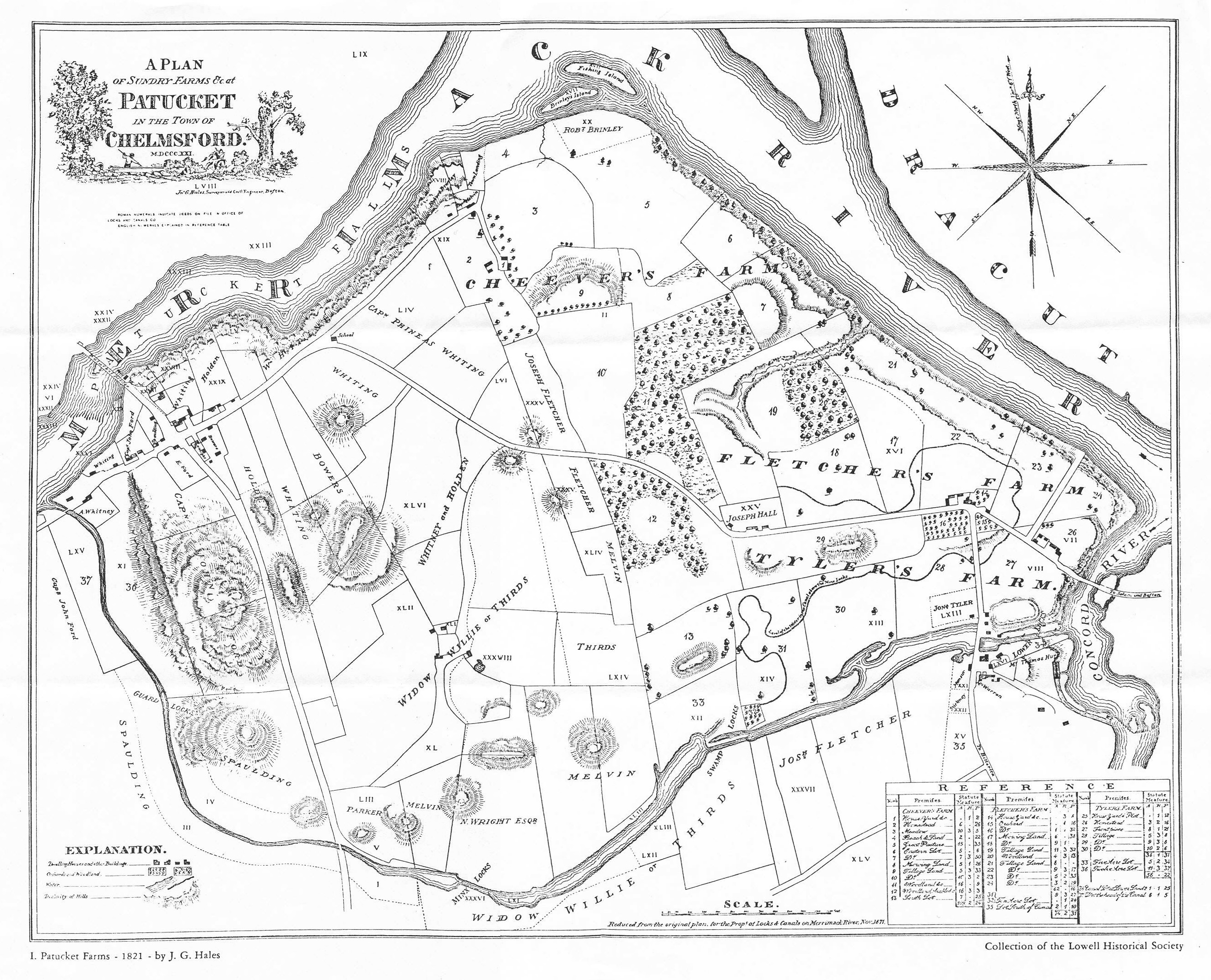
            Lowell was a much different place in 1822. For a start, it was named East Chelmsford. Most of the town was still covered by woods, swamp, and farmland. The Chelmsford Historical Commission has a lovely compendium of maps on their website (http://www.chelmsfordgov.com/CHCwebsite/Maps.htm) and this one from 1821 paints a clear picture of the land that Hugh Cummiskey and his thirty men arrived at on April 6th, one hundred and ninety two years ago today: http://www.chelmsfordgov.com/CHCwebsite/CHC_files/Map1821NorthEast.jpg


Hugh Cummiskey was a man’s man. In his early 20’s he departed his home in County Tyrone, Northern Island to come to America. He made his home in Boston where he met his wife Rose, and ran work crews on jobs that changed the face of Boston. Early records show him working on a project to help flatten Beacon Hill for the construction on the State House; a project that employed a horse drawn railroad to take the debris removed from the hill and use it to backfill a swamp and create Boston’s Back Bay neighborhood. In 1822, Cummiskey and 30 Irish laborers walked from Charlestown, MA to East Chelmsford, where they arrived on April 6th and were met by Mr. Kirk Boott, agent to the Merrimack Manufacturing Company. Boott and Cummiskey drafted a deal to widen and modify the canals that powered the Company’s mills. Take a moment and go back to that map. How many roads do you see? How many homes?  Buildings?  Establishments? You’ll observe mainly open farmland along a bend in the Merrimack River, and the 27 miles between Charlestown and Lowell was much the same. So imagine the walk that those 31 Irishmen took that day. They walked the edge of the Old Middlesex Canal, which had been built to move goods from the East Chelmsford (now Lowell) area to the seaport of Boston. The walk would have been dusty, and the men would have to be completely equipped with their own provisions. However, none of them were daunted by this.

            As a teen, a few friends and I got the bright idea that we were going to walk to Boston. Having ridden the commuter rail line to North Station, we considered the train tracks to be the most direct root so we filled our backpacks with bottled water and sandwiches and set out in early morning for a fun filled day in Boston. We hopped on to the train tracks at Red Bridge, behind E. A. Wilson’s workyard on Broadway, and off we went.  About 7 or 8 hours later we found ourselves at North Station…EXHAUSTED. We immediately bought train tickets home to Lowell, and slept the entire ride. We weren’t nearly the men that Hugh and his workers were.

Upon arrival in Lowell after their 27 mile trip (a marathon is only 26.2 miles) over rough terrain, Hugh and his men went immediately to work on the canals which would power the mills that made Lowell become the second largest city in Massachusetts. Employing the methods he had gained experience on in Boston, Hugh would lead his men to use the fill from the Suffolk canal to backfill swampland in Lowell… and if you’re reading this from an apartment in the Market Mills… that swampland was where your apartment building stands today…thanks to Hugh.   

Hugh brought water to the water powered mills of the American Industrial Revolution. He brought land were there was once swamp. His sweat anointed the land beneath the State’s Capitol building. And he was instrumental in bringing about the infrastructure of early Irish community in Lowell. So today, as you go about your day, lift a glass to those early Irish pioneers, and the man that led them here: Mr. Hugh Cummiskey.

Slainte!

Thursday, April 3, 2014

Mrs. Castle & the Know-Nothings


The Philadelphia Know Nothing Riot, 1848
“I know nothing.”  When a member of the Native American Party was asked about this semi-secret political group that was based on American nativism and anti-Catholic bigotry, that was to be his response.  “I know nothing.”  New England in the 1850s was fertile ground for such a group.  Too many immigrants.  Too many Catholics.  They infiltrated every level of government and Lowell was no exception.  Members of the Know-Nothings felt it their duty to purge America of foreign, especially Catholic, influence. 
Reading through the few accounts of life that exist of life in this period there is a story that keeps popping up.  It tells of when the Know-Nothings were in power and made themselves known in Lowell.  The year was 1854 and tensions were tight.  The Know-Nothings were known to make visits to convents and demand entry to see what atrocities they could find.  The Sisters of Notre Dame spent the nights in vigil waiting for the alarm to be sounded.  Men spent the night in the church tower keeping their eyes on Lowell Street for the mobs to be crossing the bridge which would lead them to the church and the convent.
It was a June night when their fears became reality.  According to one account that has been passed down to us, the crowd with guns and bayonets advanced upon the convent in martial order, followed by the mob yelling, shrieking and brandishing clubs and road tools.
On came the frenzied force, their shouts filling the air and penetrating the convent walls to the great terror of the sisters. The roar of the mob signified no mercy to the noble women whose lives were dedicated to mercy, and there seemed to be no hope. But in the meantime the news had reached a Catholic woman whose life was of less value lo her than her religion.
The woman in question was Mrs. Julia Castle (Cassell), wife of Henry Castles.  Putting a large rock in an apron, she called upon the neighboring wives, mothers, and sisters to follow her example, and soon full fifty women were massed in front of the convent gate, led by the dauntless Mrs. Castle. There they stood, shoulder to shoulder, right in the teeth of the advancing horde, each one firmly resolved lo let the infuriated Know-Nothings trample over her body ere the gates should be forced and the sacrilege consummated.
Leading the military company was a burly policeman, whose sworn duty was to preserve peace and order. He was some thirty yards in advance of the rest, his zeal in the cause having quickened his steps. When he pompously ordered the woman to make off and clear the way, instead of being obeyed as he expected, he found himself in the grasp of a pair of stout Irish arms, and felt himself lifted bodily ore the ground. The canal was nearby, but before the approaching mob could come up he was seized by the scruff of the neck and the seat of his trousers, and was flung into the slimy depths. The crowd halted in amazement at the audacity of the thing, and then, by one of those instantaneous impulses which sometimes turn the current of events and shapes history, the mind of the mob was diverted from its infamous purpose.  The sight of the half drowned wretch as he floundered and splashed in the reeking water ere he crawled up the banks, changed the yells of rage to shrieks of laughter, and gave men time to take a second thought of what they were contemplating. When old Mrs. Castle, her straggling grey locks unconfined, bade them come on and get treated to more drinks of the same tap, they turned about and slunk home. Had the convent been burned there would have been a bloody retaliation that night, and many who participated would have never seen the light of another day.
Stories tend to snowball.  They grow with each telling.  The above narrative was part of Mrs. Castle’s death notice when she passed away in 1887.  So did it happen?  There is an eyewitness who swears to her account.  There are other accounts; one written by a Sister of Notre Dame, and then the actual newspaper account from the period.  One can imagine Mrs. Castle telling her story year after year; her grandchildren sitting on her lap.  And with each telling, the story grows.
So what’s your story?

Friday, March 28, 2014

Benjamin Day's Workshop


Map- Lowell, 1850
Lowell Street (now Market Street) was a busy place in 1830s Lowell.  The arrival of the first Irish in the 1820s spurred a commercial boom in the area.  It wasn’t long before the tents and shacks of the first arrivals were being replaced by the shanties and ten-footers of the ever growing Irish population.  Soon alleys and makeshift walkways began defining the Acre neighborhood.  Lowell Street was at the heart of the hustle and bustle.  More and more hopefuls were arriving from all over and even across the sea in need of work.  With those increasing numbers, came the need for good and supplies. 

Lowell Mercury, 1830
Right on Lowell Street was Stephen Gale who sold stoves.  And there was Willard’s West Indies Dry Goods Store specializing in “pure and choice wines.”  You could have your clothes made at Hobb’s Clothes Ware-House.  Bethuel Cross sold crockery and China ware on Lowell Street.   The Exchange Coffee House, owned by Owen Donohoe, was a busy place for Irish and Yankee alike.  Mrs. Rice had a cottage just off of Lowell St. where she offered her nursing services.  Richard Walsh had his Catholic bookstore right across the street from the Rev. Mr. Blanchard’s house.  (Was it intentional that Walsh made it a point to advertise his Catholic business was located across the street from a Protestant minister’s home?)  There were a myriad of livery stables and harness shops as well.  Hugh Cummiskey, in partnership with Samuel Murray, had a West Indies Dry Goods Story on the corner of Lowell Street and Cummiskey Alley.  Almost all were Yankee businesses in these early days, but the Irish did have a sort of monopoly on one certain business.  Grog shops abounded in every basement along Lowell Street and all the little alleys in between.  On the weekends it was known that local living rooms transformed into saloons. At least that was the opinion of the local constabulary. 
If you kept walking down Lowell Street the shanties became fewer and father apart.  Heading towards the river, you might have heard the sound of stone being cut and carved.  You would have come across the workshop of Benjamin Day, stone carver.   Day had probably arrived in Lowell to set up shop as early as 1830 and started advertising his trade in the Lowell Mercury.  Previous to Lowell he established himself in Salem, MA.  His work could be found throughout Essex and Merrimack Counties.  Day’s workshop would have been on the corner of the present Salem and Decatur Streets.  Grieving families, looking to purchase a grave stone, would have gone to his shop and seen stacks of slates that had been precut, many with the iconic willow and urn pattern of Yankee New England, already carved.  The stones lay there awaiting the names and dates of the deceased to be added.  Day’s price also included delivery and setup at the cemetery.  With his shop within the Irish district, it’s not surprising a number of his stones can be found at St. Patrick’s Cemetery.  One can imagine families walking by his workshop day after day going to work or to shop.  At the time of a loss they might find a familiar face with Mr. Day, their neighbor. 
John Bork's stone w/ Day signature
Each carver had his particular style that he would call his own.  Stones can be identified by certain borders, finials, and stippling.  The earliest stone in Saint Patrick Cemetery is that of young John Bork carved by none other than B. Day.  Bork’s simple, small, slate stone with willow and urn design is typical of Day’s carving style.  A number of stones, slate and marble, have the name Benjamin Day name carved at the base, as was typical of his style.  The sad part is that most of the early slates have been snapped to lay flat in the ground and the signature of the carver is missing.  Even sadder is that the many shamrock slate stones in the cemetery, show great similarities to Day’s style, but cannot be proven to be his work. 
As the city grew other carvers such as David Nichols and Theodore Warren joined in to fill the need.  Benjamin Day kept his shop going for many years.  As historian, Marilyn Day states, Benjamin Day bought a lot at the Lowell Cemetery, but ironically no stone marks his grave.
For a great read on a history of Benjamin Day read Ms Day’s account http://www.pelhamnhhistory.org/library/pdffiles/day/benjaminday.pdf . 
I must add here that like many of you I walked Market and Salem Streets (Lowell Street) many times in my youth.  I was always struck by the old store fronts with the large glass windows.  They reminded me of a time past, and I wondered what shops had first sold their goods here.  Many of these businesses still retained the old entry to cellar ways in the middle of the sidewalk that were used to bring goods into storage.  A misstep could send you flying.  .  The storefronts had advertisements for fresh black olives and windows filled with pyramids of cans of olive oil from Greece.  Tournas’ had their trays of baklava and barrels of peanuts.  The neighborhood Hugh Cummiskey had known was transformed to one that represented those that came after him, and would change hands yet again.  When I got to the corner of Salem and Decatur there was an empty lot.  I often wondered about that lot.  After doing research for this article I found this was the site of Benjamin Day’s workshop.  I remember an old garage being in the rear.  Was this part of Benjamin’s shop?  Was the lot empty because of the stones left behind by Benjamin?  It’s nice to think so.

Sunday, March 23, 2014

A Tale of Two Daniels

One of the goals of this blog is to collect stories of Lowell's Irish past.  It's one thing for me to write little vignettes of happenings from generations past or my own Acre memories, but it is far more important we collect yours.  There have been folks who have shared their own stories, or stories from their families, but they are not as many as I hoped.  Everyone says they'll get to it at some point, but rarely does that happen.  Soon there stories will slip away and will be lost to the next generation.  We have a duty to preserve them.  Our recent documentary, shown during Irish Cultural Week, was made up of several folks who just shared a few moments of their time, yet added to our Lowell Irish history.

I'm reminded of Jack Flood, recently deceased.  He called me to sit with him so some of his stories could be preserved.  Smart man.  How about you?  Drop me an email.  dadumc@comcast.net  I'd be glad to sit down and chat with you.  I'll do all the work, you do the talking.  If that's too much, send me your story.  It doesn't have to be long.  If you like we'll publish it.  If you don't we'll just put it in the archives.

This week's entry is one sent in by a reader, Rosemary K. Nunnally.
Google image


Young Daniel Lawn, Jr. left County Donegal with his mother Mary and siblings Elizabeth, Michael, Mary Ann, Sarah and James.  They arrived in New York on October 11, 1880.   They traveled on to Lowell, MA to join the head of the family, Daniel Lawn Sr., who was working as a laborer.  The family settled on Summer St. with other Irish immigrant families.

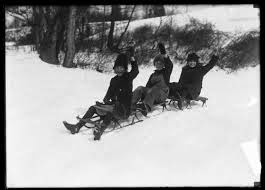
During the cold winter months, the children of the city entertained themselves with coasting, sledding on the South Common and on the streets of Lowell. The sleds they used were referred to as double runners. They were heavy and held several people. The sled could be difficult to steer with riders dragging their feet or jerking the sled sideways. Stopping the sled happened when it had played out its run at the bottom of the hill.
Ten year old Daniel enjoyed coasting. He left his home on a Friday afternoon in January of 1884 and made his way over to the South Common.  He probably went down the hill several times, walking back up to the top to start over again.
As the afternoon darkened into night, a terrible accident occurred. Daniel was hit by a sled. He suffered injuries which ultimately ended his life the next morning, January 26, 1884.
The Lowell Sun reported on the accident on the front page of the newspaper with the heading “Boy Killed By A Sled”.  The article went on to state “Daniel Lawn, residing at 25 Summer St., was run into by a "double-runner" sled on which boys were coasting on the South Common at 6 o'clock last evening, and died shortly before 6 o'clock this morning, notwithstanding the almost constant efforts of Dr. Phelan.”  Dr. Arthur Q. Phelan had his home and office at 4 Summer St. not far from where Daniel lived.

Daniel’s accident was also reported in the Boston Journal and Boston Daily Globe.  Both newspapers had a brief sentence explaining that Daniel had died from the effects of injuries from a coasting accident on the South Common.  Though there is no record of it, Daniel was most likely buried in St. Patrick’s Cemetery.  Daniel’s father, Daniel Lawn Sr., was buried there in yard 5F in 1902 and his mother Mary in 1912.

One hundred twenty-four years later in 2008, Daniel Lawn Jr.’s great great grandnephew, Daniel, went out sledding in a friend’s yard in the Belvidere section of Lowell. This Daniel also had a sledding accident.  Thankfully, due to improved medical care, the outcome of his accident was different. Though he had serious injuries to his face and mouth, Danny made a complete recovery. Separated by over one hundred years in Lowell, two young Daniels, two sledding accidents, and two stories to tell.

Wednesday, March 12, 2014

"Happy Days" Casey & the St. Patrick's Day Parade


THOMAS “HAPPY DAYS' CASEY
CA. 1850 6 July 1942
"TO HAPPY DAYS THAT WERE, TO HAPPY DAYS THAT ARE,
TO HAPPY DAYS THAT ARE TO COME"
Lowell Sun image, 1928
Thomas Casey was born in Ireland – date unknown – place unknown.  He kept that information to himself. He came to Lowell in the 1860's and worked as an expressman. He acquired his nickname at a picnic in the 1890's when he offered that toast. That was the end of Thomas – now he was “Happy Days”.
 With his horse and wagon, for 30 years Irish laborers, mill workers, teamsters and their children contacted “Happy Days” when there was a chest or trunk to be moved.  When one disputed his Irish birth, he would invariably tell that person something of his or her family back in Ireland, which would leave that individual dumbfounded – HOW could he know that!?” –  and never again doubt Casey's Irish origin.  He was known for his long white hair and full white beard. 


There was one day of the year, however, when he put on a quite distinctive appearance.  That day of course was St. Patrick's Day.  He would don his best cutaway coat and top hat with of course a touch of green in his lapel.  That took care of his attire and appearance.  He would then go to the stable and properly adorn his horse.   After saddling his horse, “...with affectionate hands he would further embellish the silvered trappings with everything green that he had laid his hands on over a period of months – green and gold.  Across the horse's long nose would be found the Harp of Erin, rescued from a Hibernian's discarded sash.  The animal's mane would be trimmed carefully in braids of green silk.  There's even a large bow of silk on the flowing tail.” (SUN 7 July 1942)  Thus equipped and adorned, he was off to join the parade leading such groups as the Meagher, Wolf Tome and Sheridan Guards through Lowell.  St. Patrick's day did not end for Happy Days when the parade was over.  He, and his horse, then went on a 'tour' of several drinking establishments.  When he entered, he was mounted on his horse, and fittingly asked for a beer for his horse as well.
Casey' Grave, St. Pat's Cemetery

During one St Patrick Day parade, Mary O'Malley described him thusly to a group of boys, ''There's Happy Days Casey, he's St. Patrick when you look at him in summer, and Santa Claus when you look  at him in the winter. Wouldn't you wonder, now, whether the man was ever born, but just came here from nowheres?'' (SU N 7 July 1942)   Happy Days was a beloved character such as we shall not see again.  He was struck by a bus on 6 July 1942 and died that day.

I am indebted to two articles which appeared in the Lowell SUN: 14 July 1928, and 7 July 1942.  Both have a photo of Happy Days with his wagon and horse. Submitted by Walter H.

Friday, March 7, 2014

"The Day We Celebrate" - Saint Patrick's Day in Lowell, 1833

St Patrick Church, 1880s
So begins the opening line of the first recorded celebration of St Patrick’s Day in Lowell. The Lowell Mercury of 1833 gives us a picture into the past. They were all there at the Mansion House. Mr. Blanchard, the owner of the establishment, served a fine supper. He was known for his oysters and setting a fine table. They were a close-knit group, a tight band of“native sons” who were making new lives for themselves. Of course there was Hugh and Eugene Cummiskey. Hugh’s close friend and business partner, Samuel Murray, was also there. At the head table would be Charles Short. He seemed to be involved in everything in the Paddy Camps, land dealings, business arrangements, and even causing the Bishop some grief with choosing a new Pastor. But that won’t be for a few months. The Campbells came in, one a tailor and the other a laborer for the Corporation. They were among the growing number of businesses in the Acre. Most of the crowd, being solely men, made their way over from Lowell (Market) Street and Fenwick Street. Most were part of Lowell’s growing Irish middle class. There were teamsters, carpenters, real estate agents, stable owners. They were here to show their fellow Irish countrymen that America had much to offer.

Lowell Directory, 1833

After the table cloth was removed the musicians, and they were a fine group by all accounts, started up their tunes. Of course the first was St. Patrick’s Day. They slapped their hands on the tables and prepared the first round of toasts. “The day we celebrate- may its memory be celebrated in the breast of every Irishman.” The glasses were lifted, another jig was played and the sentiments continued. They remembered their homeland and those left behind. They remembered their heroes and cursed their oppressors. They lifted their glasses to O’Connell and the Irish harp. Over and over again they remembered their new home: President Jackson, Democracy, the Constitution, the Merrimac River and to the owners of the loom. They sang Adeste Fideles when they recalled Bishop Fenwick and sang Yankee Doodle. Music and poetry filled the room. As the night drew late someone reminded the crowd that it was a Saturday and the next day was Mass. And so some made their way to their hacks and others bundled up and walked out into the March night to return to their homes.
In the words of James Campbell, “May the Sons of Old Hibernia celebrate the festival of their Patron Saint, with mirth, cheerfulness and convivia."

CHECK OUT THE LOWELLIRISH FACEBOOK PAGE FOR THIS YEAR'S EVENTS.  IT ALL STARTS THIS WEEKEND WITH OUR CONCERT AND MASS (WITH IRISH READINGS).  THEN WE'RE OFF TO CITY HALL FOR A GRAND PARADE WITH A PIPER AND FLAGS, FOLLOWED BY AN IRISH BRUNCH. 

CELEBRATE YOUR CULTURE.  KEEP IT ALIVE!!!

Thursday, February 27, 2014

Mr, Boott's Gardener


Kirk Boott's Home (Mill and Mansion)
When Kirk Boot was given the task of managing the new mill town being built on the Merrimack, he was leaving behind the family mansion in Boston and the life of the socially elite to which he was accustomed.  Back in Boston, the Boot’s were well known for their mansion on Bowdoin Street and its fine art and architecture.  The family was also known for its beautiful gardens, greenhouses, and especially for their roses.  So it was providential in 1822 that when Mr. Boott was building his Greek-Revival mansion in East Chelmsford, soon to be Lowell, he would include space for the cultivated lawns and landscaping to which he was accustomed.  His blueprint for the construction of the Merrimack Manufacturing Company would include a landscaped entrance area to the mill along with plants and flowers placed between the different buildings.
 To achieve that end Mr. Boott brought John Green up from Boston to serve as his gardener and steward.  History does not tell us how the two men met.  Perhaps he worked for the Boott family in Boston?  John Green was born in Aughavading, Co. Leitrim in 1798.  He arrived in Boston in 1823 living there for a short time before settling in Lowell.  Green’s name appears in several histories of Lowell being listed as one of the prominent Irishmen of the period.  His first mention in Lowell was paying the poll tax in 1826.  His occupation was regularly listed in the Town/City Directories as gardener working at Boott’s.  After his death his son, John J Green, reminisced about his father being the superintendent of landscaping at the Merrimack and being part of the planning of the North Common.
When Mr. Boott died unexpectedly in 1837, Green continued working as a gardener at the 
Lowell Map, 1850
 “Company farm.”   In Boott’s will, he bequeathed Green $72 in wages, a very hefty sum for a gardener.  Later Green was listed as “botanic physician.”  He became a US citizen and started acquiring property.  He moved into a new home on the corner of Willie and Cross Streets where he lived for the remainder of his days.  The 1850 census showed he owned $10,000 in real estate.  Few Irishmen of this period had such holdings.  By the time he reached the age of 60, John Green considered himself a “gentleman.”  One can imagine him in his garden on Willie Street, pruning and weeding.  Then he would stroll through the North Common making his way to Saint Patrick’s Church for Mass.  His niece, Anne Flynn, moved into the home to act as his nurse.  Upon his death he recognized her help by granting her a small stipend.  His will divided his properties among his survivors, but his final hope was that the family would remain together and share the holdings.  In 1866 he joined his fellow Irish pioneers in Yard One of St. Patrick Cemetery.  His brief obituary, obituaries not even being common practice at the time, testified to his fine character and reiterated the bond he had with Mr. Boott almost 30 years previous.   He left Ireland a poor man, but died wealthy in more ways than one.


His son, John J Green, was a member of the Lowell chapter of the Irish American Historical Society, which attempted to preserve the Irish history of Lowell.  Unfortunately none of the minutes of the group survive today that recorded the actual recollections of those early Irish pioneers.  In 1921 John J Green tried to persuade the city to memorialize the walk of Hugh Cummiskey and the first Irish laborers with parades, lectures, church services, and the erection of a suitable monument on the North Common. 
Like John J Green, George O’Dwyer (author of Irish Catholic Genesis of Lowell), and others, the Irish Cultural Committee of St. Patrick Parish tries to preserve Lowell’s Irish past.  Please join us this March as we present the 31st annual Irish Cultural Week. https://www.facebook.com/#!/LowellIrish

Saturday, February 22, 2014

The Four Hundred from the Grove


Garrett Sheehan from the St. Pat's Irish Cultural Committee sent along this great article which originally appeared in the Lowell Sun in 1988.  Thomas the fiddler, referred to in the article, was his grandfather.
'The Four Hundred' Irish from the Grove     By THOMAS M. SHEEHAN

Postcard image
LOWELL - It is a known fact that the original Irish immigrants to Lowell settled in what is known as "The Acre," where they built St. Patrick's Church and School.  Less recognized have been the efforts of "a third wave" of Irish immigrants who arrived in Lowell in the late 1800's.  This "third wave" of Irish came to make their homes in a neighborhood situated on a wooded hillside which had become known as the "The Grove.”  "My own Irish heritage is founded in this area of the city which surrounds Sacred Heart Church on Moore Street.”  These Irish settlers put the same energy into the building of a parish as their predecessors in "The Acre."  It was a very close knit neighborhood where people stuck together during good times and bad, weddings and funerals, births and deaths, sickness and health, through peace and war.  There was once a time when just about everybody in "The Grove" was related in one way or another.  From it's beginning in the 1880's, a family would come to Lowell from Ireland and secure a place to live, and be a base of support for brothers and sisters, as well as cousins when they arrived - to get jobs and establish a home of their own after marrying.  In many cases, single persons were married off within a year of their arrival.  There was lots of matchmaking going on.

FORMING A CLAN
Many of the relations of the first settling families married each other's cousins, sons and daughters, forming a clan.  This became a tradition as these families - referred to as "The Four Hundred" - banded together and built Sacred Heart Church, and later, a school for their children, while establishing a wholesome neighborhood environment.  Here, they found the opportunity to make a good life for them self’s, prosper, and provide the necessary opportunities for their children.  Many of the Irish who were living in the "Flats" (back Central, Newhall and Lawrence Streets) moved to new homes being built in "The Grove."  The foundation of Sacred Heart Church had been built, and was dedicated on Aug, 10, 1884.  With the help of the Oblates of Mary Immaculate Missonary Fathers, a parish was formed.  Parish members put their hearts and souls into church bazaars, raffles and other fund-raisers, and on Sunday, Sept. 29, 1901, Rev. Fallon of Buffalo delivered an impressive sermon at the church's grand dedication ceremony.  The ceremony was conducted by Lowell-born Bishop O'Connell, then Bishop of Portland, Me. and later to become Cardinal of the Archdiocese of Boston.  The parish pastor, Rev. J. P. Reynolds, proclaimed that the church wouldn't have come to fruition if it hadn't been for the "Four Hundred."

PRINCIPAL FAMILIES
The principal families of the "Four Hundred" were considered to be the Lynchs, Murphys, Sheehans and Finnegans.  Checking the city directory, it was quite surprising to find just how many families with these last names lived in "The Grove" well into the 1900's.  Several Lynch families were listed on Andrews, Crowley, Agawam, and South Whipple Streets.  A number of Murphy families could be found on Andrews, Otis, Agawam and South Whipple.  Numerous Sheehan families made their abode on Agawam, St. James, South Whipple, Andrews, Bourne and Bleachery Streets.  The Finnegan families tended to reside along Lawrence Street, where several operated small shops.  To the descendants of these hard working Irish Families, the area is not Spaghettiville as it says on the Lawrence Street RR Bridge and it was never Bleacheryville, but “The Grove.”  The Murphys have been involved and intertwined with the Sheehans and Lynchs for about 200 years, going back to Ireland.  So it is no accident that they settled in the same neighborhood.  These first two families came from the farmland between Castleisland and Brosna in County Kerry, across the Feale River from Mt. Collins in County Limerick.  This is an area of rolling hills and lush fertile valley called Coom.  From the top of Castlehill, you can see the shimmering waters of Tralee Bay.  My great-great-grandmother was Mary Murphy, who married Tom Sheehan.  Their sons were Daniel (my great-grandfather), James, Mortimer, Tom (the soldier), Jeremiah (the tailor).  All except Daniel came to Lowell, but his granddaughter, Joan (Sullivan) McCarthy will arrive here next month with her adult children.There was a Thomas J. Murphy who married Josephine Sheehan (my grandfathers' sister) at Sacred Heart in 1898.  Should I trace my own roots back to the 12th century in Ireland, I just might find our ancestry stemming from Murchadh (Murphy), father of Sidechan (Sheehan), who were the 5th and 6th generation descending from Cenneitig (Kennedy), kind of Thamond; by his son Mathgamhain (Mahon), kind of Munster (Brother of Brian Boru kind of Ireland until 1014 A.D.)

The Lynchs and Finnegans came from a farmland called Garravane, outside Mt. Collins in County Limerick, a beautiful and peaceful place which I visited two years ago - in search of relatives.

My great-great-grandfather, John Lynch, a stonecutter, was married to Mary Finnegan on Feb. 6, 1842 and came to Lowell in 1883 with his six children - Timothy (my great-grandfather), Michael, Daniel, Thomas John, Mary Jane, and Catherine. 

John the stonecutter's granddaughter, Mary, was the wife of former State Rep. Connie Desmond.  Longtime Dracut High School football coach Ed Murphy was a descendant of the Grove's Murphy and Finnegan families.  The wife of State Rep. Edward LeLacheur (the former Eileen Mahoney) is a descendant of Jeremiah Sheehan the tailor, who had a shop at 20 Central Street.  Another Sheehan, nicknamed "Tom the Fiddler," was the son of Martin and Johanna, who had emigrated from Brosna.  Tom's son, John "Dukey" Sheehan, was the father of Lowell Chief of Police Jack Sheehan.  Marathoner Bob Hodge, who holds the record for running up the Mount Washington auto road, is married to Eileen (Hodge) Kempton, a Sheehan relation.  Many "grove" children, whose parents stressed respect for the law and service to community, grew up to become members of the city's Police and Fire Departments.

Edited from The Lowell Sun,  Sunday, April 17, 1988

Wednesday, January 22, 2014

Bradt's Crackers- an Acre original


Image from ebay.com
Thursday nights were food shopping nights when I was growing up in the Acre.  We’d get in our 55 Ford and head down Broadway to the Giant Store.  It had a big ramp that led up to the food store, or you could take the stairs and go down to look at the toys.  When you were done grocery shopping, they’d put your brown paper bags in a metal bin and send it down a long set of rollers, which led outside in order to load at your car.  I always wanted to take a ride along that conveyor, but I digress. 
One of the items that was on our weekly shopping list was a box of Bradt’s crackers.  They came in a long, white rectangular box with blue lettering that said “Bradt’s Soda Crackers.”  The crackers were snow white with little air pockets that made them “crispy, but not brittle” as was advertised on the box.  I remember they were on a shelf near the ice cream, and I’d have to climb up on the freezer to reach them to put in the shopping cart.  There was always the warning of not dropping the box and breaking them before we got them home.  There was always a little anxiety to pull out that perfect cracker without breaking it, and then snapping it along the little perforations that would divide the square into quarters. 
The company was a Lowell original being manufactured on Whiting Street (between Fletcher and Salem Streets).  Today the parking lot for the new UMass buildings completely covers where the small wood and stone factory once stood.  My friend, David, lived just steps away from the factory.  You could smell the crackers baking in the oven as we played in back of his house.  The white-aproned men would often keep the doors and windows open to escape the heat or sneak outside for a smoke.  From time to time they’d give us a few of the broken crackers.   The wooden floors of the factory were almost snow white with crackers that didn’t meet quality control.  Occasionally, farmers would pull up to haul away the sacks of broken pieces to feed their hogs.
City Directory, 1890
Since my dad had ulcers they were a staple of his diet whenever they flared up.  My Mother used them in her stuffing, as I think every Lowell mother did.  They were great on meatless Fridays with butter or peanut butter.  Probably every family in the area had a box of Bradt’s in their pantry. 
The company had deep Lowell roots.  It was started by David, Gerrit J(Garrett), and David Bradt in 1833.  The Bradts originally worked for Mr. Pierce’s bakery.  In just a couple of years the brothers opened their own bakery on Whiting Street and built a home.  They acquired tracts of land that make up parts of Bowers Street.  Through the years the company took on several names; Bradt’s Soda Crackers, Bradt’s Soda Biscuits, and Bradt’s Common Crackers.  The family did well enough that they became involved in real estate and banking.  The founder, David Bradt died in 1892, leaving the company to various relatives and slowly declining over the years.  He was buried in the family plot in the Lowell Cemetery.
The company was sold off to Oswald Turcotte in the 1930s who tried to re-energize it by broadening the selling area to outside of Lowell and a new advertising campaign.  Ads appeared in the papers using the theme “crispness without brittleness.”  Mr. Turcotte assured his patrons that they were keeping the original recipe and quality of the 100 year old product, while expanding the line to include oyster crackers  and saltines.  As November rolled around the ad campaigns showed up in the Lowell Sun.  One was a “telegram” by grandchildren reminding Grandma they were coming home for the holiday and her stuffing made with Bradt’s crackers.  Another was a personal endorsement by a Mrs. Edna Riggs Crabtree who used them at her cooking school.  The company even had a quite successful bowling league in the 1940s and 50s competing against the likes of Laurin Morticians and Turcotte Wines. They were still advertising for employees in the Lowell Sun up to 1970.  The actual date of closing is unclear. 
Today we buy water biscuits at outrageous prices at specialty stores.  Yet nothing today could compare to a Bradt’s!

Tuesday, December 31, 2013

The Problems of Digging Up the Family Tree


Duncan Rankin McKean
I only remember him as an old man with a shock of snow white hair.  His face showed little sign of his 86 years.  His sky blue eyes gave the notion he had stories to tell.  He spoke with that distinctive burr that some born in Scotland would have, though I rarely recall him speaking of his youth in Glasgow.   He spoke so softly you had to listen to hear what he was trying to say.  The smile (some say a grin) was a permanent fixture on his face.  He was immensely proud of his Scottish heritage often telling his grandchildren not to admit to their Irish side from their grandmother.  (Research would show Clan McKean made many trips originating in Donegal and moving to Scotland over the centuries.)  He would sit in the chair in the corner of his apartment in the housing at 323 Adams Street, rarely having much to say.  It was only after he was gone we learned the truth of my grandfather’s story. 
Duncan Rankin McKean was born in the bleaching fields of the township of Milngivie, Scotland in 1875.  The family story was that he left at 16 to work on a cattle boat to make his way to Lowell.  That was all he would admit to.  But technology changed that as I went in search of my grandfather’s roots.  Both his parents worked jobs in the woolen mills.  He was one of 6 children before his father died when Duncan was still a boy.  The young mother was left with the children and her father in law to take care of.  The family situation declined quickly with the death of the grandfather leaving the mother alone.  Soon she is pregnant and gives birth to another child with a different surname. That surname reappeared soon after when she married a much younger man whose father owned the factory where she was employed.  It is at this point that Duncan leaves Scotland.  Under what conditions no one knows, but one can only surmise.  He was working in Glasgow as a shoemaker.  He traveled alone to Rhode Island where he continues the same occupation living with a family member, maybe an uncle or cousin.  The only possession he carried with him was a photo of himself taken just before he left.
He stayed briefly with family before making his way to Lowell where he worked at the Lowell Machine Shop.  He met Jennie Sweeney and they married at the Rectory of St. Patrick Church.  The day before the nuptials, he was baptized a Catholic forsaking the Church of Scotland.  He rarely entered another Catholic church again until his own funeral, but kept his promise and saw that all his children were raised Catholic.  He kept his King James Bible and told people, “You read yours, and I’ll read mine.”
Research can sometimes have its downfalls.  My grandfather, like so many others of this period, did not have an easy life.  The more I dug the more I found he was haunted by his demons.  He never saw his mother again.  In the 1900s there were pleas for money.  Then there were pleas for tickets for passage over, then the announcement that she was dead.  That’s when his name appears in police blogs time and time again.  His life took on a series of misfortunes.  Years later his wife died too soon, and that’s when he transforms to the kindly old man I remember.
Fifty years ago I was in the 4th grade at St. Patrick’s.  It was recess time.  We were out in the freezing cold.  The bell in the church tower began the funeral toll.  I stopped and turned to see them carry my grandfather down the steps of the church to the waiting hearse.  The school bell rang for us to line up.  I stayed in the yard.  Sr. Margaret Paul came over and asked why I was crying.  I told her that was my grandfather.  She walked me back to the line.  It is the last memory I have of him.
Should I have researched his story?  Should I have stopped when I saw what happened in Glasgow?  Should I have hid his life from my own genealogical accounts?  Maybe so.  When my aunts were still living I thought it wise to share his story and his encounters with them.  I was sorely mistaken.  They did not want to hear about his previous life, or merely wished to deny it.  They smiled and told happier stories of times past.  But his story is probably not that much different from others.  I cannot imagine going through what he did or how I would react.  So I share this with you and let you judge.