Showing posts with label Reader Submitted. Show all posts

Saturday, May 3, 2014

The Genealogy Genie

See description below
One mission of LowellIrish is to collect your stories.  How many have been lost because no one has written them down?  Every tour I lead ,or talk I give, inevitably one or two people tell me a great story of a relative's experience.  Some of the stories are humorous accounts of Catholic school education.  Others are stories of loss and pain.  And some are about success amidst adverse conditions.  If we are to succeed with our task, we need you.  Share your family's story.  We thank a reader, Pat Coleman, for this week's entry about discovering your past.


I am Patrick L Coleman, great great grandson of James and Margaret Coleman. I have fathered the next generation of Colemans and grandfathered the one after that. I am a retired research biochemist, a gardener, and in the midst of writing both a family history (not Coleman, but Melloys from Donegal) and a mystery story where the protagonist is a biochemist. I live in Minneapolis where, even as I write this on April 30th, there is still snow falling, not enough to shovel, unless one shovels the lawn, annoying nonetheless.


My Coleman ancestor, James, lived in and near Lowell from the late 1830s until about 1850.  While I knew his wife's maiden name, Margaret Walsh, and where each came from in Ireland, I knew nothing about their siblings or parents.  This is how the story stood through thirty years of genealogy research.  Then the Genie of Genealogy granted me three wishes in my search for my Coleman ancestors, based on the “Missing Friends” columns of the Boston Pilot.  But first some context.


My immigrant ancestor James Coleman made his appearance in American rather early, as Irishmen go.  He traveled from Ireland to St Andrew, New Brunswick, thence through Passamaquoddy, Maine, arriving in America on October 1, 1835.  He was single and listed himself as a farmer.  However, when I found traces of him in the Northeast over the next fifteen years, he was always a laborer working with other Irish to build the infrastructure for the first wave of American industrialization—canals, bridges, factories.


He met Margaret Walsh/Welch, also born in Cork, and they married in Hallowell, Maine in 1837.  Judging from the birthplaces of their children they traveled between Lowell, Mass., Maine, and Canada over the course of the next decade.  Margaret indicated on their marriage documents that she was a resident of Lowell at that time, and they returned there during 1845-48, and probably at other times, too.


They left Lowell and the Eastern seaboard in 1851, stopping in Sandusky, Ohio, for the winter as well as for the birth of son James in November that year.  Now with four children, they arrived in Dubuque, Iowa in 1852, where James became a naturalized citizen, and, for the next several years the family resided, while James commuted to a hilly farm in Allamakee county, Iowa.  His place was six miles from the Minnesota border and thirty-some from the Mississippi River.  He continued working as a laborer in Dubuque, one summer as a gardener, while periodically visiting his farm putting in crops in the spring and harvesting them in the fall.


This was the status of the Coleman story when the Genie appeared.  With respect to “wishes” there was a caveat: isn't that always the way?.  I don't get to make the wishes (a small detail about Irish Genies that they never talk about).  Rather my ancestors planted clues more than a century ago which I had to find.  It was akin to the TV quiz Jeopardy, guessing the question that gave the discovered answer.


I was to learn that the first question the Great Green Genie wanted me to ask was about Margaret's voyage to America.


From Missing Friends, 23 July 1842:
Of MARGARET WALSH, who is married to a man named James Coleman, a native of Spring Hill, parish of Glanmire, county of Cork, Ireland, who sailed for America in March 1840, and landed in St. Andrews.  Any information respecting her, will be most gratefully received by her father, Edmund Walsh, who is now living in the city of Lowell, Mass., by letter in care of Richard Walsh.


It seems that her father Edmund, later called Edward, had now come to America and couldn't find his daughter.  She and James and family (one month old John Patrick) were in Canada or Maine, judging by the various birthplaces John P. listed for himself over the next 70 years.  In the years since their marriage record, shipping and census records showed that James had been living in Maine twice, Canada, and Massachusetts in the intervening years; sometimes with Margaret and the growing family, sometimes not.


A puzzling element in that ad is the father claiming the daughter had left only two years before when she had been married five years ago.  You would think he knew.  Or is that pointing to more story than we imagine?


Not two years ago I stumbled upon the Genie again, but only through the serendipity of doing a search on the digital version of Missing Friends.  I searched “Allamakee” rather than “Coleman” or, heaven forbid, “Welch/Walsh/Welsh (and sometimes Walch).”  By using the county name I managed to by-pass the typo that was made more than 130 years ago, where the typesetter wrote “Cleman” instead of “Coleman.”  Margaret Coleman, now over sixty and with an empty nest, had time to consider the past and wonder about her siblings.  She wrote:


From Missing Friends, 13 Mar 1880
OF JOHN, WILLIAM, PATRICK, EDWARD, CORNELIUS, also MARY, ELLEN, HANNAH, and SUSAN WALSH, sons and daughters of Ellen and Edward Walsh.  Information of all, or any of the above named will be received by their sister. Address James Cleman, Quandahl P. O., Allamakee county, Iowa.


What a goldmine!  Mom and Dad and all the siblings.  Still the problem was they were cloaked in the surname Walsh, a problem even if the name had but one spelling.  The best tool I had from this clue was “Cornelius,” but, even though it provided many candidates in the US during the last half of the 19th century (but not too many), none had a tell-tale attribute that I could pin to the scantily defined Ed & Ellen Walsh family.


However, as unlikely as it might be, I have made some progress through the Ann Walsh connection, despite her marrying a man with a surname as popular as her own, William Fitzgerald.  So now I know that Ann Walsh married William Fitzgerald, a butcher in Troy, NY, (later Coxsackie, NY) and that they had ten children from 1870-1885, all with the standard-issue Irish names (Thomas, Michael, William, Anna (aka Hannah), Nellie, Ellen, Mamie, James, Mary, Frank), not even one Cornelius, Fergus, or Deirdre.


At this point the story-teller should have the readers in the palm of his hand waiting for the voila of the third wish.  Alas, I'm still trying to figure out the question I'm supposed to ask.  This is not to say I've made no progress, just that I'm still waiting for the great leap forward that the first two wishes provided.


Maybe this blog post will provide a clue to help me ask the correct question for the answer the Genie has in mind.


PHOTO CAPTION: The fellow with the hat and the watch chain is John P Coleman, the first born of James and Margaret. He was a prosperous businessman in Dubuque, Iowa in the second half of the 19th century. He owned a saloon, restaurant, and hotel on the levee of the Mississippi River.

Sunday, April 6, 2014

April 6, 1822- Our Story Begins

SPECIAL EDITION!-  Over the last 2 weeks I've had a flood of emails from folks willing to share their stories or asking for a little guidance.  Bob Rafferty, creator of the video Made in Lowell, wished to mark this day, the anniversary of Hugh Cummiskey's arrival in Lowell with a special posting.

What is the most important day of the year to an Irishman from Lowell? No, there isn’t a punch line… unless you answered St. Patrick’s Day? If you did, then the joke is on you. Today, April 6th is the most important day in the history of the Irish of Lowell for it is the day that the first Irish set foot here. 

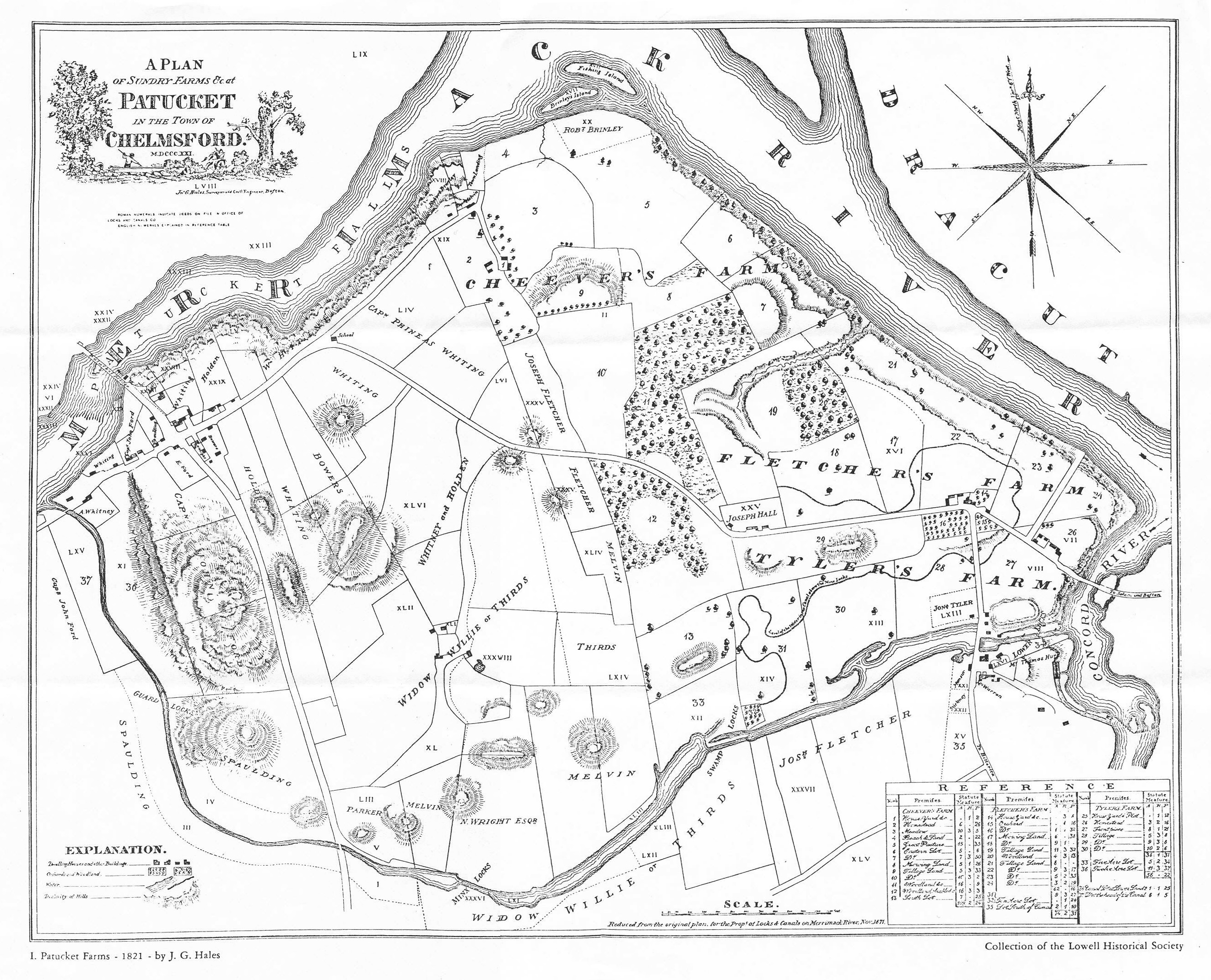
            Lowell was a much different place in 1822. For a start, it was named East Chelmsford. Most of the town was still covered by woods, swamp, and farmland. The Chelmsford Historical Commission has a lovely compendium of maps on their website (http://www.chelmsfordgov.com/CHCwebsite/Maps.htm) and this one from 1821 paints a clear picture of the land that Hugh Cummiskey and his thirty men arrived at on April 6th, one hundred and ninety two years ago today: http://www.chelmsfordgov.com/CHCwebsite/CHC_files/Map1821NorthEast.jpg


Hugh Cummiskey was a man’s man. In his early 20’s he departed his home in County Tyrone, Northern Island to come to America. He made his home in Boston where he met his wife Rose, and ran work crews on jobs that changed the face of Boston. Early records show him working on a project to help flatten Beacon Hill for the construction on the State House; a project that employed a horse drawn railroad to take the debris removed from the hill and use it to backfill a swamp and create Boston’s Back Bay neighborhood. In 1822, Cummiskey and 30 Irish laborers walked from Charlestown, MA to East Chelmsford, where they arrived on April 6th and were met by Mr. Kirk Boott, agent to the Merrimack Manufacturing Company. Boott and Cummiskey drafted a deal to widen and modify the canals that powered the Company’s mills. Take a moment and go back to that map. How many roads do you see? How many homes?  Buildings?  Establishments? You’ll observe mainly open farmland along a bend in the Merrimack River, and the 27 miles between Charlestown and Lowell was much the same. So imagine the walk that those 31 Irishmen took that day. They walked the edge of the Old Middlesex Canal, which had been built to move goods from the East Chelmsford (now Lowell) area to the seaport of Boston. The walk would have been dusty, and the men would have to be completely equipped with their own provisions. However, none of them were daunted by this.

            As a teen, a few friends and I got the bright idea that we were going to walk to Boston. Having ridden the commuter rail line to North Station, we considered the train tracks to be the most direct root so we filled our backpacks with bottled water and sandwiches and set out in early morning for a fun filled day in Boston. We hopped on to the train tracks at Red Bridge, behind E. A. Wilson’s workyard on Broadway, and off we went.  About 7 or 8 hours later we found ourselves at North Station…EXHAUSTED. We immediately bought train tickets home to Lowell, and slept the entire ride. We weren’t nearly the men that Hugh and his workers were.

Upon arrival in Lowell after their 27 mile trip (a marathon is only 26.2 miles) over rough terrain, Hugh and his men went immediately to work on the canals which would power the mills that made Lowell become the second largest city in Massachusetts. Employing the methods he had gained experience on in Boston, Hugh would lead his men to use the fill from the Suffolk canal to backfill swampland in Lowell… and if you’re reading this from an apartment in the Market Mills… that swampland was where your apartment building stands today…thanks to Hugh.   

Hugh brought water to the water powered mills of the American Industrial Revolution. He brought land were there was once swamp. His sweat anointed the land beneath the State’s Capitol building. And he was instrumental in bringing about the infrastructure of early Irish community in Lowell. So today, as you go about your day, lift a glass to those early Irish pioneers, and the man that led them here: Mr. Hugh Cummiskey.

Slainte!

Sunday, March 23, 2014

A Tale of Two Daniels

One of the goals of this blog is to collect stories of Lowell's Irish past.  It's one thing for me to write little vignettes of happenings from generations past or my own Acre memories, but it is far more important we collect yours.  There have been folks who have shared their own stories, or stories from their families, but they are not as many as I hoped.  Everyone says they'll get to it at some point, but rarely does that happen.  Soon there stories will slip away and will be lost to the next generation.  We have a duty to preserve them.  Our recent documentary, shown during Irish Cultural Week, was made up of several folks who just shared a few moments of their time, yet added to our Lowell Irish history.

I'm reminded of Jack Flood, recently deceased.  He called me to sit with him so some of his stories could be preserved.  Smart man.  How about you?  Drop me an email.  dadumc@comcast.net  I'd be glad to sit down and chat with you.  I'll do all the work, you do the talking.  If that's too much, send me your story.  It doesn't have to be long.  If you like we'll publish it.  If you don't we'll just put it in the archives.

This week's entry is one sent in by a reader, Rosemary K. Nunnally.
Google image


Young Daniel Lawn, Jr. left County Donegal with his mother Mary and siblings Elizabeth, Michael, Mary Ann, Sarah and James.  They arrived in New York on October 11, 1880.   They traveled on to Lowell, MA to join the head of the family, Daniel Lawn Sr., who was working as a laborer.  The family settled on Summer St. with other Irish immigrant families.

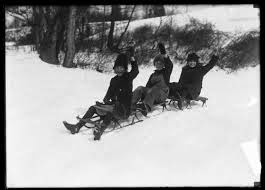
During the cold winter months, the children of the city entertained themselves with coasting, sledding on the South Common and on the streets of Lowell. The sleds they used were referred to as double runners. They were heavy and held several people. The sled could be difficult to steer with riders dragging their feet or jerking the sled sideways. Stopping the sled happened when it had played out its run at the bottom of the hill.
Ten year old Daniel enjoyed coasting. He left his home on a Friday afternoon in January of 1884 and made his way over to the South Common.  He probably went down the hill several times, walking back up to the top to start over again.
As the afternoon darkened into night, a terrible accident occurred. Daniel was hit by a sled. He suffered injuries which ultimately ended his life the next morning, January 26, 1884.
The Lowell Sun reported on the accident on the front page of the newspaper with the heading “Boy Killed By A Sled”.  The article went on to state “Daniel Lawn, residing at 25 Summer St., was run into by a "double-runner" sled on which boys were coasting on the South Common at 6 o'clock last evening, and died shortly before 6 o'clock this morning, notwithstanding the almost constant efforts of Dr. Phelan.”  Dr. Arthur Q. Phelan had his home and office at 4 Summer St. not far from where Daniel lived.

Daniel’s accident was also reported in the Boston Journal and Boston Daily Globe.  Both newspapers had a brief sentence explaining that Daniel had died from the effects of injuries from a coasting accident on the South Common.  Though there is no record of it, Daniel was most likely buried in St. Patrick’s Cemetery.  Daniel’s father, Daniel Lawn Sr., was buried there in yard 5F in 1902 and his mother Mary in 1912.

One hundred twenty-four years later in 2008, Daniel Lawn Jr.’s great great grandnephew, Daniel, went out sledding in a friend’s yard in the Belvidere section of Lowell. This Daniel also had a sledding accident.  Thankfully, due to improved medical care, the outcome of his accident was different. Though he had serious injuries to his face and mouth, Danny made a complete recovery. Separated by over one hundred years in Lowell, two young Daniels, two sledding accidents, and two stories to tell.

Friday, December 20, 2013

Poem- A Winter in Ireland

Portadown, geography.ie
In keeping with the season an entry from Daniel Patrick Murphy who writes: Mary Sweeney was a gentle poet with many children. She was born in County Cork, Ireland and immigrated to this country as a young woman and always wanted to visit her homeland but never had the resources to do so. I read some of her poems and the words in italics in my poem are her words. Mary Sweeney was the mother-in-law of a close friend of mine who is also a poet.


The characters of Deidre, Cuchulainn, and Oisin are well known figures in ancient Irish folklore.


Christmas In Ireland
(For Mary Sweeney, age 88)
I don’t know who came first, poets or friends.
Nevertheless, it was the funeral parlor
That caused me to meet Mary Sweeney.
She lay in a casket surrounded by
Flowers, family, and neighbors;
The scent of green distant mountains,
 Weathered valleys and waterfalls.
A seal was heard sounding,
A voice, yielding and mournful.
Coastal waters rumbled rhythmically.

 Blind villagers danced a reel,
Old Timmy lilted along.
Deirdre danced on the tip of a wave.
Cúchulainn and Oisín argued over
Who would be pallbearers.
Isn’t interesting how the sound
Of a poem begins like railroad tracks
And the train isn’t seen till the end.
Sure, God be thanked, we’re all together
Beneath one roof.

And the train arrived on schedule.
Flowers, family, and neighbors got aboard.
A seal sat up front, singing;
O, the cares of tomorrow must wait ‘til this day is done.
Several fine villagers sat down in relief,
Timmy had finally taken a nap
Deirdre sat next to Cúchulainn,
And Oisín kept notes. You and I smiled,
For didn’t we know,
There’s hope from the ocean,
But there’s none from the grave.

 As the train tugged uphill, we glanced backward.
Mary Sweeney stood there waving goodbye.
There was a shout for music, festivity and fiddles.
And her father placed a Yule log on the fire;
The countryside awakened with white.
Christmas bells rebounded over the valley below.
Mary was at peace, arrangements had been made
For her to stay a little while in Ireland.
--Daniel Patrick Murphy
blackthorncottage.co.uk

Thursday, September 26, 2013

A Poem: Mill Girl

Our guest blogger this week is local poet Daniel Patrick Murphy

Google image
My aunt Catherine O'Connor Riley (her husband, my uncle Bill, was from the corner of Rock and Willie St. in the Acre) began to work in a cotton mill in her mid-teens and stopped in her mid-sixties. She worked from early morning until early evening, sometimes 12 hours a day 6 days a week. She had unassuming grit and iron determination and little freedom while working in the mill. This poem hopes, posthumously, to offer her a modicum of freedom.


Mill-girl
Kathleen. Wake now.
Go weave your waving wings,
Taste the seeds, eat the buoyant blue,
Inhale the flaxflower scent of loom,
Sow your seeds in flight,
Flap your flaxen hair in air,
My butterfly, my Kathleen.

Dance up the airy ferns and rushes,
Dance up the fields of flaxflower bloom,
Wet your patterned wings with dampness,
Fly your supple self so fair,
Softly lace the darkened night,
When you were where,
My Kathleen, my siskin care.

Before you go, take one last dance in dreamy air,
Leave me lowly lapping wings,
Ascend and unfold.
Thread through growing light.
Let my fingers reach the dark,
When you were where,
My Kathleen, my linen queen.


--Daniel Patrick Murphy

Thursday, April 4, 2013

Making Their Mark on the City

City Documents, 1894

The Seal of the City is familiar to most Lowellians.  The river.  The mills.  The bales of cotton.  They have all been well-known symbols of Lowell as the City of Industry.  A careful look through city documents shows that the Seal has gone through several changes over the decades; each one emphasizing a certain phase of the city’s evolution.  Often a cornucopia, a horn of plenty, can be seen in the sky, advertising the profits created by the mills.  In the 1880s and into the 1890s a new image is seen in the skyline, a church tower.  The steeple of Saint Patrick Church can be seen amongst the outline of the mills.  The 13th century gothic-style church had been completed in 1854.  Early visitors commented on the grandiose size of the church compared to the shanties, shops, and dwellings of the Acre.  The gold cross that adorned the top of the steeple could be seen from many points across the city marking the Irish presence in the City.  While the church was built in the middle of the Anti-Catholic panic of the 1850s, by the 1880s the Irish had assumed political power.  It was sending a message to the old guard.  Now it was the turn of the Irish to add their brand onto the City’s official seal for all to see.
The idea for this post came from Anam Cara honoree, Dick Howe Jr., who shared this finding during Dr. Mitchell’s presentation.