Showing posts with label Paddy Camps. Show all posts

Thursday, June 30, 2016

A Date to Remember- July 3, 1831

St. Patrick Church, 1831 in Irish Catholic Genesis of Lowell

From Bishop Fenwick’s Diary: The Bishop this day performs the ceremony of dedication of the catholic Church in Lowell, under the auspices of St Patrick.  The Very Rev Dr O'Flaherty preaches on the occasion & the Rev Mr Mahoney celebrates Mass.  An immense concourse of people attend of all denominations, as also many Catholics from Boston.  The large open space around the Church is literally covered by those unable to obtain place in the Church.  The Choir is conducted by singers chiefly from Boston who volunteered on the occasion.  In the afternoon the Bishop administers the holy sacrament of Confirmation to thirty nine persons.  The weather is excessively hot.  The Church at Lowell is 70 feet by 40 & is neatly finished in the Gothick style.  

July 3rd, 1831.  The dedication of Lowell’s first Catholic church (only the third in all of New England) received but a single sentence in the Lowell Mercury.  More space was given to elections in Kentucky or rowdiness of certain boys in the city.  Other cites’ newspapers gave more space to the event than did the Mercury.  

The day was exceptionally warm.  Dr. O'Flaherty who gave the sermon was the preeminent Catholic speaker of his day.  The Catholic Miscellany (the forerunner of The Pilot) stated that the Catholic population was about a thousand people in 1831, and 2 to 3 thousand showed up for the dedication.  The church was likely constructed by the Irish workers who made up the Paddy Camps.  It was made of wood with a stone basement.  The top of the steeple was surmounted by a gold orb and cross.  (The top of the cross is among the prized artifacts in the parish archives.)  Surely the steeple was one of the tallest buildings in the town of Lowell and made a bold statement to the Yankee population.  

In the afternoon the bishop confirmed 39 candidates.  It was a busy day for the Bishop with Benediction and Vespers rounding out the day.  The Miscellany concluded by saying, "May Lowell enroll it among the happiest days of her history."

Interestingly, just weeks before the Mercury gave detailed accounts over several days of the troubles in the Acre while the church was being constructed.  In May of 1831, several groups of trouble makers (some say unemployed men, others say out-of-towners) made threats upon the Paddy Camps with threats of burning down the church which was under construction.  

Father Mahoney of St Mary’s church in Salem MA had been assigned as the visiting priest prior to the church being built. Poor Mahoney had a wide circuit, probably on horseback, of riding through different towns during the week to celebrate Mass.  Bishop Fenwick made him pastor in Lowell to the disappointment of those in Salem.

When the church was opened in July of 1831 it was already too small for the growing congregation.  People traveled as far as Nashua and Groton to attend Mass.  If Mahoney knew what was in his future he may have told the Bishop no thanks.  Within a short time, trouble within the Irish community brewed to the point of in-fighting between those who came from different counties in Ireland, problems with his new curate, and problems with fundraising for extensions and paying workers.

It’s good for us who claim Irish roots to remember this date and to remember those who went through trials and tribulations so that we can be here today.  For 185 years St. Patrick’s has been a landmark in the Acre continuing the mission of those who started our story.  May they be remembered.


Wednesday, July 4, 2012

So, where is the Acre?


Detail of section of the Acre, Map of Lowell, 1850
Lowell Historical Society
You don’t know how many times I’ve been asked that question.    I’ve been fortunate to work with the Tsongas Industrial History Center and their summer programs for teachers from across the US.  Each year the Center, under Director Sheila Kirschbaum, invites teachers from across the US to come and learn about the Lowell story, share their teaching expertise, and return to their school districts perhaps with a new sense of understanding history.  Historian Gray Fitzimons and I lead the participants on a walking tour of the Acre neighborhood.  On the previous days the teachers are brought to museums, boat tours, and hands-on workshops.  On their final day we show them the working people’s story.  It’s often mentioned that this is a highlight of the trip.  Why?  If you have walked through the Acre you might be able to answer the question yourself.  It’s alive!  There’s history there in between the traffic and Acre residents.  But time and time again, the question is asked, “Where is the Acre?”
There’s the political Acre.  The historical Acre.  The cultural Acre.  Ask a half dozen people for boundary lines; you’ll get half a dozen different answers.  Just try looking up maps produced by the city and organizations throughout the decades.  The Acre is more a state of mind than a political division.

The Acre is often listed as the original settlement of the first Irish in Lowell.  Well, where was that first settlement?  There are a few sources of that first settlement.  One says there was a camp of Irish behind where the Pollard Library is today about 1822.  The settlement is mentioned as having tents and crude shelters.  Another writer mentions that there were 40 Irish here who walked from the camp to the falls each day carrying the tools of their trade, while the citizens stared on.  These Irish workers would walk by Kirk Boott’s home (where the former St Joseph Hospital stands) and the gentleman himself would often oversee the work of the laborers as they widened and deepened the canals.    Was this the Acre?
We also know that there was a settlement around the area of Market St. (then called Lowell St.) and Lewis Street.  There is little proof today that this was an Irish settlement, and its consistent use over the decades, along with the building of the Housing, probably obliterated any artifacts that could have been uncovered.  The people who settled here were from the west of Ireland, Connaught.  Though in the beginning their numbers were not large, the Irish often settled with people from their own province or county.  This section was actually referred to as the Half Acre.  So this wasn’t the Acre either.

There was yet another section, and this one was referred to as the Acre.  It was the area around Cork and Dublin Streets (formerly Marion and Lagrange Streets).  Those from the southwest of Ireland settled here.  It was a larger settlement first described in the Niles Register of 1831, which our Parish Archives owns an original copy.  The description reads:

In the suburbs of Lowell, within a few rods of the canals, is a settlement, called by some, New Dublin, which occupies rather more than an acre of ground.  It contains a population of not far from 500 Irish, who dwell in about 100 cabins, from 7 to 10 feet in height, built of slabs and rough boards; a fire-place made of stone, in one end, topped out with two or three flour barrels or lime casks.  In a central situation, is the school house, built in the same style of the dwelling-houses, turfed up to the eaves with a window in one end, and small holes in two sides for the admission of air and light.  In this room are collected together perhaps 150 children.
So there is our Acre, or is it?

But say you, what of the story my father told me?  The one where Kirk Boott asks his Irish maid, Mrs. Winters, how to control her fellow countrymen?  Her response is to get a priest to which Mr. Boot befriends Bishop Fenwick.  The two decide this is a good move, and the Corporation donates an acre of land.  What of this story?  It’s got some truth in there.  The story was passed down and not recorded for many years after the event supposedly took place, so we’re not sure of the details.  But the facts need some work.  Benedict did pay for the land.  The cost was $1.  There wasn’t an acre of land; the deed called for 8140 feet. 
Paddy Camp Deed, Archives of St Patrick Parish

The next part of the story has to do with the placement of the church.  The story goes on to say that the decision was made to put the church between the two groups that often broke out into fists to cuffs.  That’s probably based in fact since both parties were aware of the problems the Irish were causing for themselves and the new mill town, and a solution had to be sought.  And that’s why Saint Patrick’s Church is located where it is today.

Over the years the Irish population grew, the separate sections melded into each other.  The area becomes known as the Paddy Camps and evolves into the Acre.  The Acre today is still evolving.  The names and faces have changed, but the stories continue.

Friday, January 20, 2012

Denis Crowley & The Rocky Road to Boston


The trip between the towns of Lowell and Boston was a long one, about 45 miles.  Driving it along mostly unpaved roads that were dusty in the summer, muddy in the spring and fall, and frozen in the winter, made the journey arduous no matter what season you were called on.  And if he was carrying a double or triple load, well that just made Denis Crowley’s day.  Sure there were some places where the road was paved and even cobble stoned, but that was the exception. Work was work; it paid the rent. Besides he was performing one of the corporal works of mercy.  Surely the good Lord would look kindly on him when it was his time to meet his maker.  You see it was Denis Crowley’s calling to bring Lowell’s Irish Catholic departed to the consecrated, burial ground of St Augustine’s Cemetery in South Boston.  Sometimes he would have to continue on and drive his wagon up the hills of Charlestown all the way up to Bunker Hill Cemetery where Irish Catholics were just given permission to bury their dead by Boston’s city fathers who had denied burials to Catholics.
Born around 1800 in Cork, Denis left the home of his parents David and Joanna Crowley to travel  to America about 1820.  This makes him one of the earliest pioneers to come to Lowell.  It was in Lowell where he met and fell in love with Mary Connolly, another Irish immigrant.  They filed their intent to marry in Lowell in October of 1827.  The ceremony may have been performed on one of Father Mahoney’s trips to the Paddy Camps in the town of Lowell, since it would be another decade almost until a permanent church would be built.  Mahoney tried to visit once a month to say Mass, baptize babies, marry couples, or pray for their dead.  The good Father would then get back on his horse to continue to the next mission.  At this point the Diocese of Boston covered Massachusetts, New Hampshire, and Maine, along with the Indian settlements in the far north.  All of this territory was ministered by a handful of priests.  If the ceremony wasn’t performed in Lowell, then Denis and Mary may have made a trip into Boston to be married at Holy Cross. 
But Lowell remained his home throughout his life, specifically the Acre, to be more exact in all the records that remain, Denis never moves more than a block away from St Patrick Church.  It may have been on one of these long trips into Boston that he decided to raise his status in the Paddy Camps by white washing his house.  This action made such an impression on the Yankees of the town that it was recorded as a practice other “Kelts” might follow, which they did.  He listed his occupation as a laborer and later ended up working at different corporations and then the Lowell Machine Shop.
The Crowley home must have been hive of activity, not only with the eleven kids Denis and Mary had, but with all the Crowley relatives that would spend time with them.  Census records show a number of possible Crowley relatives that remain close neighbors throughout his life.  One of Denis’ children becomes the Hon. Jeremiah Crowley Esq., who has his own special role in Lowell history. 
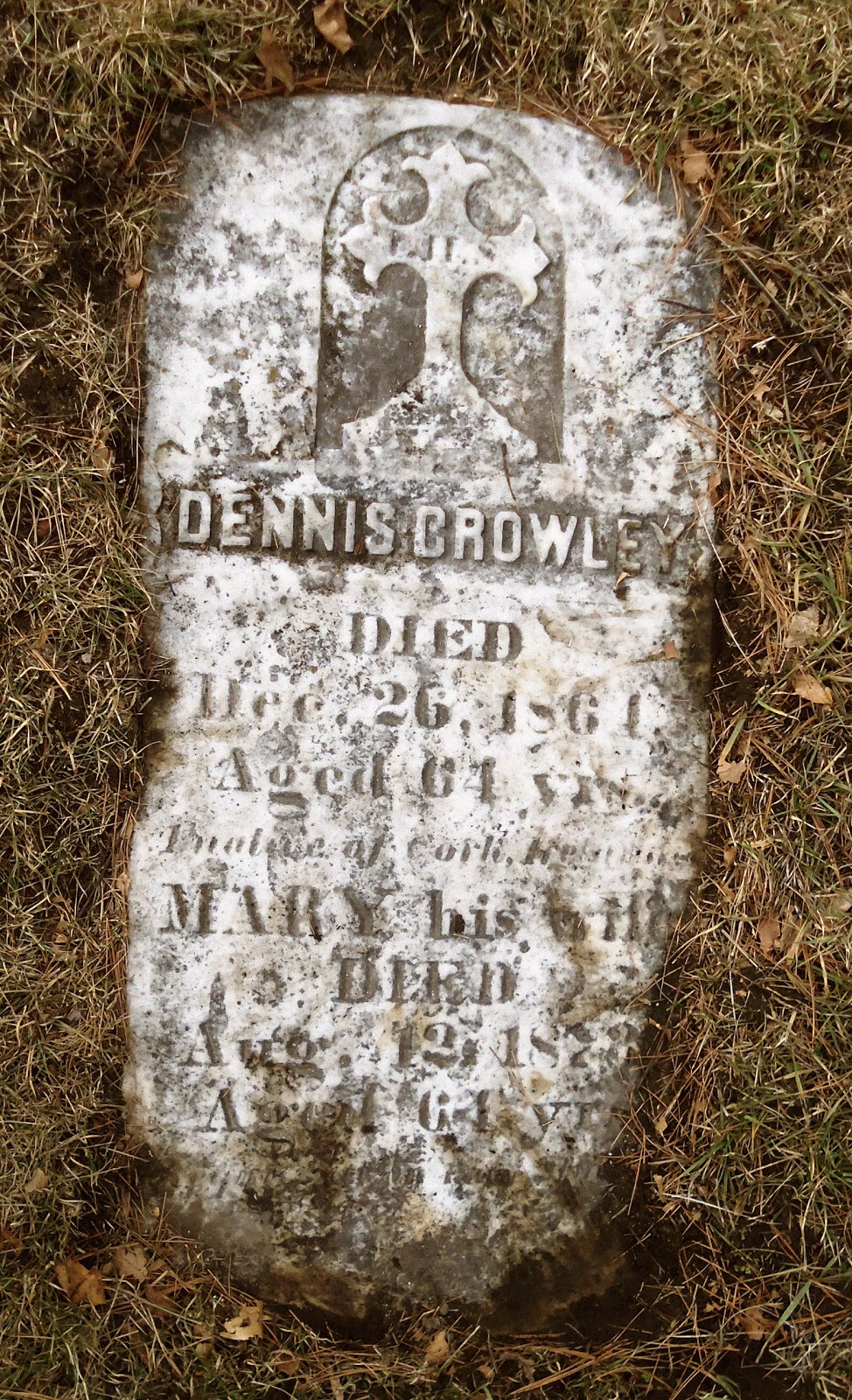
Just after Christmas in 1864 Denis’ heart failed on him.  The doctor listed his cause of death as dropsy, congestive heart failure.  The man who brought so many of Lowell ‘s early Irish to their final resting place in Charlestown and South Boston was brought to Yard One in St. Patrick Cemetery  along with the other Irish pioneers who were laid to rest.  A small marble stone was erected.  Mary would remain another eleven years in the family home on Broadway Street before joining her husband of almost forty years. 

Sunday, June 19, 2011

Gathering Data

I tend to get obsessed easily.  One of my obsessions used to be with eBay.  Luckily I have gotten it under control.  Oh it started rather simply with Lowell postcards.  From there I got into heavier items like advertisements of Acre businesses.  Then I started noticing that I was betting on items I already had.  Those of you who are "collectors" probably empathize with what I say.  Things are in better control now, but recently my old demons came back to haunt me.  In a moment of weakness I went to eBay and what did I find, but a deed for a parcel of land in the Paddy Camps!!!  I lost control.  My initial bid was a simple $10.  It quickly went to $20, then doubled and doubled again.  Before I knew it I was pushing the "confirm bid" button for $110.  For those of you who know me, I need you to promise you will never share this info with my wife.  I simply left off the last zero when I told her the price.  But it's mine, and it's a beauty.

Which leads me to the topic, where was the Paddy Camp?  More correctly it should be where were the Paddy Camps?  The Camps were "probably" (Please note every time I share new information I now say "probably'"  That's what you get for hanging around archaeologist.) in several locations, likely on Lowell Street, possibly near Merrimack Street,  probably on St Pat Church property.   There is an interesting case that went to the Supreme Court on who owned the land, the Irish squatters or to whom the deeds were passed.  Soon many of the "camps" grew and merged.  So if you're looking for one definite location- sorry.
The Dig this summer may uncover more of the story.

Thank goodness we have some careful readers.  The date for an initial cemetery walk to search for Civil War graves was incorrect.  The correct date is MONDAY, JUNE 27TH AT 9 am.  Again be prepared for heat, walking, and being frustrated.

Lastly, another passing to report of another Lowell historian, Catherine Goodwin.  Many, many years ago Catherine and John were good enough to take me under their wings and walked St Pat's Cemetery with me.  They helped me see the work that had to be preserved.  A couple of months ago Catherine asked if I would promise to do a CW tour of St Pats.  She told me it wouldn't happen for a while, but she wanted me to promise her it would be done.  The work we are doing now in the CW search is all because of her and her insistence that the Irish be recognized in Lowell's Civil War cemetery.  Requiescat in pace.