Showing posts with label Bunker Hill Cemetery. Show all posts

Friday, January 20, 2012

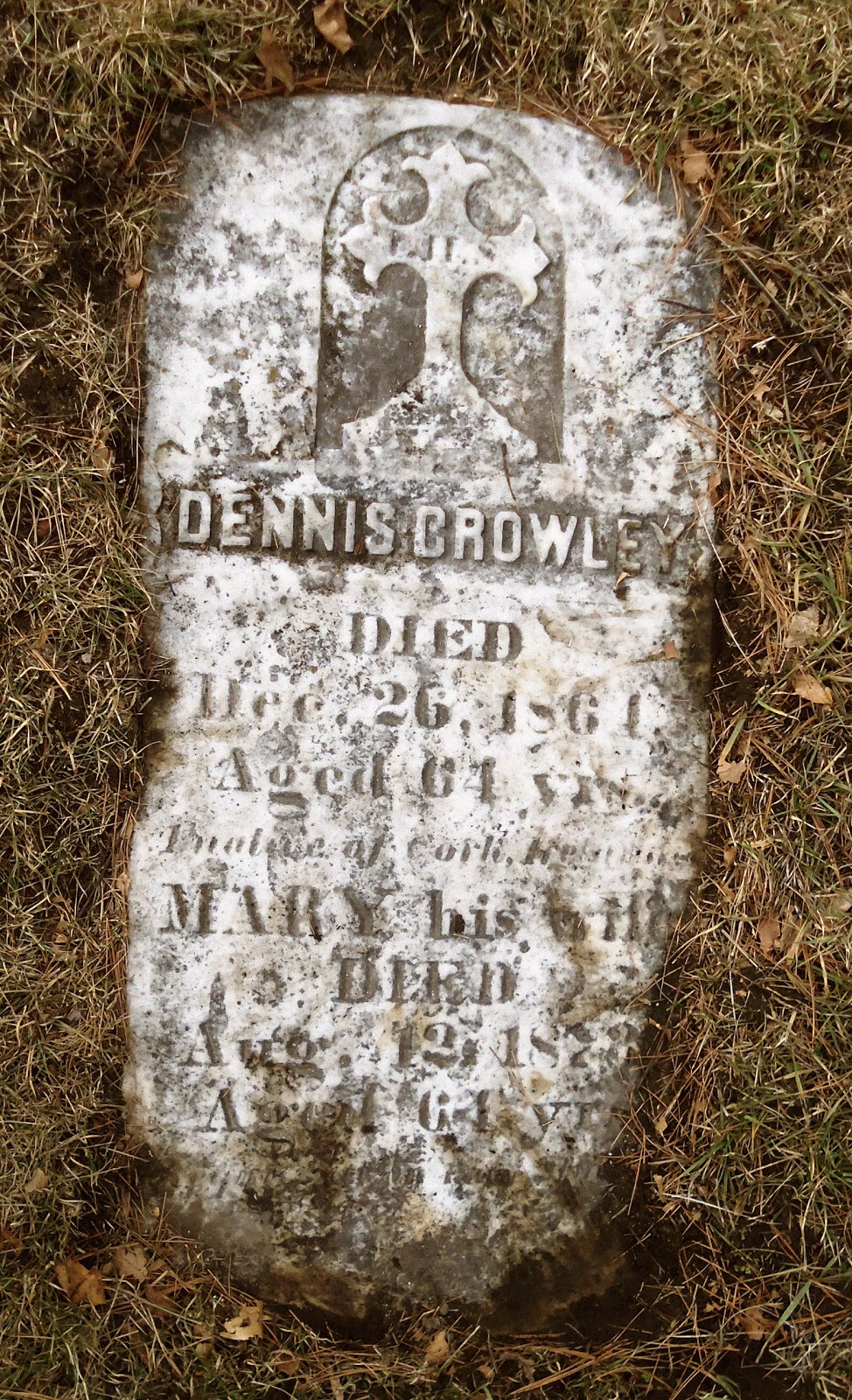
Denis Crowley & The Rocky Road to Boston


The trip between the towns of Lowell and Boston was a long one, about 45 miles.  Driving it along mostly unpaved roads that were dusty in the summer, muddy in the spring and fall, and frozen in the winter, made the journey arduous no matter what season you were called on.  And if he was carrying a double or triple load, well that just made Denis Crowley’s day.  Sure there were some places where the road was paved and even cobble stoned, but that was the exception. Work was work; it paid the rent. Besides he was performing one of the corporal works of mercy.  Surely the good Lord would look kindly on him when it was his time to meet his maker.  You see it was Denis Crowley’s calling to bring Lowell’s Irish Catholic departed to the consecrated, burial ground of St Augustine’s Cemetery in South Boston.  Sometimes he would have to continue on and drive his wagon up the hills of Charlestown all the way up to Bunker Hill Cemetery where Irish Catholics were just given permission to bury their dead by Boston’s city fathers who had denied burials to Catholics.
Born around 1800 in Cork, Denis left the home of his parents David and Joanna Crowley to travel  to America about 1820.  This makes him one of the earliest pioneers to come to Lowell.  It was in Lowell where he met and fell in love with Mary Connolly, another Irish immigrant.  They filed their intent to marry in Lowell in October of 1827.  The ceremony may have been performed on one of Father Mahoney’s trips to the Paddy Camps in the town of Lowell, since it would be another decade almost until a permanent church would be built.  Mahoney tried to visit once a month to say Mass, baptize babies, marry couples, or pray for their dead.  The good Father would then get back on his horse to continue to the next mission.  At this point the Diocese of Boston covered Massachusetts, New Hampshire, and Maine, along with the Indian settlements in the far north.  All of this territory was ministered by a handful of priests.  If the ceremony wasn’t performed in Lowell, then Denis and Mary may have made a trip into Boston to be married at Holy Cross. 
But Lowell remained his home throughout his life, specifically the Acre, to be more exact in all the records that remain, Denis never moves more than a block away from St Patrick Church.  It may have been on one of these long trips into Boston that he decided to raise his status in the Paddy Camps by white washing his house.  This action made such an impression on the Yankees of the town that it was recorded as a practice other “Kelts” might follow, which they did.  He listed his occupation as a laborer and later ended up working at different corporations and then the Lowell Machine Shop.
The Crowley home must have been hive of activity, not only with the eleven kids Denis and Mary had, but with all the Crowley relatives that would spend time with them.  Census records show a number of possible Crowley relatives that remain close neighbors throughout his life.  One of Denis’ children becomes the Hon. Jeremiah Crowley Esq., who has his own special role in Lowell history. 
Just after Christmas in 1864 Denis’ heart failed on him.  The doctor listed his cause of death as dropsy, congestive heart failure.  The man who brought so many of Lowell ‘s early Irish to their final resting place in Charlestown and South Boston was brought to Yard One in St. Patrick Cemetery  along with the other Irish pioneers who were laid to rest.  A small marble stone was erected.  Mary would remain another eleven years in the family home on Broadway Street before joining her husband of almost forty years. 

Friday, December 30, 2011

Roadtrip!

What would 2 red blooded American males do on a day off?  Why go cemetery hunting of course!  Walter Hickey and I (along with my daughter, Cait) took off to find more of Clan Cummiskey.  First we drove to St Francis de Sales Church in Charlestown.  How the good people of Charlestown negotiate the hills I'll never know.  On top of that, most of the parking is residential only.  The cemetery is usually locked, but the folks at the Catholic Cemetery Assoc made the contact to St Francis to have it open.  Sometimes in doing research you find folks don't open their doors too wide, but not in this case.  I am really grateful for their cooperation.  Once we climbed the hill there was the church sexton waiting for us.  He could tell Walter and Cait were out of breath (not myself since I am in tip top condition).  He smiled when he informed us the cemetery is on the other side of the hill.  So what goes up, must go down, and then back up. 


Our quest was to find James Cummiskey.  All evidence says that James might have been Hugh's brother.  The entrance to the Cemetery has a beautiful Celtic cross that is at the head of the field of stones.  Looking over it we knew we had a daunting task to find James.  The saints must have been guiding us for exactly where we stood was James Cummiskey.  The stone was slate with the traditional willow pattern.  He's buried there with his wife, both "from the parish of Dromore, County Tyrone."


The Cemetery is is in back of the church.  It is wonderfully maintained with respect for those who rest there.  Originally, it was the encampment for the "Brits" during the Battle of Bunker Hill.  As someone who has spent a lot of time in old burial grounds, this place was a gold mine.  Almost all the stones are upright and legible.  One of the first items we noticed was the varied types of slate used compared to our area.  There went very light to dark grey tones.  The next point of interest was the style of carving.  You can actually tell the carver since each developed his own style.  The Charlestown carvers carved their lettering much deeper than the carvers in Lowell, such as Warren and Day.  One line repeated itself on a number of stones A Cary Fecit (A Cary made this.)  A good number of the stones had the identical icon of IHS with some decoration under.  This was obvious as stone after stone appeared the same, but then the carver used some very unique stenciling not seen anywhere in our area.  The sunburst was another motif used throughout the cemetery.  One stone I've never seen before was a lamb on slate material.  The carving needed to do such, had to be made by an expert hand.  I had a personal interest in finding any shamrock stones on slate.  To this date St Pat's appears to be the only such examples anywhere on either side of the Atlantic.


The trip down to the car was a lot easier than the way up. With time on our hands we made our way to North Cambridge Catholic Cemetery to find another Cummiskey, Captain Hugh.  Like St Pat's, Cambridge tells a story.  The Cemetery is a heavy mix of old stones next to new.  The mid-nineteenth century Irish names evolve into Italian and then a mix.  Where to begin?  I stopped the car, looked to my right, and there he was.  Providence once again pointed the way.  The grave is that of boat captain Hugh Cummiskey.  He makes quite a name for himself in guiding boats through the harbor and shipping.  Another native of Tyrone, was he a cousin?  Research cannot tell us anymore- yet.  But in this journey surprising things have turned up.