Showing posts with label The 1800s. Show all posts

Wednesday, October 8, 2014

When the Battle is Over


Major Donovan's monument,
St. Patrick Cemetery
What happens when the flags are furled after the last battle?  When the victor returns home to the cheers of family and friends?  When the last four years have been filled with blood and battle and you’re expected to return to the life you knew before?  What happens?

When the news that soldiers from the 6th Mass Regiment had been attacked and killed by Confederate sympathizers in Baltimore in April of 1861 the citizens of Lowell rallied to the cause of the North.  The first to do so were a band of Irishmen who formed the 16th Mass.  Before marching off to war, the soldiers attended Mass at St. Patrick church.  When the host was elevated at the time of consecration the officers withdrew their swords from their scabbards to salute the sacrament.  The men were then marched to the train depot where they would meet their fate.  Of those who served in the Sixteenth, 150 officers and men would be mortally wounded, along with 93 who would die of disease.  A few would have their remains returned and interred in the consecrated ground of St. Patrick cemetery, most would not.  This was the story of one who served and returned.

Matthew Donovan would eventually achieve the rank of major, but not before enduring bloodshed, imprisonment, and disease.  Born in Ireland in 1830 he appears in Lowell about 1850 as a housepainter.  Father Timothy O’Brien witnessed his marriage to Ellen Rowe in 1852.  Soon there were 5 little Donovans, including a set of twins.  The growing family moved from place to place along Broadway and Lowell Streets.  Perhaps it was to accommodate the growing family or the financial need, but the movement was almost yearly.

When the call for soldiers to defend the North was made just after Baltimore, Matthew was among the first to enlist.  His Civil War career included battles at Fair Oaks, Second Bull Run, and Spotsylvania.  He spent months in a hospital in Annapolis, probably from wounds he received at Fair Oaks or from one of the camp diseases that spread so quickly.  His account of the 16th’s engagement at Gettysburg tells much about the man.  He told of hours of doing nothing, looking for a place to let his men bathe, and waiting for the inevitable as more and more troops filled the town.  The 16th was in charge of protecting the Emmetsburg Road.  They dug trenches and at times hid in the woods as they were often shot at from different sides.  Eighty-one men of the 16th were lost at Gettysburg.  On the 4th of July he reported that the enemy went “skedaddling.”  On another occasion Donovan had to write home to the family of a Lowell soldier, Private Barry, who died in Donovan’s arms with his last words being, “Tell my mother I die a brave Union soldier.”    Newspapers reported that Donovan spent an extended period in the hospital after the Spotsylvania campaign.  He’s mustered out in 1864, before the war ended.

Upon his return to Lowell he attempted to reopen his house painting business and met with limited success.  He turned to a trade that had shown success for many of his fellow countrymen- liquor.  Just after the war he opened a restaurant and referred to himself as a “restorator,” using the vernacular of the day.  He also became involved in local Republican Party politics and started accepting small city appointments, such as surveyor of highways.    He became well-known at political conventions and became a “chief officer” for the Fenian Brotherhood, an Irish republican group with hopes of freedom for Ireland.

If he wasn’t busy enough he maintained a position in the Sergeant Light Guards, a local militia group.  He was present at every muster and parade the group has and was named commander.  He took a prolonged trip back to Ireland, accompanied by a friend, the purpose being started as “business.”   What kind of business was not mentioned and the trip was extended to the point where the Light Guards was disbanded due to its “officer” not being present and uniforms and arms not being maintained.

But Donovan’s story does not end here.  While he was keeping this small place for serving meals on Merrimack Street, he also started serving and then selling liquor.  The liquor laws in Massachusetts vary over the years, but there were strict rules as to when and how much alcohol could be kept or sold.  Donovan was arrested at least 10 times between 1865 and 1873.  He was fined hundreds of dollars, which would be a great amount at the time, but he reopened and continued his sales.  He was even put in jail several times for days and even weeks, but still he persisted.  One wonders what his family would do during this period.  Interestingly his name appeared more than any other in the arrest records of constables seizing or fining him on the spot.  He was not alone, and a few other names were mentioned again and again.  Just before his death an investigation was put together questioning why the same names appear and asked if all the money that was given as a fine was returned to the city.  This does not stop Donovan and he was once again fined and imprisoned.  As soon as he was released he was marching in the GAR parade, toasting at the St. Patrick’s Day banquet, and most amazingly, the city continued to grant him his yearly liquor license.

In December of 1873, while speaking to a friend, he offhandedly said he felt he would die quickly, and he did.  At age 47 he was found dead in his bed.  Cause- heart disease.  He was carried to his grave by his fellow GAR members, the Knights of St Patrick, and the Lowell Coronet Band, whom he sponsored.  His marker bears the kepi and insignia of the 16th Mass. with the epitaph, “Life’s battle is o’er.”

Thursday, August 21, 2014

Ship Fever!


The headline in bold type must have stunned the citizens of Lowell.  If you lived in 1847 you probably knew that more than half of those who contracted ship fever never survived.  The disease made no preference as to gender, age, or economic status.  It took whomever it met, and its effects were swift and agonizing.  It would first appear as a rash on the chest accompanied by a high fever, often reaching 102 degrees.  As it progressed victims would fall into delirium and most often death. 
The disease was transferred so quickly by means of the common body lice.  In the 19th century lice were common to many people, but it was also known to be found more so in places of crowded conditions and poor hygiene.  If there was one group that could be pointed at as those spreading the contagion it was the Irish.  The disease was more appropriately known as typhus, but to use the terminology of the day it was better known as Black Irish Typhus.  The term would ensure that those immigrating on ships and the Irish population would be associated with squalor, disease and death. 
The year the article appeared, 1847, was no accident either.  In the Irish diaspora, 1847 was better known as Black 47, the worst year of the famine.  Between 1835 and 41, the port of Boston saw about 10,000 emigrants from Ireland.  Just in the year 1846 there were 65,000 entering the same point.  Cities like Boston and Lowell saw the effects of such an increase in the population.  Many of the ships which would carry those escaping the Famine were not meant to carry passengers.  They were converted freighters where profit was based on how many souls could be fit into a limited area.  Often planks were placed just above the bilge water giving a breeding ground to all types of germs.  The crowded conditions, unclean water, and lack of food made for a perfect storm.  They became known as Coffin Ships.  Those who were able to obtain passage on a ship leaving Great Britain were not guaranteed a successful journey.  It is estimated that approximately 5% of those who crossed the Atlantic died at sea, and a full 16% of those who crossed died shortly after from all types of diseases, ship fever being among them.
A moving account was published by a British lady who was on such a ship.  With him we endured a trip of four months from Queenstown to Castle Garden, and with him we endured three, months' quarantine for ship' fever in New York harbor. Halfway over we stood with him, a lad often with his little brothers and sisters, about the body of the poor mother who had succumbed to the fever leaving her five babies alone in mid-ocean. With him, we looked curiously at the unrecognizable figure secure in its canvas wrapping, a bag of sand tied to the feet. It lay on a plank, which supported by two sturdy seamen, rested on the gunwale.  With him we heard the droning voice of the captain reading the burial service, and like the little lad failed to realize the full significance of the proceeding until we, too, hear a splash in the water below. For moment the mother's body bobbed u and down on the waves, then obedient to the bag of sand attached to the feet, sank. A few bubbles, a little heart-rending cry of “Mamma! Mamma!" from the eldest sister who stood with her baby brother in her arms, and all was over.   The orphans turned their eyes westward to this Land of Promise, and the old wooden vessel with its flapping sails proceeded on its way.

When the headline appeared in the Lowell Courier it was very clear to the reporter who was to blame.  Surely it was because of the great influx of immigrants which has taken place in Lowell.  There was even a case of Lowell’s Mayor finding an infected person on his doorstep, and another case of an infected man being stranded alone in his home by his own family when hearing of the diagnosis.  To demonstrate the deep fear people had of ship fever the reporter wrote of a supposed visitor to Lowell who stopped at a local hotel on his way to Boston.  Having heard of fever in the city, he reportedly left the next day after hearing a funeral pass by the hotel every ten minutes.  The funerals were merely carts removing night soil (waste) during the hours of darkness.

There were attempts to curb the illness by quarantining ships for up to 20 days to stop the spread of new arrivals infecting the population.  Places like Grosse Isle, Quebec with their 5000 burials and Deer Island in Boston Harbor with 1000 Irish burials were built for such a purpose.  In Lowell the plan was to use the pest house on Chelmsford road.  Typhus, as Ship Fever is really known, was not new to Lowell.  There were waves of it before the Famine Irish came and waves for many years after until living conditions improved.  Earliest records record the disease passing through entire families and neighborhoods.  Through burial records, it can often be traced moving down streets taking its victims.  Though reports of its occurrence continued through the rest of the century, nothing would parallel Black 47.

Monday, August 11, 2014

Lives of Service- the Plunkett Family of Lowell


The Plunkett Family
County Mayo, Ireland to Lowell, MA
Rosemary K. Nunnally
 
Many are aware of the large, high cross on the path to the chapel of St.Patrick Cemetery.  Each marker tells a story of someone's life, their times of joy and sadness, beginnings and ends.  The Plunkett family of Lowell represent a life of serving their community and honoring their heritage.  This week's blog is another story of a life to be remebered by guest blogger, Rosemary Nunnally.

Remains of Castlemore House, Co. Mayo
The Plunkett family has a very, very long history in Ireland.  The family has been documented back hundreds of years in the book Irish Pedigrees by John O’Hart.

 In about 1825 in County Mayo, Joseph Plunkett of Castlemore House, Ballaghaderreen married Frances French, the daughter of Edward French, Esq., of Bella, near Frenchpark, County Roscommon.  Joseph Plunkett was a Justice of the Peace and proprietor of Castlemore House.  During the 1830’s and 1840’s the Plunketts had several children: Walter, Joseph Jr., Francis Charles, Arabella, Frances, Ann and Mary.  It appears they led a comfortable life.

As with many Irish families, some event prompted several members of the Plunkett family to leave their home and come to the United States.  Perhaps it was the death of Joseph Sr.  Between 1855 and 1865, Mrs. Plunkett and her children Fanny (Frances), Mary, Joseph, and Ann Cavendish along with granddaughter Agnes Cavendish were living in Blackstone, MA.  Joseph and Ann worked in the mills there.  Daughter Arabella remained in County Mayo, married to Dr. A. Dillon.  Francis Charles also stayed behind attending medical school.

The Plunkett family had relocated to Lowell, MA by 1865.  Joseph and his sister Ann again worked in the mills while 65 year old Mrs. Plunkett stayed home with grandchildren Agnes Cavendish and
Joseph McGinnis. 
 
Several members of the Plunkett family chose a medical profession.  Francis Charles Plunkett, born 1844, studied at The Schools of Surgery, Royal College of Physicians in Dublin for medical training.  Francis apprenticed with his sister’s husband, Dr. Andrew Dillon.  When Francis completed his medical training, he came to the United States.  From 1859 to 1862 he was an apothecary while he was a private with Co. A, 2nd Battalion, NY Volunteer Infantry.  In 1862 he opened an account with the Emigrant Savings Bank in New York.   Francis worked in Washington D.C. as an acting hospital steward and apothecary at Camps Barry, Duncan and Meagher.  He became involved in the fighting of the Civil War in November of 1864 and was an Assistant Surgeon with the 183rd Ohio Volunteers.   After a year of service, Dr. Plunkett went to a hospital in North Carolina and then the Invalid Corps in Washington, D.C.   In 1866 he came to Lowell to join his family members.

Dr. Francis C. Plunkett started as an apothecary and quickly built up a medical practice.   He was on the original staff of St. John’s Hospital in Lowell.  He married Alice Martin in 1869.  She died a few years later.  Francis remarried Mary Ann McDuff in Nova Scotia in 1876.  They had a son Harry and two daughters Frances and Florence. In most newspaper accounts and records he is referred to as “Dr. F. C. Plunkett.”

Along with his steady work as a physician, Francis was involved with the Lowell community.   He was active in public and charitable affairs.  He was a member of the Board of Aldermen, president of the North District Medical Society and a member of the City Hall commission.   When Charles Stewart Parnell, President of the Irish National Land League, came to Lowell in 1880 he stayed at the home of Dr. Plunkett.
Chief Marshal of the Columbus Day Parade
Joseph Plunkett first worked in the mills of Lowell as a wool sorter. When Dr. F.C. Plunkett came to Lowell, he was an apothecary (druggist). However within a few years, Joseph was now the apothecary in the family.  Maybe Francis turned this business over to Joseph as he became a leading doctor in Lowell.  Joseph was a well-known druggist for over twenty years.  His shop was on Dutton Street at the corner with Market Street.  Joseph did not marry and lived with his mother and later with his brother on Worthen Street.

As opposed to his civic minded brother, Joseph did not participate in that aspect of life in Lowell.  His obituary in the Lowell Sun on May 18, 1897 said “He was not identified with any societies and considerable of his time was spent in travel.”  Joseph’s funeral at St. Patrick’s Church was largely attended.  He was buried in the family grave at St. Patrick’s Cemetery.  He was 62 years old.

 Francis Plunkett suffered a stroke in 1894.  Though he could no longer go out to make house calls, he kept part time hours with patients coming to see him at his home and office at the corner of Worthen Street and Broadway.


In August of 1899, Dr. Plunkett put a new monument on the family grave in St. Patrick’s Cemetery. The Lowell Sun put a drawing of the stone on the front page of the newspaper.  The Sun commented that it was “a very handsome monument …. The Celtic cross is very pretty and the workmanship perfect”.  Sadly in just three months, Dr. F.C. Plunkett passed away and was buried under this cross.
Lowell Sun Sept. 2, 1899                      
Dr. F.C. Plunkett’s funeral was held at St. Patrick’s Church on December 1, 1899. The Lowell Sun reported the following – “All day yesterday and last evening people from all parts of the city visited the house of mourning at the corner of Broadway and Worthen streets to look for the last time on the face of the deceased, for whom they held the highest respect…. The funeral was very largely attended by sorrowing relatives and friends of the deceased.”  The Journal of the American Medical Association, Volume 33, 1899 reported “With the death of Dr. Plunkett there passes out of view one of the most remarkable physicians ever known in Massachusetts. Though not known as a writer, on account of the demands of an enormous practice, he was a man of deep culture and versatile accomplishments.”

Dr. Plunkett’s son, Harry B., was born in Lowell on September 3, 1877.  He followed in the footsteps of his father and uncle and chose medicine as his profession.  Harry attended Fordham University and graduated in the class of 1906 from Kentucky University School of Medicine. He was a staff member of the hospitals in Lowell.  Later he was a doctor at the Tewksbury State Hospital specializing in tuberculosis and psychiatry.  Dr. Harry B. Plunkett died on February 10, 1950 and is buried in the family plot at St. Patrick’s Cemetery. 


Wednesday, July 9, 2014

The Irish Doctor


A number of physicians' names reoccur from time to time in the few records of Lowell's Irish.  One of them was a Dr. Green, a Yankee who ministered to the needs of the early irish community.  As time passed other names began appearing as well.  But Arthur Quinn Phelan was one of their own.  Here is his story brought to us by guest blogger, Rosemary K. Nunnally.  We greatly appreciate her contribution to recording the story of the Irish in Lowell and invite others to submit their stories as well.  Every family has a story.  What is yours?

Arthur George Phelan from the report on his funeral.
Published in the Lowell Sun on August 23, 1897.
Irishman Arthur Quinn Phelan, M.D. ministered to the needs of the citizens of Lowell, MA in the later part of the 1800’s.  His obituary in the Lowell Sun on January 11, 1890 said this: “Dr. Phelan was a gentleman generally beloved and respected. He was modest and retiring and relied entirely upon his worth as a gentleman and a physician to build up his practice. To know him was to respect him.”  What was the story of this good doctor from County Cork?
The newspapers of Lowell were filled with stories of the accidents and difficulties that befell the working families of the city.  Several of these articles mentioned Dr. Phelan as the physician who assisted the sick or injured person.  On July 8, 1882, the Lowell Sun reported that Alexander Reed, aged 8 years, died Thursday night from the effects of a concussion caused by an exploding rocket on the South Common, during fireworks that evening.  Dr. Phelan, who attended him, gave his opinion that the death resulted from fright.  In 1884, seventy year old Mrs. Hannahan fell while leaving St. Peter’s Church.  Dr. Phelan assisted with her fractured thigh though it was doubtful she would survive the shock.  Mrs. Ganley was shot in 1886 and Dr. Phelan attended her.  On January 8, 1887 the Lowell Sun told the story of a boy named Rolly who had his hand caught in the gearing in the Prescott.  One of his fingers had to be amputated with Dr. Phelan doing the service.
Arthur Quinn Phelan was born to Lanford and Mary Phelan in County Cork, Ireland in 1848.  He came from an affluent family.  Arthur’s uncle Robert Swanton was a landowner in West Cork.  Mr. Swanton was killed in 1881 after obtaining an eviction decree against a tenant during the Land War.  Arthur’s family was able to apprentice their son to Dr. O’Callahan, a leading physician in Cork.  Arthur went on to Dublin and passed the examination for the College of Surgeons of Ireland and was a pupil of Dr. Baxter for two years.
It is not known why Arthur Phelan left Ireland.  He came to Lowell in 1868 possibly with members of his family.  In the 1870 census, twenty-two year old Arthur was living with his mother and sisters, Ann and Elizabeth.  Arthur worked for Joseph Plunkett as an apothecary, a pharmacist, for a few years and then studied medicine with Dr. F. C. Plunkett.  Arthur next enrolled in the College of Physicians and Surgeons at the University of New York, graduating after 12 months on Feb. 15, 1876.
Dr. Phelan returned to Lowell and opened an apothecary shop at the corner of Summer and Gorham streets.  He was so successful in his practice of medicine that he sold the apothecary business and opened a medical office in his home on Gorham Street.  Arthur enjoyed a busy life with his wife Mary Malloy and three children – Arthur G., Mary and John.
As a dedicated physician, Arthur was on call for his patients all day, every day; in all conditions; for all ailments and illnesses.  In the winter of 1889 – 1890, the inhabitants of Lowell were suffering with “the grippe”, today called influenza.  Dr. Phelan’s services were in such great demand that he could not rest, even when he contracted the disease.  He showed signs of pneumonia.  Four days later, another physician was called.  Arthur Phelan died that afternoon on January 7, 1890 at age forty-two.
The Lowell Sun reported on Dr. Phelan’s funeral at St. Peter’s Church. The church was almost filled with the friends and relatives of the deceased.  Over 100 members of Court Middlesex Ancient Order of Foresters attended along with delegates from Division 2, Ancient Order of Hibernians and the Massachusetts Medical Society.  The funeral cortege was quite lengthy.  Arthur was buried in the Catholic cemetery, St. Patrick’s in Lowell.

Following Arthur’s death, his wife and daughter carried on as pharmacists in Lowell for over twenty years.  Arthur’s son, Arthur George, died of tuberculosis at age 22 in 1897.  Son John became a civil engineer.  By 1920, the census recorded daughter Mary married to James Monaghan and living in Waltham, MA with her mother in the same household.  John Phelan was living in Washington D.C. and worked for the War Department as a civil engineer.  He had married Emily Matter and had a son John J. Phelan, Jr.

St. Patrick’s Cemetery in Lowell has only a record of son Arthur George’s burial in 1897.  However there must be other family members also buried there.  Dr. Arthur Phelan bought the large plot in December, 1873 presumably for his mother who died in January of 1874.  There is no stone on the large grassy space.

Wednesday, July 2, 2014

"Killed by a Blast" Patrick Tiernan July 4, 1840


Patrick Tiernan's stone,
St. Patrick Cemetery
How you prepared to celebrate the Fourth of July probably had a lot to do with the kind of family you came from.  Many of Lowell’s citizens made their way to rum shops to fill their stoneware jugs in order to toast the day.  On the other extreme was the Cold Water Army who had taken the pledge and had chosen non alcoholic beverages as their drink of choice.  Those who were more interested in politics were reminded to wear their Harrison badges to any festivities.  Many of Lowell’s citizens were taking carriages to Concord’s sacred battleground to see the giant parade, hear the Declaration of Independence being read, and then partake in a free supper.
Those who stayed in the city had to find their own ways of celebrating.  While many would spend that Saturday gathering with family and friends, others created their own entertainment.  Some liked to celebrate by firing off pistols or firecrackers.  One tragic victim of the day was Patrick Tiernan.  The next day’s newspaper recorded the events.  A few boys and men got together and brought along a small cannon.  As youth would do, they loaded it with a double charge.  The cannon exploded and the shrapnel flew into the 16 year old’s face.  As period newspapers would do, the details were rather gruesome.  Half the boys face was torn off.  The eye socket and nasal area were exposed.  He lingered until the next day and died at noon.  He was taken to the Catholic Cemetery (St. Patrick) and was interred.
That is about all known about Patrick or his family.  Trying to find the rest of his family’s story has proven futile, not too amazing for anyone else trying to locate Lowell’s Irish in this period.  Interestingly his stone tells us most about him.  He was born in County Longford and was just 16 years of age.  He is one of the few to have a slate stone, most internments were either unmarked or marked with a wooden cross or marker.  Just as interesting, is that his stone is one of the few shamrock stones in the cemetery.  This leads one to believe his family must have had the means to purchase such a stone.  Adding to his family’s tragedy is what is included to the stone’s inscription.  Patrick’s 24 year old brother, Thomas Tiernan, died in New York just one week later.  No other details were added or are known.

NOTE: When we first started doing cemetery tours almost 20 years ago, Patrick's stone was in very good condition.  Unfortunately today it is broken into a dozen pieces with no hope of restoration due to cemetery policy.

Saturday, May 10, 2014

St Patrick Goes to the World's Fair - 1893


St. Patrick tapestry, St Patrick Church
February, 1893- Early in February, preparation was made for the exhibition of the children’s work at the “World’s Fair” held in Chicago.  The higher classes of the Parochial School and Academy of Lowell sent several elegantly bound volumes of specimens of class work- both written and illustrated.  Needlework and drawings were also a particular feature of our contribution.
The exhibit of the Sisters of Notre Dame was highly commended and at the close of the “Fair,” which lasted six months, a diploma and medal were awarded to fifteen of our houses in Massachusetts, Lowell’s parish and day schools being among the favored.     From the Annals of the Sisters of Notre Dame, Lowell, MA, 1893.

The whole country was abuzz about the news that Chicago would host a World’s Fair, also called the Columbian Exhibition, in order of the 400th anniversary of Columbus’ arrival in the Americas.  The city prepared by building over 200 buildings that would house the exhibits that would show the best of America.  As soon as news of the Fair was announced, Catholics around the country rallied that they should play an active role.  There was much being discussed about Columbus being Catholic and how Catholics helped build the foundation of the country.  This was also the period of massive European immigration and many of them being Catholic.  There was growing fear that Catholics educating their children in parochial schools was not American enough and possibly a plot for a Catholic takeover.  The goal of hosting a Catholic Educational Exhibit was one way of showing what was going on in the Catholic schools and how students were being prepared to be future citizens.  Even Pope Leo XIII gave his blessing to the venture.

The exhibit was shown in the massive Manufacturers and Liberal Arts building.  Catholics were given 10,000 sq. ft. to show the work of all the Catholic schools of the entire country who wished to send in materials.  Tables filled the area and every square inch of wall space was covered with artwork, illustrated manuscripts, needlework, vestments, musical pieces, and anything else that could demonstrate the viability of Catholic education.  Pieces of religious artwork were kept behind wire in fear of anti-Catholic vandalism.  To balance the religious entries, bunting and American flags filled any empty space.  A Chicago newspaper reported that the Catholic schools looked more American than the public schools.

As stated in the Sisters’ journal the girls of the academy at Lowell sent examples of their art and
written work.  A newspaper account stated that a certificate was received by the girls with much excitement at the close of the exhibit.  It showed a tell engraving and was signed by many Catholic dignitaries.  The Lowell community was accorded an extra commendation for their fine work.


Photos taken during the Chicago exhibition show one of the tapestries produced by the Lowell academy.  It is of St. Patrick shown as a bishop with crosier and miter banning the snakes from Ireland.  That tapestry is still in possession of the church.  At one time it hung in the rectory.  Hints of the scarlet red of his cope and emerald green of the landscape are still present.  Years of priests’


Photo from Fair, showing the St Pat's tapestry.
(SND Archives)
smoking and being open to sunlight have taken some wear.  The family of a former pastor thought it wise to reframe it with glass, not the best archival treatment for a tapestry.  It is one of the myriad of projects that awaits a benefactor to come to its aid.  A good cleaning and a new backing, and Patrick would be in fine shape.  Still he looks pretty good for being about a hundred thirty years old and having traveled to Chicago to see the World’s Fair!

Wednesday, April 23, 2014

The Schoolmaster & the Acre Boys

Samuel A. Chase
An interesting obit appeared in the Lowell Sun of 1904.  It was that of local businessman, Mr. Samuel A. Chase.  Mr. Chase had been ill for 4 weeks, but had retained his senses to the end, even being able to list those who should be pall bearers at his funeral.  Details, that we may conceive to be morbid, were not uncommon at this time.  What was more interesting was what appeared in the rest of the article.  There were reminiscences from local tradesmen and city leaders speaking of his work with finances.  But the most touching comments were by those who knew him when he first came to Lowell- his boys, more specifically his Irish boys.

Samuel Chase left his home in Haverhill, Mass and came to early Lowell in 1853.  He procured a position as teacher at the Mann School, which was opened in 1844 on Lewis Street, mostly for the Irish who lived in the Acre.  At this point in Lowell’s history several attempts had been made to have a sort of parochial school off and on with only minimal success.  There were further attempts at “Irish Schools” where the priests had some say over the hiring of teachers and approval of texts.  This agreement between church and city lasted several years until it again evolved into public schools we know today.  The Mann School maintained a very high population of Irish boys from the Acre.  Many of the Acre girls left the Mann School in 1852 when the Sisters of Notre Dame opened a school for girls, which would become Notre Dame Academy.
The fame or infamy of the Irish boys was well known throughout the city and needless to say the young Mr. Chase when he took the position of teacher at the Mann School.  The reputation of the school was described as “tumultuous.”  To say the Irish boys of the Acre were known for their rowdiness would be an understatement.  More than one new teacher’s career was crushed after his experience at the Mann School.  Discipline had to be swift and severe. 
But the boys met their match in Samuel Chase, not through power and might, but by looking beyond their rough exteriors and seeing their potential.  Mr. Chase was a man of slight build.  He was not many years older than some of his own students.  He became their friend and they often returned after leaving the school to seek his advice.  Each year the school committee “examined” the schools.  On more than one occasion the “Acre boys” of the Mann were pointed out as exceeding the expectations of the superintendent and committee, even noting “they were not naturally inferior to other scholars.” He was a great proponent of music in the schools and included musical presentations for the committee and families who visited.  In 1869 the program for the committee included Johnny Whalen’s, “Finnegan’s Wake.”  And a “broth of an Irish boy,” Charlie McCue sang “No Irish Need Apply.”  Miss Ellen Bagley sang “The Drunkard’s Child” in a most excellent manner.  Eventually Chase was made principal of the school.  A later visit by the Committee noted how the students looked upon their school master with admiration.  His motto for his students was “Onward and Upward.”
He made it a point to visit the homes of his students in the Acre, and when needed he gave in Christian charity.  Upon his passing someone noted, he was “without pretence to a superior culture and in a school composed of foreign extractions most of whom are unrefined and poor, has gained a place so exalted .”  It went on to say, “Around the humble hearthstones of his pupils’ homes, humble benedictions are pronounced upon his name.”  “He won the hearts of the wild, untamed Acre boys and remained their friend.”  Many of those who graduated from the Mann under his tutelage and became the businessmen and politicians of the early 1900s credited him for their success.
His obituary closed with, “Such was Samuel A. Chase, the Acre schoolmaster, and as he now passes forth into darkness alone, the prayerful well wishes of thousands accompany him.”
Rest in peace, Mr. Chase.

Sunday, April 13, 2014

Holy Week at St. Pat's - 1890

Interior, St Patrick Church, c. 1900
Included in the parish archives are a few issues of a small magazine printed monthly by the parish called The Calendar. It gives interesting insight to the workings of the community and the way people worshipped at the turn of the century. Reading through the journal reminds one how little and how much things have changed in the last century.
The April 1900 issue focused on the rites and rituals of Holy Week. It was assumed every adult would show up for each of the liturgies. It began with the procession of palms around the church on Palm Sunday, continued with daily Mass and Tenebrae on Monday, Tuesday, and Wednesday, and the Triddum of Holy Thursday, Good Friday, and Holy Saturday services. If one attended each of the expected liturgies it could amount to 10 or more hours in church. A special note was made to the male parishioners. The parish priests had addressed certain male congregants about not fully participating in the ceremonies. They often stood down the back of the church or even outside the doors. The writer advised that males show follow the good example of the women by being more active participants. He continued that men should be taking the leadership role here and to not allow the women to outdo the men in piety. Warning was also given to some of the faithful who were arriving late and leaving early. Their comings and goings had been duly noted by the priests.
The Catholic bookstores were well stocked with small prayer books that contained all the prayers for each of the services. The price was a mere 50 cents and each parishioner was encouraged to bring his/her copy to church each day. Parishioners were also encouraged to bring their Protestant friends to services, but wait to answer their questions until later. The writer knew with certainty that many Protestants were just waiting for a personal invite to attend one of the services. It was the Catholic’s duty to remind their Protestant friends to keep silence and to forego answering questions until they are outside.
The tradition of visiting 7 churches on Holy Thursday was expected of Catholics. Each church would decorate an altar of repose where the Blessed Sacrament would remain overnight. Men from the Holy Name Society would keep vigil until dawn when the Good Friday prayers would begin. It became an unspoken tradition that each church would try to outdo the other with a bit of extravagance. The faithful were reminded when visiting not to just look at the flowers and candles, but remember that this was an opportunity for prayer. The writer also noted that some had begun taking carriages form church to church and that walking was the preferred way of traveling on such a sacred night. And not to forget that visitors should always approach the altar on 2 knees on such an occasion.
A last entry reminded parishioners that they were honored to have a piece of the True Cross imbedded in the altar stone of the main altar. It was an honor not given to many churches and was installed with other relics when the altar was dedicated in 1854. Its presence made being at St Patrick’s during the Triduum take on a special meaning. (Note: the altar of which the writer speaks is the altar presently located in the lower church. It once was in the upper church, but relocated after the fire of 1904.)

Sunday, April 6, 2014

April 6, 1822- Our Story Begins

SPECIAL EDITION!-  Over the last 2 weeks I've had a flood of emails from folks willing to share their stories or asking for a little guidance.  Bob Rafferty, creator of the video Made in Lowell, wished to mark this day, the anniversary of Hugh Cummiskey's arrival in Lowell with a special posting.

What is the most important day of the year to an Irishman from Lowell? No, there isn’t a punch line… unless you answered St. Patrick’s Day? If you did, then the joke is on you. Today, April 6th is the most important day in the history of the Irish of Lowell for it is the day that the first Irish set foot here. 

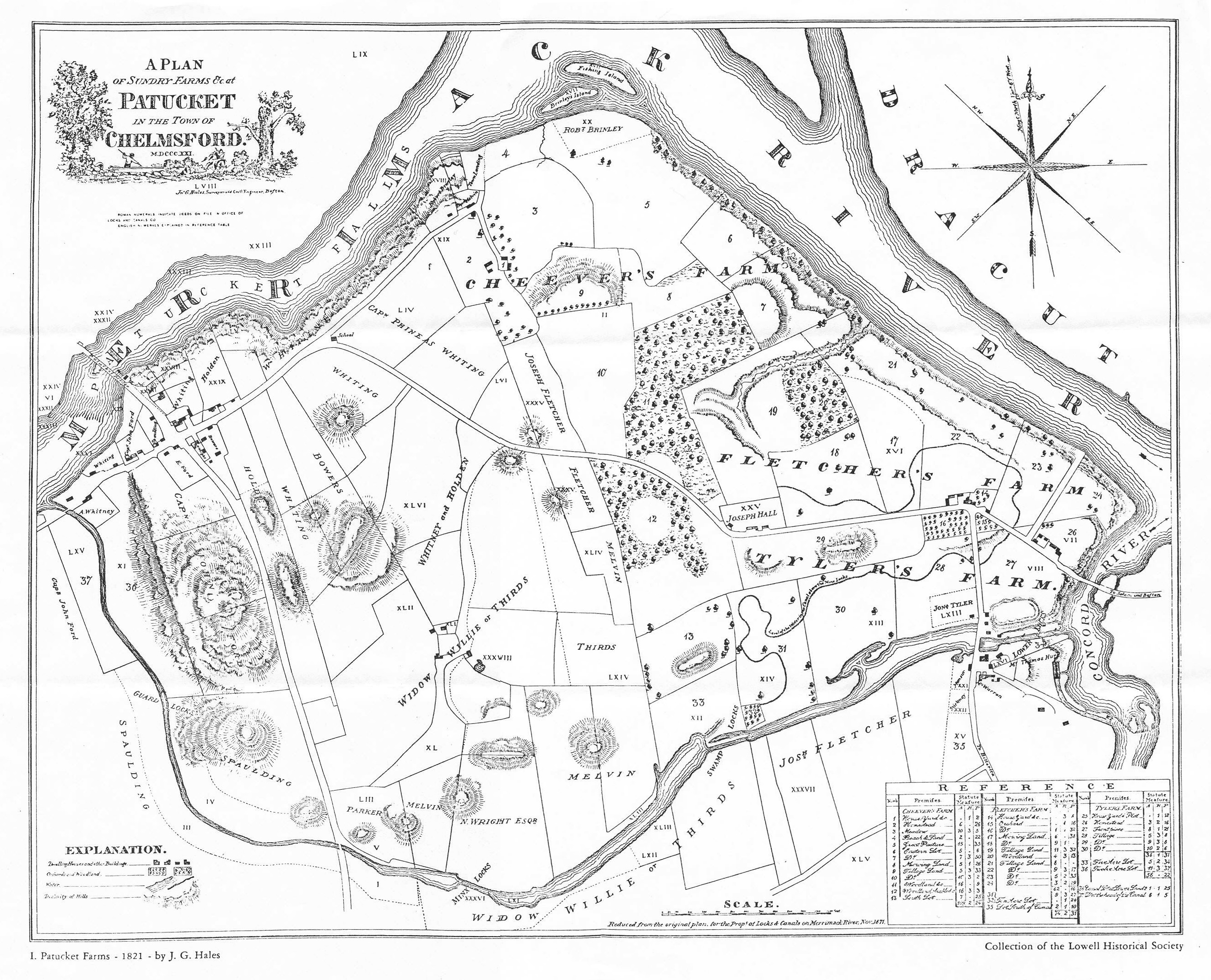
            Lowell was a much different place in 1822. For a start, it was named East Chelmsford. Most of the town was still covered by woods, swamp, and farmland. The Chelmsford Historical Commission has a lovely compendium of maps on their website (http://www.chelmsfordgov.com/CHCwebsite/Maps.htm) and this one from 1821 paints a clear picture of the land that Hugh Cummiskey and his thirty men arrived at on April 6th, one hundred and ninety two years ago today: http://www.chelmsfordgov.com/CHCwebsite/CHC_files/Map1821NorthEast.jpg


Hugh Cummiskey was a man’s man. In his early 20’s he departed his home in County Tyrone, Northern Island to come to America. He made his home in Boston where he met his wife Rose, and ran work crews on jobs that changed the face of Boston. Early records show him working on a project to help flatten Beacon Hill for the construction on the State House; a project that employed a horse drawn railroad to take the debris removed from the hill and use it to backfill a swamp and create Boston’s Back Bay neighborhood. In 1822, Cummiskey and 30 Irish laborers walked from Charlestown, MA to East Chelmsford, where they arrived on April 6th and were met by Mr. Kirk Boott, agent to the Merrimack Manufacturing Company. Boott and Cummiskey drafted a deal to widen and modify the canals that powered the Company’s mills. Take a moment and go back to that map. How many roads do you see? How many homes?  Buildings?  Establishments? You’ll observe mainly open farmland along a bend in the Merrimack River, and the 27 miles between Charlestown and Lowell was much the same. So imagine the walk that those 31 Irishmen took that day. They walked the edge of the Old Middlesex Canal, which had been built to move goods from the East Chelmsford (now Lowell) area to the seaport of Boston. The walk would have been dusty, and the men would have to be completely equipped with their own provisions. However, none of them were daunted by this.

            As a teen, a few friends and I got the bright idea that we were going to walk to Boston. Having ridden the commuter rail line to North Station, we considered the train tracks to be the most direct root so we filled our backpacks with bottled water and sandwiches and set out in early morning for a fun filled day in Boston. We hopped on to the train tracks at Red Bridge, behind E. A. Wilson’s workyard on Broadway, and off we went.  About 7 or 8 hours later we found ourselves at North Station…EXHAUSTED. We immediately bought train tickets home to Lowell, and slept the entire ride. We weren’t nearly the men that Hugh and his workers were.

Upon arrival in Lowell after their 27 mile trip (a marathon is only 26.2 miles) over rough terrain, Hugh and his men went immediately to work on the canals which would power the mills that made Lowell become the second largest city in Massachusetts. Employing the methods he had gained experience on in Boston, Hugh would lead his men to use the fill from the Suffolk canal to backfill swampland in Lowell… and if you’re reading this from an apartment in the Market Mills… that swampland was where your apartment building stands today…thanks to Hugh.   

Hugh brought water to the water powered mills of the American Industrial Revolution. He brought land were there was once swamp. His sweat anointed the land beneath the State’s Capitol building. And he was instrumental in bringing about the infrastructure of early Irish community in Lowell. So today, as you go about your day, lift a glass to those early Irish pioneers, and the man that led them here: Mr. Hugh Cummiskey.

Slainte!

Thursday, April 3, 2014

Mrs. Castle & the Know-Nothings


The Philadelphia Know Nothing Riot, 1848
“I know nothing.”  When a member of the Native American Party was asked about this semi-secret political group that was based on American nativism and anti-Catholic bigotry, that was to be his response.  “I know nothing.”  New England in the 1850s was fertile ground for such a group.  Too many immigrants.  Too many Catholics.  They infiltrated every level of government and Lowell was no exception.  Members of the Know-Nothings felt it their duty to purge America of foreign, especially Catholic, influence. 
Reading through the few accounts of life that exist of life in this period there is a story that keeps popping up.  It tells of when the Know-Nothings were in power and made themselves known in Lowell.  The year was 1854 and tensions were tight.  The Know-Nothings were known to make visits to convents and demand entry to see what atrocities they could find.  The Sisters of Notre Dame spent the nights in vigil waiting for the alarm to be sounded.  Men spent the night in the church tower keeping their eyes on Lowell Street for the mobs to be crossing the bridge which would lead them to the church and the convent.
It was a June night when their fears became reality.  According to one account that has been passed down to us, the crowd with guns and bayonets advanced upon the convent in martial order, followed by the mob yelling, shrieking and brandishing clubs and road tools.
On came the frenzied force, their shouts filling the air and penetrating the convent walls to the great terror of the sisters. The roar of the mob signified no mercy to the noble women whose lives were dedicated to mercy, and there seemed to be no hope. But in the meantime the news had reached a Catholic woman whose life was of less value lo her than her religion.
The woman in question was Mrs. Julia Castle (Cassell), wife of Henry Castles.  Putting a large rock in an apron, she called upon the neighboring wives, mothers, and sisters to follow her example, and soon full fifty women were massed in front of the convent gate, led by the dauntless Mrs. Castle. There they stood, shoulder to shoulder, right in the teeth of the advancing horde, each one firmly resolved lo let the infuriated Know-Nothings trample over her body ere the gates should be forced and the sacrilege consummated.
Leading the military company was a burly policeman, whose sworn duty was to preserve peace and order. He was some thirty yards in advance of the rest, his zeal in the cause having quickened his steps. When he pompously ordered the woman to make off and clear the way, instead of being obeyed as he expected, he found himself in the grasp of a pair of stout Irish arms, and felt himself lifted bodily ore the ground. The canal was nearby, but before the approaching mob could come up he was seized by the scruff of the neck and the seat of his trousers, and was flung into the slimy depths. The crowd halted in amazement at the audacity of the thing, and then, by one of those instantaneous impulses which sometimes turn the current of events and shapes history, the mind of the mob was diverted from its infamous purpose.  The sight of the half drowned wretch as he floundered and splashed in the reeking water ere he crawled up the banks, changed the yells of rage to shrieks of laughter, and gave men time to take a second thought of what they were contemplating. When old Mrs. Castle, her straggling grey locks unconfined, bade them come on and get treated to more drinks of the same tap, they turned about and slunk home. Had the convent been burned there would have been a bloody retaliation that night, and many who participated would have never seen the light of another day.
Stories tend to snowball.  They grow with each telling.  The above narrative was part of Mrs. Castle’s death notice when she passed away in 1887.  So did it happen?  There is an eyewitness who swears to her account.  There are other accounts; one written by a Sister of Notre Dame, and then the actual newspaper account from the period.  One can imagine Mrs. Castle telling her story year after year; her grandchildren sitting on her lap.  And with each telling, the story grows.
So what’s your story?

Friday, March 28, 2014

Benjamin Day's Workshop


Map- Lowell, 1850
Lowell Street (now Market Street) was a busy place in 1830s Lowell.  The arrival of the first Irish in the 1820s spurred a commercial boom in the area.  It wasn’t long before the tents and shacks of the first arrivals were being replaced by the shanties and ten-footers of the ever growing Irish population.  Soon alleys and makeshift walkways began defining the Acre neighborhood.  Lowell Street was at the heart of the hustle and bustle.  More and more hopefuls were arriving from all over and even across the sea in need of work.  With those increasing numbers, came the need for good and supplies. 

Lowell Mercury, 1830
Right on Lowell Street was Stephen Gale who sold stoves.  And there was Willard’s West Indies Dry Goods Store specializing in “pure and choice wines.”  You could have your clothes made at Hobb’s Clothes Ware-House.  Bethuel Cross sold crockery and China ware on Lowell Street.   The Exchange Coffee House, owned by Owen Donohoe, was a busy place for Irish and Yankee alike.  Mrs. Rice had a cottage just off of Lowell St. where she offered her nursing services.  Richard Walsh had his Catholic bookstore right across the street from the Rev. Mr. Blanchard’s house.  (Was it intentional that Walsh made it a point to advertise his Catholic business was located across the street from a Protestant minister’s home?)  There were a myriad of livery stables and harness shops as well.  Hugh Cummiskey, in partnership with Samuel Murray, had a West Indies Dry Goods Story on the corner of Lowell Street and Cummiskey Alley.  Almost all were Yankee businesses in these early days, but the Irish did have a sort of monopoly on one certain business.  Grog shops abounded in every basement along Lowell Street and all the little alleys in between.  On the weekends it was known that local living rooms transformed into saloons. At least that was the opinion of the local constabulary. 
If you kept walking down Lowell Street the shanties became fewer and father apart.  Heading towards the river, you might have heard the sound of stone being cut and carved.  You would have come across the workshop of Benjamin Day, stone carver.   Day had probably arrived in Lowell to set up shop as early as 1830 and started advertising his trade in the Lowell Mercury.  Previous to Lowell he established himself in Salem, MA.  His work could be found throughout Essex and Merrimack Counties.  Day’s workshop would have been on the corner of the present Salem and Decatur Streets.  Grieving families, looking to purchase a grave stone, would have gone to his shop and seen stacks of slates that had been precut, many with the iconic willow and urn pattern of Yankee New England, already carved.  The stones lay there awaiting the names and dates of the deceased to be added.  Day’s price also included delivery and setup at the cemetery.  With his shop within the Irish district, it’s not surprising a number of his stones can be found at St. Patrick’s Cemetery.  One can imagine families walking by his workshop day after day going to work or to shop.  At the time of a loss they might find a familiar face with Mr. Day, their neighbor. 
John Bork's stone w/ Day signature
Each carver had his particular style that he would call his own.  Stones can be identified by certain borders, finials, and stippling.  The earliest stone in Saint Patrick Cemetery is that of young John Bork carved by none other than B. Day.  Bork’s simple, small, slate stone with willow and urn design is typical of Day’s carving style.  A number of stones, slate and marble, have the name Benjamin Day name carved at the base, as was typical of his style.  The sad part is that most of the early slates have been snapped to lay flat in the ground and the signature of the carver is missing.  Even sadder is that the many shamrock slate stones in the cemetery, show great similarities to Day’s style, but cannot be proven to be his work. 
As the city grew other carvers such as David Nichols and Theodore Warren joined in to fill the need.  Benjamin Day kept his shop going for many years.  As historian, Marilyn Day states, Benjamin Day bought a lot at the Lowell Cemetery, but ironically no stone marks his grave.
For a great read on a history of Benjamin Day read Ms Day’s account http://www.pelhamnhhistory.org/library/pdffiles/day/benjaminday.pdf . 
I must add here that like many of you I walked Market and Salem Streets (Lowell Street) many times in my youth.  I was always struck by the old store fronts with the large glass windows.  They reminded me of a time past, and I wondered what shops had first sold their goods here.  Many of these businesses still retained the old entry to cellar ways in the middle of the sidewalk that were used to bring goods into storage.  A misstep could send you flying.  .  The storefronts had advertisements for fresh black olives and windows filled with pyramids of cans of olive oil from Greece.  Tournas’ had their trays of baklava and barrels of peanuts.  The neighborhood Hugh Cummiskey had known was transformed to one that represented those that came after him, and would change hands yet again.  When I got to the corner of Salem and Decatur there was an empty lot.  I often wondered about that lot.  After doing research for this article I found this was the site of Benjamin Day’s workshop.  I remember an old garage being in the rear.  Was this part of Benjamin’s shop?  Was the lot empty because of the stones left behind by Benjamin?  It’s nice to think so.

Sunday, March 23, 2014

A Tale of Two Daniels

One of the goals of this blog is to collect stories of Lowell's Irish past.  It's one thing for me to write little vignettes of happenings from generations past or my own Acre memories, but it is far more important we collect yours.  There have been folks who have shared their own stories, or stories from their families, but they are not as many as I hoped.  Everyone says they'll get to it at some point, but rarely does that happen.  Soon there stories will slip away and will be lost to the next generation.  We have a duty to preserve them.  Our recent documentary, shown during Irish Cultural Week, was made up of several folks who just shared a few moments of their time, yet added to our Lowell Irish history.

I'm reminded of Jack Flood, recently deceased.  He called me to sit with him so some of his stories could be preserved.  Smart man.  How about you?  Drop me an email.  dadumc@comcast.net  I'd be glad to sit down and chat with you.  I'll do all the work, you do the talking.  If that's too much, send me your story.  It doesn't have to be long.  If you like we'll publish it.  If you don't we'll just put it in the archives.

This week's entry is one sent in by a reader, Rosemary K. Nunnally.
Google image


Young Daniel Lawn, Jr. left County Donegal with his mother Mary and siblings Elizabeth, Michael, Mary Ann, Sarah and James.  They arrived in New York on October 11, 1880.   They traveled on to Lowell, MA to join the head of the family, Daniel Lawn Sr., who was working as a laborer.  The family settled on Summer St. with other Irish immigrant families.

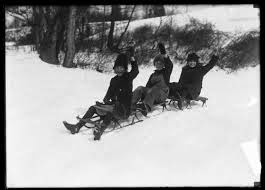
During the cold winter months, the children of the city entertained themselves with coasting, sledding on the South Common and on the streets of Lowell. The sleds they used were referred to as double runners. They were heavy and held several people. The sled could be difficult to steer with riders dragging their feet or jerking the sled sideways. Stopping the sled happened when it had played out its run at the bottom of the hill.
Ten year old Daniel enjoyed coasting. He left his home on a Friday afternoon in January of 1884 and made his way over to the South Common.  He probably went down the hill several times, walking back up to the top to start over again.
As the afternoon darkened into night, a terrible accident occurred. Daniel was hit by a sled. He suffered injuries which ultimately ended his life the next morning, January 26, 1884.
The Lowell Sun reported on the accident on the front page of the newspaper with the heading “Boy Killed By A Sled”.  The article went on to state “Daniel Lawn, residing at 25 Summer St., was run into by a "double-runner" sled on which boys were coasting on the South Common at 6 o'clock last evening, and died shortly before 6 o'clock this morning, notwithstanding the almost constant efforts of Dr. Phelan.”  Dr. Arthur Q. Phelan had his home and office at 4 Summer St. not far from where Daniel lived.

Daniel’s accident was also reported in the Boston Journal and Boston Daily Globe.  Both newspapers had a brief sentence explaining that Daniel had died from the effects of injuries from a coasting accident on the South Common.  Though there is no record of it, Daniel was most likely buried in St. Patrick’s Cemetery.  Daniel’s father, Daniel Lawn Sr., was buried there in yard 5F in 1902 and his mother Mary in 1912.

One hundred twenty-four years later in 2008, Daniel Lawn Jr.’s great great grandnephew, Daniel, went out sledding in a friend’s yard in the Belvidere section of Lowell. This Daniel also had a sledding accident.  Thankfully, due to improved medical care, the outcome of his accident was different. Though he had serious injuries to his face and mouth, Danny made a complete recovery. Separated by over one hundred years in Lowell, two young Daniels, two sledding accidents, and two stories to tell.