Friday, September 30, 2011

Will the real Hugh Cummiskey please stand up?

Hugh's signature as it appears on his naturalization record.

Sometimes I think I have a touch of OCD.  I remember once I read a Tony Hillerman mystery novel.  I was hooked.  Within a couple of months I had read every single piece the man ever wrote.  Did I stop there?  No.  I made a number of visits to Arizona and followed the route the main character, Jim Chee, followed.  My wife would wonder why I was driving out of our way to get somewhere, but I knew what I was doing.  Jim Chee rode this highway and stopped at this rest stop.

Just as I thought I've recovered from my addiction, Hugh Cummiskey pops up, or I should say Hugh CummiskeyS pop up.  Yes, you read it correctly.  I was sitting in Mahon's Hotel in Irvinestown.  The team was out at a local pub.  By this day every muscle in my body was crying out in agony so I snuck away to my room.  I came across a note we had made weeks earlier of a second Hugh Cummiskey, this one in Boston, but at about the same period.  Were they related?  One was a labor leader, the other a ship's pilot.  Ever since we came back, we've made little inroads as to who Hugh2 was.  That's when the little voice in the back of my head started speaking to me.  It said one word, "Google."  And that's what I've been doing every night since then.  The last name of Cummiskey is not that common.  The first name Hugh is not uncommon, but it's not Patrick or Mike either.  So you figure the name Hugh Cummiskey must be unique.  Nah!  There are more Hugh Cummiskeys than you can shake a stick at, and they're all over the place. 

Right now I'm following one line on Prince Edward Island about the same time period as Hugh1.  I'll call him Hugh3 (though there are more Hughs in this family).  One of the streets where Hugh3 lives is Dromore (the area in Ireland where Hugh1 is from).  One of Hugh3's family has the last name of Sherry (Hugh1's wife's last name was Sherry).  Hugh3's family moves to Lowell for a short period.  So obviously they're the same family!!!  Nah!  At least no proof yet. 

On another note, just got an email from Colm.  Irish America magazine just published a nice piece in their magazine.  Some of you may know IA magazine as one of the leading journals of Irish culture on both sides of the Atlantic.  Take a look: http://www.irishcentral.com/IrishAmerica/  We made the big time!

Saturday, September 24, 2011

Cemetery Walk

Neither rain, nor sleet, nor..... wait.  That's for mailmen.  But it's similar for those who give tours where the advert says rain or shine.  Actually, the sun was out, and it was a little tepid by the time we finished up.  The LAOH began with their Mercy Drive dedication.  Led by Donna Reidy, 3 stones of Irish immigrants who have been laid to rest without benefit of a marker to remember them, were dedicated.  Seeing the field of tri-colors of previous dedications, gives you a great visual of all the work Donna has done over the years.

The year 2011 marks the beginning of the sesquicentennial anniversary of the Civil War.  Those who are regular readers know the extensive work that has been done for the past few months gathering the names of Irish Civil War vets interred in St. Pat's.  Eileen, Walter, and myself have been gathering not only burial info, but regimental and family info where applicable.  These were real people with hopes and dreams who experienced the battlefield.  Many of them took America as their new home and picked up arms to show their commitment.  It is only right and just this be done in their name.  The cemetery office was given a copy of the spreadsheet which is 90% complete.  (Hey, it was a bigger job than we could imagine, but we couldn't let it go.)  We hope those who are searching for ancestors will find some benefit from our labors.  Eileen and Walter spoke at several of the CW vets graves.  Next year we will begin dedicating CW stones for those who are missing markers. 


9th Reg Recruitment Poster
Hugh Cummiskey was 82 years old when he passed away from this his home on Adams Street.  He referred to himself as a "gentleman" in his later years.  Lowell had changed greatly from his arrival in 1822.  By the time many of the Irish had moved out of the Acre for the new neighborhoods of Pawtucketville and the Highlands.  Three daughters had become nuns.  One remained unmarried, and the last had her family.  He lived with his wife Rose.  As old age approached I imagine he would sit in his home staring out the window at the tower of Saint Pat's, his memory drifting back to his home in Crossan.  Walking the tree lined lane to his homestead.  Weeding the garden behind the house.  Looking over the rolling hills and mountains as he brought the cows to the next pasture for feeding.  Colm and I shared this image and thought it appropriate to take a stone from the Cummiskey homestead and place it in Hugh's final resting place.  Walter and I shared the honors of doing so. So Hugh now rests with a little piece of his home.  The circle closes.


Friday, September 16, 2011

The Cross and the Shamrock - Back in print!!!!!

There are a lot of unsung heroes when it comes to honoring our forebears.  I thought I'd make a list, but if I did that you know what would happen.  Each year as the tour finishes all those great folks who turn out, some year after year, say thanks and how much they enjoyed the walk.  While I nod my head in appreciation, I'm thinking Domine non sum dignus.  (Parochial school Latin sticks with you.)  All I do is collect stories others have shared.  I recall walking the cemetery about 20 years ago and seeing glimpses of slate stones under the sod.  Volunteers joined me in the cemetery uncovering the stones one by one.  Soon we had 1500 names from the very earliest pioneers collected with all the inscriptions left by them.  There were poems, prayers, and petitions to the saints.  It was like looking through a window into their lives. 

Now I was hooked.  I kept asking George Merritt for more info, but he said there was nothing else, unless I wanted to look at 2 old books he had.  What???  Breaking every oath an archivist takes, I kept those books at my house for over a year (Confession is good for the soul right?  And besides I was young and naive.)  But those books, which were quickly deteriorating with age and mold, contained 8000 names of burials before records were kept.  Again, another window was opened.  Now we know more of what occupations they had, what were the causes of deaths, and the numbers being interred. 

Folks started asking for tours and that's when Catherine and John Goodwin forced me to start.  That was over 15 years ago, and folks still come for our walk through time.  It was also Catherine's idea to do a book, and thus came The Cross and the Shamrock.  About 1500 copies of that book were sold or given to libraries etc.  It went out of print- until now.  Donna Reidy is one of those unsung heroes.  Donna's dream is to help restore the oldest stones that are in need of repair.  It costs money.  So I have donated the rights to the 2 books we have on Irish history in Lowell to the AOH for the express purpose of restoration of the stones in Saint Patrick Cemetery.  It will be on sale at next week's tour.  It's a nice little piece with some interesting stories.  Pick one up.  (Think Christmas gifts!)  And know you will help preserve the past.

Saturday, September 10, 2011

CEMETERY TOUR - Saturday, September 24 at 10 am

Our annual tour of the St Patrick Cemetery will be on September 24 at 10 am.  As has been past practice we begin with the AOH dedication of stones of forgotten Irish immigrants as part of their Mercy Drive program.  Donna Reedy and the AOH have taken on the task of remembering forgotten Irish who are interred in the cemetery in this yearly memorial.  The tour starts immediately after and takes about an hour to 90 minutes.  This year we will be honoring some of the Irish Civil War veterans and visit some new stones that you may have passed before.  The story of the Irish during the CW is fascinating.  Blog readers know we have been doing research to remember these soldiers and honor them in this 150th anniversary year.  We will also place a stone taken from Hugh Cummiskey's homestead into his burial site.  Hugh will rest in a bit of earth of County Tyrone. 

I started giving tours 16 years ago.  I was but a young lad at the time.  I was thinner, had more hair, and more energy.  Catherine and John Goodwin used to join in.  Some folks come out yearly and could probably give the tour themselves.  For those who have asked, the AOH has reprinted the cemetery book onto a CD.  All proceeds will go to helping restore the stones.  All rights have been handed over to them, so that we can start restoration.  By the way the tour goes out rain or shine so maybe I will have a chance to show off my Wellies!  Please pass on the cemetery tour info.  Every year we get calls and emails weeks after the tour asking when it will take place.  We send out plenty of notices and pay the Sun for advertising, but it just seems to pass folks by.  So, spread the word.

Don't forget the Lowell Cemetery is also giving their tours in September.  If you haven't been go.  What a great way to cover the history of early Lowell. 

Walter and I are becoming consumes with the search for the Cummiskeys.  We just spent a wonderful day in the Boston Public Library looking at faded microfilm of old newspapers.  Walter gave up his day off in search of Hugh2.  yes, I did say Hugh2.  Turns out there were Hughs 3 and 4 and maybe more.  Like my own family, they had no imagination in naming their children.  They had a few names and stuck with them through the century. 

There was a great article in the Globe.  Thanks to Dave Raddigan for his interest.  Follow the link: http://www.boston.com/news/local/articles/2011/09/08/students_digging_in_lowell_ireland_for_connections_to_history/

Monday, September 5, 2011

Reality Check

I'm trying to resume my normal schedule.  Within twelve hours of getting off the plane from Dublin, I was in front of 26 new students.  Tomorrow night I begin my adjunct instruction at SNHU.  I am fortunate that I love my work.  The word vocation comes from the Latin voco- meaning a calling.  I think that I have been called to teach and to teach teachers.  But I have been spoiled. 

There is an expression, "The glory of God is man fully alive."  If that is true I have lived in God's glory for the 11 days I spent in Ireland.  I wish I had words to express what I have learned and experienced.  A couple of firsts-
          - Wellies (Wellington Boots)  Hey I watch Masterpiece Theater.  I've seen the Basil Rathbone movies portraying Sherlock Holmes.  They always walk around with their Wellies.  So for a full week I envisioned myself with Basil Rathbone walking the moors.  In all honesty my Wellies came from WalMart and I did not wear my tweed jacket and cap.
          - Bangers and Champ-  Ok, it's just sausages and mashed potatoes, but doesn't it sound better saying "bangers and champ."
          - Magners-  Guinness, be gone!  Magners is apple cider with the mildest of kicks.  I downed my first within 5 minutes and learned to slow down after that.  Let us say it is too good.
          - Irish whiskey-  I'm not much of a drinker, but I had about 3 hours to wait at Duty Free.  They had samples of several types of whiskey.  So what do you do when you have time to waste.  Keep walking the circle of samples until someone notices it is your 5th visit.
         
And the experiences?  Well I have a new appreciation for the work an archaeologist does.  Folks keep asking if I'm over my jet lag.  Jet lag was not the problem.  The problem was fatigue.  Digging, scraping, shoveling, spading, hauling, kneeling and scraping, kneeling and digging, then holding onto the shovel to stand upright because my back gave out and knees refused to work.  I begged Stuart to just leave me in the hole and cover me with dirt, but he said that would compromise the site. 

For two years I've complained that I can't get a straight answer out of Colm or Ronan.  As the week progressed I found myself saying, "This is perhaps, maybe, sorta, could be....... ."  They have brainwashed me.

So again folks keep asking what was the best part of the trip?  With my whole heart I can say the folks I worked with.  To be given this opportunity by the University, to be in the presence of professionals who love their work and wish to share it with you, and most of all to be with a team of individuals with their likes and differences and to be part of the community.  That's what was formed- a community, a family of sorts.  There were times of sharing, teaching, supporting, and bonding.  That to me was what I will take away the most.  I miss them all already.


Now you may think this is the end of The Big Dig 2011.  No way!  Since our return Colm has had us investigating new leads.  How about a second Hugh Cummiskey!!!!  Say what?  Yup.  The Cummiskey clan was a lot larger than we thought.  Putting the pieces together may lead to new revelations to our Hugh.  On top someone who saw the BBC piece in N. Ireland has sent Colm a new lead on that side of the Atlantic.  I have decided to seek a sabbatical and become a full time Cummiskey investigator.  (Hey, I never thought I'd be at Crossan, so a paid sabbatical is not that far fetched.)

Lastly, don't forget the St Pat's Cemetery tour on Saturday, September 24th.  We've gone some new stories to share with you and we'll be placing a piece of Hugh's homestead into his grave.

Wednesday, August 31, 2011

On Saturday night, the team was in Belfast to celebrate the end of our time together.  There was good food, good company, good Guinness (or Magners!), and good craic.  Stuart had shared some of his Dad's poetry with us.  Maybe it was being at Kelly's where there was a great session going on with some trad music.  Or maybe it was the sense we were all leaving, much like the character in the poem.  But our thoughts turned to good byes, and someone came up with th idea of Stuart reciting his Dad's poem for us.  Many, many thanks to Monty Alexander for sharing his work.  Everyone who read the poem identified somehow with it on some level.

EVENING THOUGHTS
I remember long ago, beside the warm turf fire
Father resting in his chair, before he did retire
Oil lamp with double burner, sitting on the shelf
High up, out of reach, for someone like myself

The newspaper it was poised, so as to catch the light
Enabling him to read it, in a glow that was not bright
Plug tobacco’s heavy fragrance hung upon the air
Nowhere I’ve ever been, does that scene compare

Griddle, pot and pan, at that hour were all at rest
For supper, soda farl and pancake, butter of the best
Then to bed under patchwork quilts, we lay down to sleep
Before this nightly repose, we’d pray us the Lord to keep

When grown I walked the loanin, by the dry stone wall
That far off sad departing, I here now recall
Mother kissed me on the cheek, a tear within her eye
A sister trudged beside me, wrecked by sob and sigh

Father shook me by the hand, and told me to take care
And remember all of them, I was leaving there
Aware of my crunching boots, I looked back in a final nod
My future to America, I placed before our God

Passing the school where I was taught, on that far off morn
I vowed the write to one and all, just there where I was born
Believing I was on my own, I happened to look round
The Dog, he had followed me, paddling along the ground

I patted him upon the head and ordered him back home
No longer would we hunt and fish, o’er the hills to roam
He just stopped and stood there, as I disappeared from view
Never to see each other again; this he somehow knew

Years have passed since I sat, beside the burning turf
I’ve seen mountains high and valleys low, and the Pacific’s surf
Here in my adopted land, I have dallied and I’ve wrought
Conflict I have faced, I have hunted and I’ve fought

But in the gloom of evening, when each day is over
I see Whin Bushes blooming, the Shamrock and the Clover
Bramble intertwined with Thorn, along the lanes of home
In the land of Erin, from whence I was to roam


Monday, August 29, 2011

There's no place like home......

We just heard, once we arrived in Dublin and resigned ourselves to having to stay here and forcing ourselves to see the treasures of the city, or giving up and visiting a pub or two or three, that we have a flight home.  We will be resting in our own beds tomorrow night.  Well, a couple of us will be, the others must remain behind and wait for another flight.


Our bus left Belfast and we arrived about 2 1/2 hours later in Dublin.  We had a spot of tea and a cup of soup at Madigans on O'Connell Street.  Even though it is August everyone has jackets on.  As you can see by the picture, life is a little tough for us.  When life gives you lemons.......


Having a little time we visited the Dublin Writers' Museum.  Now I've been  to Dublin before and this was not on my top ten list.  Big mistake.  Being housed in a Georgian mansion, the museum brings you through the full evolution of Ireland's literature.  It starts off with early monastic writings, through  Swift and Goldsmith.  It moves on to one of my favorite author's, Synge, who wrote of the Arans, and into the modern Irish writers.  It takes you through the authors of saints and poets.
Christ Church currently belongs to the Church of Ireland but at one time was a monastic church.  It dates from 1030.  The crypt has tombs from the middle ages and a mummified cat and mouse that became stuck in the church organ centuries ago.  The stonework has gargoyles and little pieces of artwork from the masons from almost a thousand years ago.
By the time we left the church it was time to visit the Temple Bar area.  A pint (or two, or was it three) of Guinness with trad music and good people with whom to share.  That is the definition of craic.  So as I pack my bags and head home I say to this place, "Slan go foill."  (Goodbye for now.) 

Sunday, August 28, 2011

An American in Exile in Belfast

I think this says it all.
The title of the book is "To Be Honest, I Am Ready to Leave"

The Ulster Museum  explores many facets of archaeology, art, and natural science.  We saw examples of the giant deer that once roamed Ireland before man arrived.  Its antlers could be over 10 feet wide, the largest in the world.  There were also exhibits on the Spanish Armada, 18th century artists such as Turner and Gainsborough, and early finds in the Irish bog.

Knowing my passion for early Irish history, Stuart and Dermot took time out to be goodwill ambassadors to show us just a few of the many ancient sites right around Belfast.

The Giant’s Ring is an example of an earthwork’s monument built about 2700 BC.  In the middle is a tomb made of 5 upright stones.  This area was a ceremonial place probably reserved for the priestly class.  It might have been dug by hand using a period tool such as an antler horn.

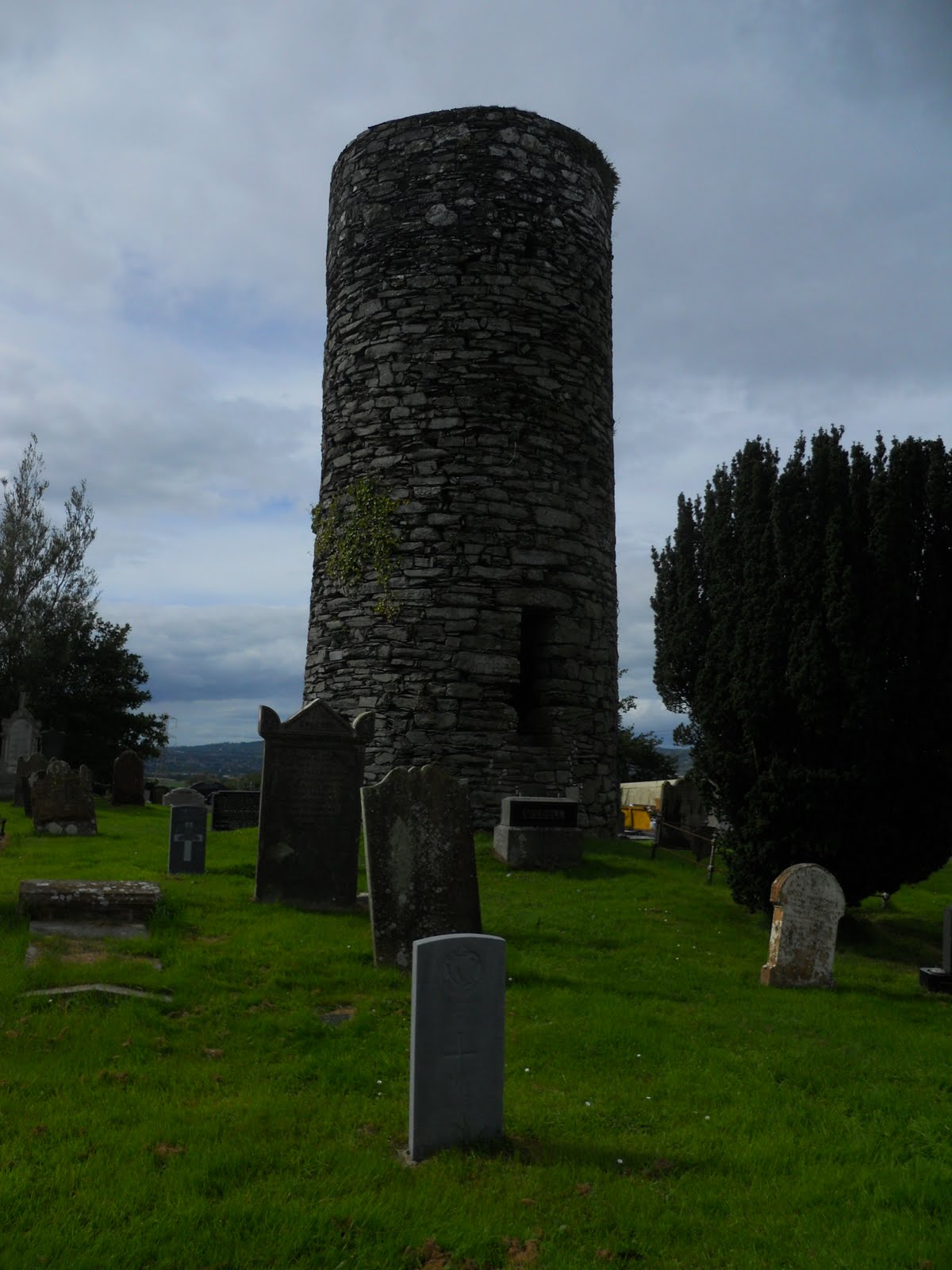
We then visited the remains of one of Ireland’s hundreds of high towers.  These were used in the invasion period to protect a site, maybe monastic, from a Viking raid.  The monks would enter the tower for protection, leaving whatever was outside to the fates.  The towers may also have been used for some type of storage.

Another prehistoric structure we visited was a rath- a hill fort.  This one dates from the early Christian period of Ireland.  From here small clans would feel protected and could possible see enemies approaching.  You may note the cow in the photo, from which the group ran screaming (sort of).  It has a vicious look in her eyes if you ask me.  Anyway, there are so many of these Ireland has tried to index them all, but it is impossible to keep each one in the most pristine condition.

Demon cow with view of Belfast in back
I’ve always liked ancient monastic sites.  This was the Benedictine Abbey of Nendrum.  What remains is the church area.  It’s located just a few meters from the coat.  One can imagine a silent Viking ship skimming along the water disguised by the morning fog.  A hoard of screaming Vikings emerge from the boat attack the small abbey, taking the gold chalices and patens, dragging sheep and cows to the boat, and kidnapping a few monks to be sold as slaves in other harbor towns.  No wonder the monks built several ring enclosures and had a tower from which a guard would be posted.  Calm seas and moonless nights meant the Vikings were about.

Tomorrow, we’re on the rocky road to Dublin looking for a flight.  This morning I visited St Bridget’s Church and lit a candle.  Let’s see if it works!


Saturday- Iverstown to Belfast, NI

Salvation!  Internet has been located.  Here is what I wrote last night.

It is Saturday night at 11:14 pm Irish time, and I don’t know when I’ll be going home.  I’m sitting here waiting, hoping, and praying we will be told our (air)ship is coming to take us across the Atlantic.  I feel much like Hugh must have if he left from Derry and sat on the docks for days or even weeks before his ship came in.  Of course I know my final destination, he had no idea.    The hurricane has us stuck in Ireland.  One might think how fortunate we are, but school starts Monday and there will be children looking for their teacher.  The word now is we are leaving Friday or Sunday of next week.  One of the students has referred to it as “the Hugh Cummiskey experience.”

Today I saw my first “Orangemen.”  The summer is marching time in N. Ireland.  Loyalist groups put on their dark suits, bowler hats, and sashes and march with bands and loud bass drums through different towns and neighborhoods.  The purpose is to remember William of Orange who defeated the Catholics thus beginning the English presence in Ireland.  I had read and seen films of the Orangemen, but never witnessed any myself.  It was all very sterile to view it from my chair at home, but to watch them strut along the road made me ask myself how I would feel if I experienced this every summer. 

When we arrived in Belfast we took a Black Cab tour.  They go on both sides of the city describing the political and religious strife that has haunted this beautiful city for centuries.  They refer to it as “the troubles.”  Again, I’ve read enough Irish history and seen enough documentaries to think I knew the situation.  I didn’t, and I still don't.  Our guide, Paul, drove us around pointing out the murals of the Loyalists who maintain they have the right to be here and rule.  And the Catholic side who maintain they are the original settlers of this place.  Throughout both sides these murals speak far more than mere words.  Have a look.


At one point Paul dropped us off in a very heavy Loyalist section.  There were dozens and dozens of Union Jacks flying on flagpoles, bannered across streets, painted on walls, and the Red Hand of Ulster displayed as a sign of Loyalist presence.  I wanted to leave.  I’m sure these are good and wonderful people who work hard and just want to raise their families, but the tension in the air made it more than I could take.

We met up with Colm, Eileen, and the students at Kelly’s Pub where there was a session going on.  The music, the atmosphere, and the company was the complete opposite of the earlier experience.  I think it demonstrated the real spirit of the people here.


Friday, August 26, 2011

Tyrone Dig - Day 5

In April of 1822 Hugh Cummiskey and his band of 30 laborers walked from Charlestown, Massachusetts to Lowell where they met Kirk Boott who hired them to widen and deepen the canals of the new mill city.

That is the way almost every biography that I have read (or written myself) of Hugh Cummiskey begins.  Though not complete, we might say that a new beginning is warranted.

In the year 1790, in the townland of Crossan in County Tyrone, a son was born.  The family lived in a cottage at the end of Crossan Road.  The home was simple, but efficient; the stones held together by clay and often white washed, the roof being thatched.  A cow was kept inside the family home against the outside wall.  The sheds in back of the house were used to keep chickens from which the family would be supplied eggs.  The garden in back of the house grew the family’s food supply, mostly consisting of potatoes.  The cows in the pasture provided the milk and butter, which along with the potatoes and eggs made up the greatest portion of the family diet.  They kept their homestead, which was average-sized for the period, extremely tidy with no refuse allowed to gather in the yard.  This was a proud family.  Just up the path from the house were the remains of an ancient ring fort, where on the little free time the children had they might go and play.  Situated on slight hill, the family home looked out on the fields and pastures of their neighbors marked off by ash trees and dry stone walls.  It is here Hugh Cummiskey began his life.

I like this a lot better.  It makes Hugh more human.  I am beginning to understand him more.  You don’t really feel you know someone until you’ve been invited to their home and got to see what their life is like.  I’m a little closer to Hugh now than I was a week ago.

Colm gave me a wonderful gift today, the best yet.  Time.  As the students did the final measurements and Colm did his paperwork I had almost a couple of hours to walk the area.  Sleep did not come easily last night.  I am drawn between home and here.  Yesterday the mood was a little somber.  I was sure today I’d be depressed.  So I spent my time walking the path to the house imagining Hugh and his siblings being told to do their chores.  I took time to listen to the sheep in the various meadows, the lowing of the cows, and the songs of the birds.  I examined the white wash flaking of the stone walls.  And then I met Hugh.  He was in the garden standing there with a spade.  He apologized for not having tea ready.  I asked what he thought of what we’re doing.  Being a humble man (at least by modern accounts he seems to have been that way) he merely smiled and gave a grin.  Farmers in Tyrone are not known for saying a lot.  Of course this visit did not really happen, but it’s better than saying the end.  Something tells me if Hugh was there he’d tip his hat and say, “Slan abhaile” (Safe home)

Something tells me we will meet again.

 We were pleased to have Brian Lambkin and his wife, Pat Fitzgerald and his two sons Owen and Conor visit the site today.  They are from the Ulster American Folk Park and authors of Migration in Irish History.  It's great to see they share interest in Hugh's story.

Our last in the series of a day in the life of an archaeologist comes from Sarah-
Trench 1 was opened to explore the relationship between the wall of the later part of the house and the ground surface.  It was located at a point where most of the wall had collapsed; therefore, it was hoped the excavation would uncover features of the wall which are now missing and details of the ground surface that are now covered. The area outside a window often collects domestic waste material, which can be indicative of the lifestyle of the period; for example, clay pipes, tin, glass or pottery.

A 1m x 2m trench, orientated North-South was opened. After removing the thin sod and topsoil, most of the collapsed wall was found; including machine cut red brick which suggested a feature such as a window. At the Northern extent of the trench large amounts of clear glass, wood and one nail were found depicting the location of the window: opposite the remaining window on the North wall of the house. Parts of burnt wood, from the house fire of 1979, brown glass and a button were also found in this context.

After removing the collapsed layer, a thin gravel layer or metalled surface was exposed. This was the yard contemporary with the older part of the house: the byre. It continued as a yard while the house was extended and when it was in use. There were no artefacts from this context which suggests it was kept clean; discarded material may have been brushed into the nearby shallow ditch.
This layer and the subsoil beneath were cut to make a gully between 10 -12cm from the wall of the house. This gave enough space for plinth stones to be inserted, and then the later part of the house was built. The subsoil was then re-deposited against the base of the supporting stones. The remainder of the gully filled later, as it was probably left open as a drain while the house was still in use.

This trench revealed, as predicted, the location of the window on the later part of the house and the association between the ground and the wall. The lack of finds is unusual as the yard was in use for many decades; further excavation may reveal a midden somewhere surrounding the yard.

Sarah Keer