Showing posts with label The 1900's. Show all posts

Sunday, March 23, 2014

A Tale of Two Daniels

One of the goals of this blog is to collect stories of Lowell's Irish past.  It's one thing for me to write little vignettes of happenings from generations past or my own Acre memories, but it is far more important we collect yours.  There have been folks who have shared their own stories, or stories from their families, but they are not as many as I hoped.  Everyone says they'll get to it at some point, but rarely does that happen.  Soon there stories will slip away and will be lost to the next generation.  We have a duty to preserve them.  Our recent documentary, shown during Irish Cultural Week, was made up of several folks who just shared a few moments of their time, yet added to our Lowell Irish history.

I'm reminded of Jack Flood, recently deceased.  He called me to sit with him so some of his stories could be preserved.  Smart man.  How about you?  Drop me an email.  dadumc@comcast.net  I'd be glad to sit down and chat with you.  I'll do all the work, you do the talking.  If that's too much, send me your story.  It doesn't have to be long.  If you like we'll publish it.  If you don't we'll just put it in the archives.

This week's entry is one sent in by a reader, Rosemary K. Nunnally.
Google image


Young Daniel Lawn, Jr. left County Donegal with his mother Mary and siblings Elizabeth, Michael, Mary Ann, Sarah and James.  They arrived in New York on October 11, 1880.   They traveled on to Lowell, MA to join the head of the family, Daniel Lawn Sr., who was working as a laborer.  The family settled on Summer St. with other Irish immigrant families.

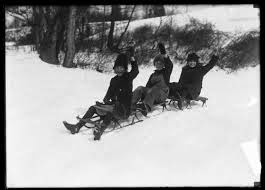
During the cold winter months, the children of the city entertained themselves with coasting, sledding on the South Common and on the streets of Lowell. The sleds they used were referred to as double runners. They were heavy and held several people. The sled could be difficult to steer with riders dragging their feet or jerking the sled sideways. Stopping the sled happened when it had played out its run at the bottom of the hill.
Ten year old Daniel enjoyed coasting. He left his home on a Friday afternoon in January of 1884 and made his way over to the South Common.  He probably went down the hill several times, walking back up to the top to start over again.
As the afternoon darkened into night, a terrible accident occurred. Daniel was hit by a sled. He suffered injuries which ultimately ended his life the next morning, January 26, 1884.
The Lowell Sun reported on the accident on the front page of the newspaper with the heading “Boy Killed By A Sled”.  The article went on to state “Daniel Lawn, residing at 25 Summer St., was run into by a "double-runner" sled on which boys were coasting on the South Common at 6 o'clock last evening, and died shortly before 6 o'clock this morning, notwithstanding the almost constant efforts of Dr. Phelan.”  Dr. Arthur Q. Phelan had his home and office at 4 Summer St. not far from where Daniel lived.

Daniel’s accident was also reported in the Boston Journal and Boston Daily Globe.  Both newspapers had a brief sentence explaining that Daniel had died from the effects of injuries from a coasting accident on the South Common.  Though there is no record of it, Daniel was most likely buried in St. Patrick’s Cemetery.  Daniel’s father, Daniel Lawn Sr., was buried there in yard 5F in 1902 and his mother Mary in 1912.

One hundred twenty-four years later in 2008, Daniel Lawn Jr.’s great great grandnephew, Daniel, went out sledding in a friend’s yard in the Belvidere section of Lowell. This Daniel also had a sledding accident.  Thankfully, due to improved medical care, the outcome of his accident was different. Though he had serious injuries to his face and mouth, Danny made a complete recovery. Separated by over one hundred years in Lowell, two young Daniels, two sledding accidents, and two stories to tell.

Wednesday, March 12, 2014

"Happy Days" Casey & the St. Patrick's Day Parade


THOMAS “HAPPY DAYS' CASEY
CA. 1850 6 July 1942
"TO HAPPY DAYS THAT WERE, TO HAPPY DAYS THAT ARE,
TO HAPPY DAYS THAT ARE TO COME"
Lowell Sun image, 1928
Thomas Casey was born in Ireland – date unknown – place unknown.  He kept that information to himself. He came to Lowell in the 1860's and worked as an expressman. He acquired his nickname at a picnic in the 1890's when he offered that toast. That was the end of Thomas – now he was “Happy Days”.
 With his horse and wagon, for 30 years Irish laborers, mill workers, teamsters and their children contacted “Happy Days” when there was a chest or trunk to be moved.  When one disputed his Irish birth, he would invariably tell that person something of his or her family back in Ireland, which would leave that individual dumbfounded – HOW could he know that!?” –  and never again doubt Casey's Irish origin.  He was known for his long white hair and full white beard. 


There was one day of the year, however, when he put on a quite distinctive appearance.  That day of course was St. Patrick's Day.  He would don his best cutaway coat and top hat with of course a touch of green in his lapel.  That took care of his attire and appearance.  He would then go to the stable and properly adorn his horse.   After saddling his horse, “...with affectionate hands he would further embellish the silvered trappings with everything green that he had laid his hands on over a period of months – green and gold.  Across the horse's long nose would be found the Harp of Erin, rescued from a Hibernian's discarded sash.  The animal's mane would be trimmed carefully in braids of green silk.  There's even a large bow of silk on the flowing tail.” (SUN 7 July 1942)  Thus equipped and adorned, he was off to join the parade leading such groups as the Meagher, Wolf Tome and Sheridan Guards through Lowell.  St. Patrick's day did not end for Happy Days when the parade was over.  He, and his horse, then went on a 'tour' of several drinking establishments.  When he entered, he was mounted on his horse, and fittingly asked for a beer for his horse as well.
Casey' Grave, St. Pat's Cemetery

During one St Patrick Day parade, Mary O'Malley described him thusly to a group of boys, ''There's Happy Days Casey, he's St. Patrick when you look at him in summer, and Santa Claus when you look  at him in the winter. Wouldn't you wonder, now, whether the man was ever born, but just came here from nowheres?'' (SU N 7 July 1942)   Happy Days was a beloved character such as we shall not see again.  He was struck by a bus on 6 July 1942 and died that day.

I am indebted to two articles which appeared in the Lowell SUN: 14 July 1928, and 7 July 1942.  Both have a photo of Happy Days with his wagon and horse. Submitted by Walter H.

Saturday, February 22, 2014

The Four Hundred from the Grove


Garrett Sheehan from the St. Pat's Irish Cultural Committee sent along this great article which originally appeared in the Lowell Sun in 1988.  Thomas the fiddler, referred to in the article, was his grandfather.
'The Four Hundred' Irish from the Grove     By THOMAS M. SHEEHAN

Postcard image
LOWELL - It is a known fact that the original Irish immigrants to Lowell settled in what is known as "The Acre," where they built St. Patrick's Church and School.  Less recognized have been the efforts of "a third wave" of Irish immigrants who arrived in Lowell in the late 1800's.  This "third wave" of Irish came to make their homes in a neighborhood situated on a wooded hillside which had become known as the "The Grove.”  "My own Irish heritage is founded in this area of the city which surrounds Sacred Heart Church on Moore Street.”  These Irish settlers put the same energy into the building of a parish as their predecessors in "The Acre."  It was a very close knit neighborhood where people stuck together during good times and bad, weddings and funerals, births and deaths, sickness and health, through peace and war.  There was once a time when just about everybody in "The Grove" was related in one way or another.  From it's beginning in the 1880's, a family would come to Lowell from Ireland and secure a place to live, and be a base of support for brothers and sisters, as well as cousins when they arrived - to get jobs and establish a home of their own after marrying.  In many cases, single persons were married off within a year of their arrival.  There was lots of matchmaking going on.

FORMING A CLAN
Many of the relations of the first settling families married each other's cousins, sons and daughters, forming a clan.  This became a tradition as these families - referred to as "The Four Hundred" - banded together and built Sacred Heart Church, and later, a school for their children, while establishing a wholesome neighborhood environment.  Here, they found the opportunity to make a good life for them self’s, prosper, and provide the necessary opportunities for their children.  Many of the Irish who were living in the "Flats" (back Central, Newhall and Lawrence Streets) moved to new homes being built in "The Grove."  The foundation of Sacred Heart Church had been built, and was dedicated on Aug, 10, 1884.  With the help of the Oblates of Mary Immaculate Missonary Fathers, a parish was formed.  Parish members put their hearts and souls into church bazaars, raffles and other fund-raisers, and on Sunday, Sept. 29, 1901, Rev. Fallon of Buffalo delivered an impressive sermon at the church's grand dedication ceremony.  The ceremony was conducted by Lowell-born Bishop O'Connell, then Bishop of Portland, Me. and later to become Cardinal of the Archdiocese of Boston.  The parish pastor, Rev. J. P. Reynolds, proclaimed that the church wouldn't have come to fruition if it hadn't been for the "Four Hundred."

PRINCIPAL FAMILIES
The principal families of the "Four Hundred" were considered to be the Lynchs, Murphys, Sheehans and Finnegans.  Checking the city directory, it was quite surprising to find just how many families with these last names lived in "The Grove" well into the 1900's.  Several Lynch families were listed on Andrews, Crowley, Agawam, and South Whipple Streets.  A number of Murphy families could be found on Andrews, Otis, Agawam and South Whipple.  Numerous Sheehan families made their abode on Agawam, St. James, South Whipple, Andrews, Bourne and Bleachery Streets.  The Finnegan families tended to reside along Lawrence Street, where several operated small shops.  To the descendants of these hard working Irish Families, the area is not Spaghettiville as it says on the Lawrence Street RR Bridge and it was never Bleacheryville, but “The Grove.”  The Murphys have been involved and intertwined with the Sheehans and Lynchs for about 200 years, going back to Ireland.  So it is no accident that they settled in the same neighborhood.  These first two families came from the farmland between Castleisland and Brosna in County Kerry, across the Feale River from Mt. Collins in County Limerick.  This is an area of rolling hills and lush fertile valley called Coom.  From the top of Castlehill, you can see the shimmering waters of Tralee Bay.  My great-great-grandmother was Mary Murphy, who married Tom Sheehan.  Their sons were Daniel (my great-grandfather), James, Mortimer, Tom (the soldier), Jeremiah (the tailor).  All except Daniel came to Lowell, but his granddaughter, Joan (Sullivan) McCarthy will arrive here next month with her adult children.There was a Thomas J. Murphy who married Josephine Sheehan (my grandfathers' sister) at Sacred Heart in 1898.  Should I trace my own roots back to the 12th century in Ireland, I just might find our ancestry stemming from Murchadh (Murphy), father of Sidechan (Sheehan), who were the 5th and 6th generation descending from Cenneitig (Kennedy), kind of Thamond; by his son Mathgamhain (Mahon), kind of Munster (Brother of Brian Boru kind of Ireland until 1014 A.D.)

The Lynchs and Finnegans came from a farmland called Garravane, outside Mt. Collins in County Limerick, a beautiful and peaceful place which I visited two years ago - in search of relatives.

My great-great-grandfather, John Lynch, a stonecutter, was married to Mary Finnegan on Feb. 6, 1842 and came to Lowell in 1883 with his six children - Timothy (my great-grandfather), Michael, Daniel, Thomas John, Mary Jane, and Catherine. 

John the stonecutter's granddaughter, Mary, was the wife of former State Rep. Connie Desmond.  Longtime Dracut High School football coach Ed Murphy was a descendant of the Grove's Murphy and Finnegan families.  The wife of State Rep. Edward LeLacheur (the former Eileen Mahoney) is a descendant of Jeremiah Sheehan the tailor, who had a shop at 20 Central Street.  Another Sheehan, nicknamed "Tom the Fiddler," was the son of Martin and Johanna, who had emigrated from Brosna.  Tom's son, John "Dukey" Sheehan, was the father of Lowell Chief of Police Jack Sheehan.  Marathoner Bob Hodge, who holds the record for running up the Mount Washington auto road, is married to Eileen (Hodge) Kempton, a Sheehan relation.  Many "grove" children, whose parents stressed respect for the law and service to community, grew up to become members of the city's Police and Fire Departments.

Edited from The Lowell Sun,  Sunday, April 17, 1988
Thursday, February 13, 2014

St Peter's Cemetery Part 2: The Little Black Book

This concludes the story of St. Peter's Cemetery as researched by Walter and Karen Hickey.
There is such a book entitled “St. Peter's Cemetery”, and we thought this would provide the answer to the locations of the graves. That expectation was relatively short-lived. The book is a record of lot owners.  In addition to the name of the purchaser, it provides the date of purchase, location of the lot, price paid, and sometimes the name or relation of the deceased.  All too often, the name of the decedent is not listed.  Instead, there is simply a notation “Opening grave” and the charge for that.  We are not told for whom the grave was opened.

 In the spreadsheet compiled from this book, there are 365 entries.  Of these only 165 have any notation of who is buried in that grave.  The remaining 200 have no decedent listed.

 Another problem is that the book seems to have been compiled after the fact as the purchases are not in chronological order.  The first burial was that of Edward Connor on 11 Dec 1900.  One would expect that this purchase would be the first listed in the book.  Instead it is listed on page 147 (of 176)

 From his obituary we know that the lot was purchased by his brother-in-law, Charles S. Little, and that this was the first plot sold.

FIRST INTERMENT

Edward C. Connor at rest in St. Peter's Cemetery

 The first man to buy a lot in the new St. Peter's Cemetery was Charles S. Little of 59 Boynton street.  The lot he bought was one of the most desirable in the cemetery, 10 feet square, with room for eight graves, and the price was $25.  The first body interred in the new cemetery was buried in this lot on Tuesday.” 11 Dec.]  (SUNDAY TELEGRAM, 12 December 1900; 5:2)

 If it were not for that obituary providing the name of his brother-in-law, Charles S. Little, we would have no way of knowing where Mr. Connor was buried.  The purchase record indicates the lot was purchased on 10 December and opened for Edward C. Connor, the lot being at Section “D”.  #1.

 The first purchaser listed is Mrs. Bridget Murphy. Who bought the lot on 20 October 1902.  The first, and only, interment was on 5 March 1907.  There is no name of the decedent.  A check of all Lowell deaths, 1-10 March 1907, showed no one by the name of Murphy.  There were interments in St. Peter's cemetery but there was nothing in the obituary or funeral notices to indicate any relation to Mrs. Murphy.  It is also quite possible that the person did not die in Lowell.

 Also on Page 2, listed below Mrs., Bridget Murphy:


James Devaney purchased Lot 24, Sec “B” on St. Cecelia's Walk on 25 April 1903.

 Like the Murphy record, the record does not tell us for whom the grave was opened.  In this case, however, by looking at the record deaths in Lowell ca. 25 April 1903, we learn that the deceased was Bridget Devaney, nee Morris, daughter of Lawrence Morris and Margaret Carey, who died 24 April and was buried by undertaker Rogers in St. Peter's Cemetery.
 The next challenge in the tale of this little cemetery will be to determine if we can match those coordinates with existing graves and locations in the present yards.  We can wait for the snow to melt!

 The information contained in the purchase book has been entered into a spreadsheet.  There are two printings.  The first is in alphabetical order and the send in page order.  These, as well as the burial spreadsheets are in the office of St. Patrick's Cemetery.

Friday, January 31, 2014

Lowell's Other Catholic Cemetery: St. Peter's (Part 1)


1906 City Atlas: Lowell Hist Society

St. Peter's Cemetery:1900 – 1913
This week's post was written by historian, Walter Hickey.

I suppose the individual responsible for this little tale is David McKean.  Invariably on one of his tours of St. Patrick's Cemetery he would mention St. Peter's Cemetery, tell us it was short-lived, and that legend had it that there was talk of 'irregularities' in it's administration, but that a lot of research would be required if the whole story be told.  This is the beginning of that story.
2013 was the year we decided to do something about that.  Dave had collected some news articles which he passed along and those provided a start.  The cemetery was created by two real estate agents, Edward R. Donovan and John J. Gray, who purchased 20 acres from William Manning on April 30, 1900 for $1000 an acre (Northern Registry 318-311).  The land was in the rear of St. Patrick's Cemetery and was bounded by Boston Road, Spencer Street, and Court Street.

By 1900, there were only two acres remaining for burials in St. Patrick's Cemetery and it was fairly obvious that additional burial space would be required.  This was part of the planning of Donovan and Gray.  As an incentive to purchase the prices of lots were considerably less that those charged by St. Patrick's Cemetery.  In St. Patrick's, a 7x8 lot (56 square feet) cost $60. In St. Peter's the lots were all 10x10 (100 square feet).The price was either $10 or $25, depending on location.

Father Michael O'Brien, of St. Patrick's Cemetery, had earlier tried to buy the land from Manning but he offered such a low price that Manning would not even listen.  One day, when both Donovan and Gray were overseeing the work being done, Rev. Michael O'Brien called to them over the fence and offered to buy the land for $10,000 over the price they had paid Manning.  His offer was refused.

The Lowell Sunday Telegram of Dec. 9, 1900 wrote:
“Examination of the plans, deeds and prices set forth by the proprietors of the new cemetery, and realization of the liberality shown therein, give evidence that the Catholic people of Lowell are to be greatly benefited by this addition to their mortuary privileges.  The land that has been prepared by Messrs. Donovan and Gray at great expense is a sightly tract of at least twenty acres, laid out with walks, drives, and wide avenues.  There are now ready about 4000 lots just as level as a floor.  Every lot is high and dry, and is perfect for burial purposes. 

The cemetery opened ...with room for thousands....but in the next 13 years fewer than 800 burials took place.  Finally, on December 26, 1913, the city council repealed the order authorizing Donovan and Gray to use the land for burial purposes and the cemetery became part of St. Patrick's cemetery as the Archdiocese of Boston had purchased the land from Gray.  (Gray's partner, Edward R. Donovan died in 1904, and was buried in St. Patrick's Cemetery – NOT St. Peter's.) 


Several years ago, St. Patrick's Cemetery computerized their records and those are now available online (http://stpatrickcemetery.com/) for burials after 1894.  BUT...those buried in St. Peter's Cemetery are not in that database. One Sunday morning, Karen, Dave and I drove to the Cemetery (doesn't everybody spend at least one weekend day in a Cemetery?) and took names of several graves and checked them against the database of St. Patrick's burials.

NONE, 1900 – 1913, were in that database.  This meant that the cemetery had no record of all those buried in the old St. Peter's Cemetery.  It appeared to us that a) the burial records had not survived, and that all were 'lost records”.  Burials dated 1913-1914 were in the database as it was then by St. Patrick's Cemetery.

The issues quickly became WHO is buried in St. Peter's Cemetery? and How do we find out?

The answers lay in the records of the Lowell City Clerk.  The actual death records through 1904 are available on Ancestry.com and death records after 1904 are on Familysearch.org as well as Americanancestors.org.

It was determined that it would be possible (if not a little insane) to compile a list of burials by looking at each death record 1900 – 1913.  Accordingly Karen and I proceeded to look at each record looking for Place of Burial: St. Peter's Cemetery.  When finished we had a list of 730 individuals. A few are dated after 1913 as the undertakers indicated “St. Peter's” as the place of burial.  At last, there is a list of those interred in the old St. Peter's.  That list is available at the St. Patrick Cemetery office.

On Tuesday, December 11, 1900, Edward R. Connor became the first to be interred in St. Peter's Cemetery.  Now, the question arose:  “WHERE is his grave?”

Tuesday, December 31, 2013

The Problems of Digging Up the Family Tree


Duncan Rankin McKean
I only remember him as an old man with a shock of snow white hair.  His face showed little sign of his 86 years.  His sky blue eyes gave the notion he had stories to tell.  He spoke with that distinctive burr that some born in Scotland would have, though I rarely recall him speaking of his youth in Glasgow.   He spoke so softly you had to listen to hear what he was trying to say.  The smile (some say a grin) was a permanent fixture on his face.  He was immensely proud of his Scottish heritage often telling his grandchildren not to admit to their Irish side from their grandmother.  (Research would show Clan McKean made many trips originating in Donegal and moving to Scotland over the centuries.)  He would sit in the chair in the corner of his apartment in the housing at 323 Adams Street, rarely having much to say.  It was only after he was gone we learned the truth of my grandfather’s story. 
Duncan Rankin McKean was born in the bleaching fields of the township of Milngivie, Scotland in 1875.  The family story was that he left at 16 to work on a cattle boat to make his way to Lowell.  That was all he would admit to.  But technology changed that as I went in search of my grandfather’s roots.  Both his parents worked jobs in the woolen mills.  He was one of 6 children before his father died when Duncan was still a boy.  The young mother was left with the children and her father in law to take care of.  The family situation declined quickly with the death of the grandfather leaving the mother alone.  Soon she is pregnant and gives birth to another child with a different surname. That surname reappeared soon after when she married a much younger man whose father owned the factory where she was employed.  It is at this point that Duncan leaves Scotland.  Under what conditions no one knows, but one can only surmise.  He was working in Glasgow as a shoemaker.  He traveled alone to Rhode Island where he continues the same occupation living with a family member, maybe an uncle or cousin.  The only possession he carried with him was a photo of himself taken just before he left.
He stayed briefly with family before making his way to Lowell where he worked at the Lowell Machine Shop.  He met Jennie Sweeney and they married at the Rectory of St. Patrick Church.  The day before the nuptials, he was baptized a Catholic forsaking the Church of Scotland.  He rarely entered another Catholic church again until his own funeral, but kept his promise and saw that all his children were raised Catholic.  He kept his King James Bible and told people, “You read yours, and I’ll read mine.”
Research can sometimes have its downfalls.  My grandfather, like so many others of this period, did not have an easy life.  The more I dug the more I found he was haunted by his demons.  He never saw his mother again.  In the 1900s there were pleas for money.  Then there were pleas for tickets for passage over, then the announcement that she was dead.  That’s when his name appears in police blogs time and time again.  His life took on a series of misfortunes.  Years later his wife died too soon, and that’s when he transforms to the kindly old man I remember.
Fifty years ago I was in the 4th grade at St. Patrick’s.  It was recess time.  We were out in the freezing cold.  The bell in the church tower began the funeral toll.  I stopped and turned to see them carry my grandfather down the steps of the church to the waiting hearse.  The school bell rang for us to line up.  I stayed in the yard.  Sr. Margaret Paul came over and asked why I was crying.  I told her that was my grandfather.  She walked me back to the line.  It is the last memory I have of him.
Should I have researched his story?  Should I have stopped when I saw what happened in Glasgow?  Should I have hid his life from my own genealogical accounts?  Maybe so.  When my aunts were still living I thought it wise to share his story and his encounters with them.  I was sorely mistaken.  They did not want to hear about his previous life, or merely wished to deny it.  They smiled and told happier stories of times past.  But his story is probably not that much different from others.  I cannot imagine going through what he did or how I would react.  So I share this with you and let you judge. 

Wednesday, December 11, 2013

The Days That Went Before Us - films from the 1920s


Almost 30 years ago an older gentleman rang the bell at St. Patrick rectory and asked to see me.  He handed m a cardboard box.  Inside were 6 reels of 16mm film.  He told me they belonged to Fr. James Supple who served as a curate at St. Pat’s in the 1920s.  He was a friend of the family and left the films with them when the priest was transferred, possibly in the 1930s.  He had no idea what was on the films, and so they sat in the box for a decade or so.  An interested volunteer showed the fragile films in 1996, and they have sat in that same box ever since, until now.
Technology is not my forte.  Luckily it is for Bob Rafferty.  Bob heard of the films and is preparing a mini documentary for 2014’s Irish Cultural Week.  The films, which could disintegrate any day, have been digitalized along with a number of VHS tapes that have been gathering dust in the parish archives.  The films are going to be permanently archives by the Irish Film Board.  A gentle reminder that any of you out there with old pictures, booklets, uniforms, etc are invited to pass them to us to give them a home.  Most of our archives is made up of donations.  It amazes everyone that a parish that is approaching its 200th anniversary never bothered recording its own past.
The films the good Father left us are a window to life in the 1920s.  He took a trip to Ireland and recorded what he saw in places like Dublin and Glendalogh.  He has footage of soldiers marching down O’Connell Street, a fiddler outside a cottage, and a woman weaving on a spinning wheel.  He also has local scenes of kids coming out of the St Patrick Boys’ School, a girl’s group at Canobie Lake, and a Corpus Christi procession in front of the church. 
Here are some teasers to whet your appetite.


A few weeks ago Ed Furey gave a great lecture on architect, Patrick Keely.  Phil Lupsiewicz videotaped the event for us and uploaded it to YouTube.  Here’s the link https://www.youtube.com/watch?v=1B-1-WUS-vo   Thank you, Phil. 

Wednesday, November 20, 2013

An Acre Memory - the Day JFK Was Shot


If my memory is correct it was one of those grey days of November.  Our teacher was Mrs. Dalton, the sole lay teacher for many years at St. Patrick’s School.  Mrs. Dalton’s daughter came driving up through the school yard honking the car horn.  She drove passed the steps of the school right under our classroom window.  Mrs. Dalton bolted to the window and opened it.  “He’s been shot.  The President’s been shot!”  The date was Friday, November 22nd 1963.  The classroom had just had a large black and white TV installed in the class.  Mrs. Dalton turned it on to see the grainy pictures coming in from Dallas.  The TV anchormen were getting mixed reports from their sources.  Mrs. Dalton left the class, probably to tell the nuns in the other classrooms.  Finally, the moment we all remember, Walter Cronkite made the announcement that JFK was dead.  Within minutes the bell of the church began to toll and kept up until it was time to go home.
I ran into the house expecting to break the news to my mother.  She was standing at the ironing board in the kitchen positioned so she could see the TV in the living room.  She was openly weeping.  I don’t think the television was off over the next 4 days.  Our usual Friday night trip to one of my aunt’s for the weekly card game was cancelled and replaced with my mother announcing we should all say the rosary for the repose of President Kennedy’s soul.  With the TV still on, we knelt by the couch and said our Hail Marys.   Instead of ending each decade with the Glory be, it was replaced with, “Eternal rest grant unto him O Lord.”
This all was happening while my dad was wallpapering the TV room.  We watched while Lee Harvey Oswald was arrested.  We watched while the crowds lined up for the viewing in Washington.  We watched while Jackie made her visit to the coffin.  On Sunday the wallpapering was nearing completion.  My folks had set up a card table in the living room, and we were given a rare opportunity to eat in front of the television.  The spaghetti was just served when my mother gave out a scream as we saw Jack Ruby shooting Oswald live on television.    No rosary was said for him.
One sound I and others will never forget would be the roll of the drums during the funeral cortege.  Catholic churches around the country had funeral Masses said for JFK on the Monday that he was to be buried.  St. Patrick’s was draped in black.  Six tall candles surrounded a coffin meant to represent the dead President’s.  The priest processed out clothed in their black chasubles.  We rushed home to follow what was going on in D.C..  There was Richard Cardinal Cushing with black cope incensing the remains.  Again the roll of the drums.  The salute of the young son.  The lighting of the flame.
The following day Sister Clair Cecilia announced the all the children would write letters to Mrs. Kennedy to express our sadness.  I remember telling her how proud we were to have a Catholic president and that we would pray for her and her family.  I ended by asking her to send me a pair of his rosary beads and I would keep them safe.  She didn’t answer.
Tucked away in a box in the cellar is a copy of the newspaper of the day he was shot.  There’s also a prayer card with a black border and a book called Four Days.  My mother said to hold onto them.  You will want to remember what happened.  Fifty years later I still remember.

Wednesday, November 6, 2013

The Day the Irish President Visited Lowell - 1920


Eamon de Velara
With the upcoming visit of Dr. Mary McAleese this Friday, it occurred to me that this is not the first time that a President of Ireland has come to St. Patrick Church.  The planning for her visit has been going on for weeks with agendas being confirmed, and protocols being checked.  This week’s visit is being co-sponsored by the Irish Cultural Committee of St Patrick Parish and UMass Lowell.  It has been a whirlwind of meetings and emails.  Things haven’t changed much from a similar event in 1920.
As the provisional president of Ireland, Eamon de Valera was on vigorous 19 month-long tour of the US seeking recognition of the Irish Republic. The purpose of his visit was to acquire a loan to help secure finances for the newly formed country and to seek the help of the American public in accomplishing these goals.  At times his itinerary had him visiting several cities in one day, making speeches to groups both small and large, and moving from one train station to another.  A committee of Lowell citizens wrote a letter in September of 1919 to de Valera petitioning him to visit the city.  A response came committing that he would arrive on Sunday, February 8, 1920.  Once word got out, it seems that every Catholic church, city dignitary and politician, every social group and fraternity and marching band wanted to join in.  The Lowell Sun tracked the President’s whereabouts day by day.  As the day of the visit drew closer, the city prepared itself.  Notices were posted about different Holy Name Societies preparing their marching orders.  Receptions were planned around the city.  A parade route was formed with each organization vying for its place to greet the President.
We are told that the skies shown bright blue on the day of the visit.  But February in New England is known for its frigid temperatures and winds, and that was what nature sent that day.  A corps of uniformed soldiers made their way to the train station on Middlesex Street.  They formed an honor guard for the motorcar that would carry him through the city.  He was set to arrive at about two in the afternoon.  Though a full agenda was planned, he was set to leave for Lawrence by 6 pm.  The crowd was estimated to be over 10 thousand that lined the route.  Many businesses had donned bunting and the Irish colors over the doorways and window fronts. 
As the fates would have it, his train had a series of delays.  There was no way to let the crowds know of the length of time they would have to wait in the cold.  Many tried making their way into the train station to get warm.  Others hid in the doorway along Merrimack Street.  The reporter of the day said few would leave their post.  Finally at 5 pm a cheer went up announcing his arrival.  The excitement passed along the parade route down Middlesex, to Central, to Merrimack, to City Hall, where a private reception was planned with speeches by a long list of politicians.  He was given the seat of the Mayor while the politicians spoke on. De Velara made his apologies and everything was cut short due to time.
Msgr. William O'Brien
There was one item on the list that was not deleted.  De Valera got in a car and was driven over to St. Patrick Parish where he had a private audience with Msgr. William O’Brien.  We have no idea what was said between the two men, but we do know that he was invited into the rectory for a small reception.  From there, he went to the main reception of the visit at Associates Hall.  It was now 7 pm.  The room could not hold another person.  Many stayed out in the cold just to hear his voice.  Mayor Thompson and Fr. McDermott of Sacred Heart introduced the President.  His speech came from the heart.  He spoke of freedom, the right to choose, and the right of a people to for their own government.  The speech was as American asyou could get, but tugged at the hearts of those who knew the Irish plight.  It was 9:15 pm by the time speeches were done and he was on his way to the next city, always working for the cause.
Please join us as we welcome President Mary McAleese on her visit to St. Patrick Church and Lowell on Friday, November 8th at 4pm.  Dr. McAleese will speak on the peace process and light a peace candle to be kept burning at the church. 

Thursday, October 17, 2013

A History Mystery- the O'Brien Monument


O'Brien Monument, circa 1880
There are lots of little mysteries when doing a history of Lowell’s Irish.  Such as, why didn’t Hugh Cummiskey have a headstone?  Or, what happened to the tapestry that hung in the rectory until about a dozen years ago and simply walked away?  Even, what happened to Stephen Castles after he shot a boy on Lowell Street in 1849?  Some answers will never be found.  Others might have their solution with readers of this blog!
Right now I’m trying to figure out what was on the O’Brien monument in front of St. Patrick Church.  Oh, I don’t mean the granite slab that is their today, but the original monument.  When Rev. Timothy O’Brien, the brother of Pastor John O’Brien, passed away in October of 1855 the sense of loss to the community was great.  It was immediately decided to bury Timothy in the front yard of the newly constructed church.  Within a year an upright granite monument was erected over the grave.  Soon Father Timothy was joined by his brother, John, in 1874. The last to be interred under the monument was their nephew, Fr. Michael O’Brien, in 1900. 
The few photos that survive show the monument was a good size.  How were the bodies placed under the monument?  One small reference uses the word “vault.”  Were there stairs leading down?  A tunnel from the basement of the church to the vault?  There are no records to let us know. 
The last photo we have of the monument is from 1946.  It’s a graduation photo.  How many families took First Communion, Confirmation, May Procession, or graduation photos at this same spot?  Yet no others survive.  Our photo shows the obelisk had marble inserts.  There appears to be a Chi Rho symbol and the words Ioannes O’Brien.  The rest of the tablet is filled with unintelligible text.   What did it say?  What did it look like?
At some time around 1956 the monument was taken down.  The pastor at the time, Msgr. Hyder, made the decision believing that its age made it unsafe.  Not all parishioners agreed with him and questioned other motives.  When it was proposed that it be moved or even petitioned of by one parishioner to buy it, they were all refused.  Before anyone knew about it, the monument was ground into rubble and replaced by the current stone.  Those who can recall the monument are fewer than before.  And, so far, no one has added to its story. 
My earliest memory was that the stone was used by newspaper boys to sell the Sun on Sunday mornings after Mass.  They would stack their papers on the stone and stand on it calling out to those leaving the church to get their papers here.  Today few know it is the final resting place of three men who are responsible for much of the story of Lowell’s Irish.  It needs a good cleaning, and there are always plans to do some sort of landscaping or improvements.  Someday.
If you have any info on the O’Brien or have a story to share drop us a line.  We need to hear from you.

Sunday, August 25, 2013

A Life in 3 Boxes

The amount of research that has been accomplished by Dr. Donnelly and his team and the work of Dr. Mitchell, along with many local historians concerning the role of the early Irish has made an indelible mark on the story of Lowell’s Irish.  Yet, we all refer to one particular source, the sort of Genesis of all studies, The Irish Catholic Genesis of Lowell written by George Francis O’Dwyer and published in 1920.  Yet, his own story is one worth telling as well. 

I visited the Boston College Library many years ago to view the O’Dwyer collection which consists of 3 cardboard boxes.  I think I was one of the few to open them since his death in 1942.   There was no rhyme or reason to its contents though the Burns Library is a Mecca for researchers in Irish Studies and its meticulous collections.  The condition of those boxes sadly resembled the author’s life.  Walt and I returned to BC this week to see the collection with a different eye than what I sought almost a decade ago.
The staff had everything prepared as they wheeled out the same 3 boxes, this time placed in some semblance of order.  The first box is a file box with maybe a thousand handwritten index cards.  After spending hours with those cards, and seeing the pencil markings on each one, you sense the passion and drive of the man.   Those who share the need to know more can easily empathize with him.  His modus operandi was to go through every newspaper and city document he had available to him.  Each time he met an Irish name he would jot it down on a little 3x5 card.  He recorded births, deaths, marriages, and real estate transactions.  Of course he did his work at the turn of the 20th century, and now at the 21st century much of the work he did over years, and as he states in a letter to a publisher that he has worked night and day for 10 years giving all of his life to this project, can be done with the click of a computer today.  So much of what he did is easily available online now.  There are some sources he did use that we no longer have available to us.  People.  It’s obvious that he brought his little notebooks with him and sat down with the children and the grandchildren of those early Irish and listened to their tales of days gone by in the Acre.  Some of the stories do not mix with known facts, but that is part of assessing oral histories.  He spoke with Sarah Smith who was baptized in the original wooden St Patrick’s Church in 1831.  He corresponded with Hugh Cummiskey’s granddaughter, Loyola McCann, teacher at the Elliot School, who recalled her grandfather.  Without these little vignettes into the past the human side of our story may have been lost forever
George O’Dwyer was born in Lowell in 1877 and spent much of his life in the family home on Midland Street in the Highlands.  His father, Jeremiah, emigrated from Ireland, possibly County Limerick  in 1872. His mother’s parents were both immigrants.  The O’Dwyer home must have been filled with storytelling and the recounting of days gone by.  From an early age Irish history and genealogy became an interest to young George.  As a young adult, he addressed the Lowell Irish Society about the early history of Ireland.  They were impressed by his knowledge.  While he did have jobs as a clerk and other positions, his real avocation was in his zeal for Irish and Irish-American history.
The remaining two boxes at BC tell more of his story.  He begins publishing small tracts on the Irish throughout New England, probably with his own funds.  He writes poetry and one act plays on religious topics and historical events.  He solicits jobs from organizations such as the American Irish Society, who hire him to solicit members throughout New England.  He does not have much success.  Sullivan Brothers prints the piece he has spent much of his life on and has placed all of his financial resources- The Irish Catholic Genesis of Lowell.  Four hundred copies are printed after a number of changes made to the original tract.  Sullivan Bros, sues O’Dwyer for non-payment.  They win and take possession of the remaining books.  This could account why there are so few remaining copies of the original text.  O’Dwyer writes a letter stating his shock at the poor selling of the book, even at the price of $2. 
The contents of those boxes are filled with his attempts to find backers for his projects.  He writes that he is totally dependent on the kindness of his sister for a bed and food.  But still he continues writing to newspapers promoting the Irish cause and collecting hundreds and hundreds of slips of paper with names and dates maybe for a future book.   He spends his last 10 years in Boston and his last three months in Long Island Hospital.  He dies in that hospital at the age of 64 in 1942.  The man who literally gave so much of his life to recording the story of the Irish in Lowell and New England has a simple 2 paragraph obituary, never mentioning the legacy he left to us.

Thursday, August 1, 2013

An Acre Memory- Summertime


Me in my
Rifleman t-shirt
I never got to operate a lawn mower until I was in my 30s.  Growing up on the corner of Broadway and Walker didn’t give much opportunity to do so.  What we did have was the blacktop in back of the blocks that ran along Broadway Street.  In-between the blocks were alleys that were inches thick with pigeon dropping.  At dawn and evening, the dozens of pigeons that made the roof their homes would serenade the inhabitants of the blocks with their cooing.  Sometimes young fledglings would fall from the roofs, and my humane father would take them into our cellar where he would hand feed them and then bring them outside to exercise until they would take wing on their own.  A summer ritual was the annual scraping of the dung in the alleyway with massive quantities of creosote.  I later found that this substance was regarded as highly toxic and potentially carcinogenic, but my parents thought cleaning the alley a neighborly duty.   The smell of the chemicals would permeate the backyard for days.  My mother explained it away by saying it was better than pigeon smell.
There were no air conditioners or even a fan.  Lying on the cool linoleum might alleviate some of the heat.  Opening and closing the screen door let in hordes of flies.  We often left doors open overnight, never fearing anyone would walk in.  The flyswatter was ever at the ready and if that didn’t work there was fly paper.  My mother would keep one above the kitchen table and more than once a wing or a leg would be pulled off some poor insect and land on a supper plate.
There was little you could do to alleviate the heat of the summer especially when it radiated off of the blacktop.  One refuge was Mike’s Field in back of the Lovejoy estate—today, the parking lot for UMass on the corner of Wilder and Broadway.  The estate had been in disrepair decades before I was brave enough to make my way up there.  Everyone knew a madman lived in the basement (or was it the attic?) and if you got close enough he’d use a hatchet on you.  By the time I was old enough (or brave enough) to get close to the building there was just enough glass left in the windows to make a crash and then run away.  There were a few apple trees that had gone rogue on the property and if it was warm enough, we’d climb up and pick a few, always wary of potential worms.  Mike’s Field was a 10 year-old’s dream.  I have no idea who Mike was or what the land was used for, but it was dotted with massive trenches dug out by man or machine that had to be 6 to 8 feet deep.  It was the 60s and playing War was how we spent most of our days.  Combat and Twelve O’clock High were necessary TV viewing for many families.  The trenches of Mike’s Field were our foxholes.  We’d fill penny candy bags with dirt and hurl them as sort of grenades into the other holes where the enemy was hiding.  If you did it correctly, the bag would open over the heads of the enemy and cover them in dirt.  Though it would be terribly politically incorrect today, we were all armed with plastic helmets and very life-like rifles.  Our fathers had served in WWII and the Cold War was on.  We knew what those yellow CD signs on buildings meant.  We heard the sirens every Friday that were tested in case the Russians attacked.  Mike’s Field was our battleground and we were there to defend it.
When we got bored with war, we might walk down Walker Street and make our way to Gage’s Ice
Google Maps. corner of Broadway & Walker Streets
House.  If we were fortunate enough to go to the beach, my Dad would come down to Gage’s to buy a cube of ice, and I mean A cube.  You’d put your money in the slot and one huge block of ice would slide down a chute.  You’d then have to take it home to break up with an ice pick to put in the heavy metal CocaCola cooler.  On super hot days we’d check out Gage’s and see if any ice chips had fallen onto the straw where the giant cubes would land at the end of the chute.  Odd how we never got sick from any of this.

If we were really lucky, we’d go to Burbeck’s Ice Cream on Pawtucket Street.  This was really rare.  This is also where my friend Ricky taught me a trick.  You’d order an ice cream cone, eat half, drop it on the ground, and they’d give you a new one.  He used that ploy several times.  The first time I tried it, the teenage clerk just walked away.  I guess I didn’t look sad enough. 
There was one thing to which we were all sworn to.  My mother made me swear on a stack of Bibles, a real stack, and that God would personally punish me if I broke the promise- that I was to never go to the river or in the canal.  She had good reason to.  Those who lived by the canals in Lowell knew that each summer a number of daredevils would jump in the canal and be dragged under.  Each time it happened she made me read the article.  I do recall watching the police, or firemen, along the Pawtucket Canal dragging a large rope, which we volunteered to help.  I was later told that at the end of the rope was a grappling hook looking for a body.  That wasn’t the only occasion.  Once my cousin Armand brought me to see a similar scene along the Merrimack canal, and yet another was when we ran out of a friend’s birthday party after the news had spread someone drowned at Francis Folley on the Pawtucket.  We were sure to return in time for cake.  These events must have made their mark, as to this day I still do not know how to swim.
Since we lived on the corner of Broadway and Walker it was a great place to set up a lemonade stand.  The city bus would disembark people on the corner, and they’d get off the bus all hot and sweaty from the ride and the long day’s work.  Sales were slow until Ricky’s brother started crying that he wanted some lemonade, but had no money.  A kind bus rider pinched his cute little face and gave the nickel for the lemonade.  Hmmm, if it worked once…..   From then on each time the bus pulled up Ricky’s brother would turn on the tears and out would come the nickels.  We must have made a fortune, or at least enough for a Mr. Softee.  We knew a good thing when we saw it and set up the stand the next day.  The same riders disembarked, but once our ploy was recognized we were put out of business.
After much pleading, we might get a nickel and go to Dostaler’s Market on the corner.  The penny candy display had all the good stuff: squirrel nuts, peach stones, mint juleps, sugar straws, flying saucers (that served as hosts when playing Mass), and black licorice records with the red dot in the middle.  Another favorite was a candy necklace that you could bite of a piece as the day wore on.  Wearing the necklace then eating it after a game of tag or Red Rover often gave the candy a sweaty flavor, but it didn’t faze us.  On those super hot days, the only thing to work was a cool orange Popsicle.  Grape and cherry were good, but orange had a greater cooling effect.  There would be 2 sticks so you could break it in two and share with a friend.  Then you’d stick your tongue out to be sure it was orange.  That was part of summer too- sharing with friends.
My fondest memory of summer was Thursday night after food shopping at the Giant Store, my dad and I would go down to the river to fish.  We’d dig up worms along the riverbed and stick them on a hook.  I only had a drop line, but it worked just fine.  The only thing I remember catching was hornpout, black catfish.  Those whiskers could really inflict damage so my dad would take the hook out.  He got stuck more than once and let out a string of curses each time.  We didn’t talk much.  That was his way, but we’d sit along the river wall tugging at the drop line.  We’d watch the orange sun set along the curve of the river.  He had fished that same spot in the river when he was my age.  As the last rays of light departed we’d gather our gear and turn up Walker Street to home.