Showing posts with label St Augustine's Cemetery. Show all posts

Tuesday, February 28, 2012

Road Trip 2- St Augustine's Cemetery

Whenever I see a sequel for a movie being promoted, I always tend to shy away from seeing it.  The second time around can never be as good.  So I was a little weary of Road Trip Two to St. Augustine’s Cemetery in South Boston.  You might remember that Dennis Crowley would cart Lowell’s early Irish deceased from Lowell to either Bunker Hill Cemetery or St. Augustine’s so they could be buried in consecrated ground.   Not sure that Mr. Crowley would hit the traffic Walter and I encountered on 93, but he certainly took more than the 90 minutes it took us to get there.

The Cemetery is located in the densely populated section of Boston, known locally as Southie.  The tenements and houses are tight packed.  The tricolor is flown from several porch railings.  Store signs, pubs, and restaurants carry on the Celtic theme.  Much has been written about Southie, good and not so good, but you have to admire the tenacity of the people who have kept the chapel open with a full calendar of weddings, funerals, and weekly masses.

The chapel at St Augustine’s is the oldest Catholic structure in the Archdiocese and probably far beyond.  The burial ground was begun in 1818.  Boston’s City Fathers had finally given permission for the French and Irish Catholics who had immigrated to the city to finally have a burial ground of their own.  Anti-Catholic sentiment was running high and this meant that Catholics had made a permanent mark on the city landscape.  Father Francis Matignon, an immigrant from a rather wealthy family in Paris, was for a time Boston’s only priest and much beloved by the Catholic population.  His dear friend Bishop Cheverus had the chapel constructed in memory of him.
Fr. Mahony's Memorial
The Cemetery and chapel are surrounded by a large ornate metal gate built upon a granite base.  The large gates open to a meticulously groomed area that just a few years ago was overgrown and stones were falling over.  The keepers of the Cemetery have righted stones and cleared paths.  Today, the main gate actually opens to the rear of the chapel.  The stones face in an easterly direction.  There is an old practice that stones face east towards the rising sun, a symbol of the Resurrection.  On the exterior of the chapel wall are the marble stones of Fathers Mahoney, O’Byrne, and O’Flaherty.  Father Byrne was the circuit priest for a large area north of Boston.  He was stationed at St Mary’s in Salem and would make a monthly visit saying Mass at the site across from the Pollard Library today.  It is said people cried when he gave his sermon in Irish.  Father Mahoney was the first pastor assigned to St Patrick’s.  After his service in Lowell, he was assigned to Holy Cross Cathedral.  Father O’Flaherty was the speaker at the dedication of St Patrick’s in July of 1831.  How fitting these three lie side by side after serving together for many years.
Lowell Burial, O'Neil Family
The interior of the chapel has maintained its simple Gothic design and has been lovingly restored by neighbors and friends of the Cemetery.  The altar area has numerous marble slabs dedicated to the many priests who pioneered the beginning the Catholic presence in New England.  One really feels the sense of history and the sense of care and reverence which keeps this site open.  The chapel interior is simple in its wooden altar and tabernacle with small shamrock cut out.  Walter pondered the idea of this chapel very likely being built in a similar style to the original wooden, St. Patrick Church of 1831.  This seems quite possible since the connection between the two places was so close.

Our original intent in visiting St Augustine’s was to identify the graves of Lowell Irish who were interred there before St Patrick Cemetery opened in 1832.  When George O’Dwyer authored Irish Catholic Genesis of Lowell in the 1920s, he included a list of St Augustine internments.  Where he got the list from is uncertain and needs to be researched further. 
Walter w/ McDermott Stone
Most of the stones that are left standing are of marble and slate.  Needless to say the marbles are in deteriorating position.  Time, pollution, and acid rain have done their job.  Some of the iconography is just amazing.  For example we saw a beautiful crucifixion scene done in slate, not seen in other cemeteries.  There was also a slate with an hour glass, symbolic of time fleeing.  This is often seen in Yankee graveyards, but not common with Catholic symbolism.  After spending a good amount of time, we only located 2 names from the Lowell list.  One was especially interesting to Walter who is doing an in-depth study of Fr. McDermott’s family, whose roots are in Boston.

REMINDER- Sunday, March 4, St Patrick Church, 10 am- Mass with readings in Irish and music accompaniment by Aine Minogue, world renown harpist.  Join us after Mass as we parade to City hall to raise the flag and remember those who came before us.  An Irish breakfast is served in the church hall after the parade.  Bring your family.  Bring your friends.  Share your pride.

Friday, January 20, 2012

Denis Crowley & The Rocky Road to Boston


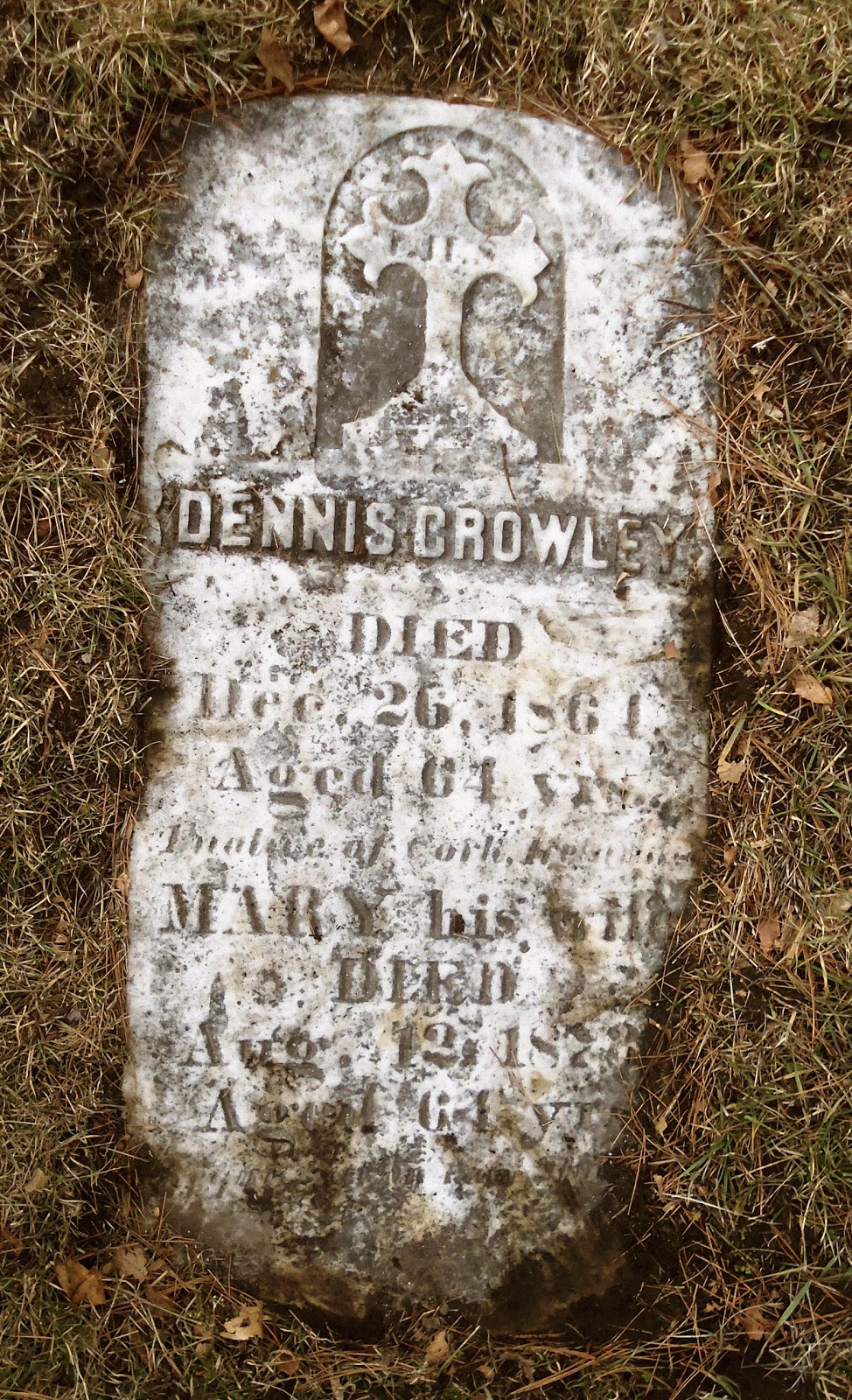
The trip between the towns of Lowell and Boston was a long one, about 45 miles.  Driving it along mostly unpaved roads that were dusty in the summer, muddy in the spring and fall, and frozen in the winter, made the journey arduous no matter what season you were called on.  And if he was carrying a double or triple load, well that just made Denis Crowley’s day.  Sure there were some places where the road was paved and even cobble stoned, but that was the exception. Work was work; it paid the rent. Besides he was performing one of the corporal works of mercy.  Surely the good Lord would look kindly on him when it was his time to meet his maker.  You see it was Denis Crowley’s calling to bring Lowell’s Irish Catholic departed to the consecrated, burial ground of St Augustine’s Cemetery in South Boston.  Sometimes he would have to continue on and drive his wagon up the hills of Charlestown all the way up to Bunker Hill Cemetery where Irish Catholics were just given permission to bury their dead by Boston’s city fathers who had denied burials to Catholics.
Born around 1800 in Cork, Denis left the home of his parents David and Joanna Crowley to travel  to America about 1820.  This makes him one of the earliest pioneers to come to Lowell.  It was in Lowell where he met and fell in love with Mary Connolly, another Irish immigrant.  They filed their intent to marry in Lowell in October of 1827.  The ceremony may have been performed on one of Father Mahoney’s trips to the Paddy Camps in the town of Lowell, since it would be another decade almost until a permanent church would be built.  Mahoney tried to visit once a month to say Mass, baptize babies, marry couples, or pray for their dead.  The good Father would then get back on his horse to continue to the next mission.  At this point the Diocese of Boston covered Massachusetts, New Hampshire, and Maine, along with the Indian settlements in the far north.  All of this territory was ministered by a handful of priests.  If the ceremony wasn’t performed in Lowell, then Denis and Mary may have made a trip into Boston to be married at Holy Cross. 
But Lowell remained his home throughout his life, specifically the Acre, to be more exact in all the records that remain, Denis never moves more than a block away from St Patrick Church.  It may have been on one of these long trips into Boston that he decided to raise his status in the Paddy Camps by white washing his house.  This action made such an impression on the Yankees of the town that it was recorded as a practice other “Kelts” might follow, which they did.  He listed his occupation as a laborer and later ended up working at different corporations and then the Lowell Machine Shop.
The Crowley home must have been hive of activity, not only with the eleven kids Denis and Mary had, but with all the Crowley relatives that would spend time with them.  Census records show a number of possible Crowley relatives that remain close neighbors throughout his life.  One of Denis’ children becomes the Hon. Jeremiah Crowley Esq., who has his own special role in Lowell history. 
Just after Christmas in 1864 Denis’ heart failed on him.  The doctor listed his cause of death as dropsy, congestive heart failure.  The man who brought so many of Lowell ‘s early Irish to their final resting place in Charlestown and South Boston was brought to Yard One in St. Patrick Cemetery  along with the other Irish pioneers who were laid to rest.  A small marble stone was erected.  Mary would remain another eleven years in the family home on Broadway Street before joining her husband of almost forty years.